Showing posts with label drug resistance. Show all posts

Sunday, March 13, 2016

Genital Shedding of Resistant Human Immunodeficiency Virus-1 among Women Diagnosed with Treatment Failure by Clinical and Immunologic Monitoring

Background.
The accumulation of human immunodeficiency virus (HIV) resistance mutations can compromise treatment outcomes and promote transmission of drug-resistant virus. We conducted a study to determine the duration and evolution of genotypic drug resistance in the female genital tract among HIV-1-infected women failing first-line therapy.

Methods.
Treatment failure was diagnosed based on World Health Organization (WHO) clinical or immunologic criteria, and second-line therapy was initiated. Stored plasma and genital samples were tested to determine the presence and timing of virologic failure and emergence of drug resistance. The median duration of genital shedding of genotypically resistant virus prior to regimen switch was estimated.

Results.
Nineteen of 184 women were diagnosed with treatment failure, of whom 12 (63.2%) had confirmed virologic failure at the switch date. All 12 women with virologic failure (viral load, 5855–1 086 500 copies/mL) had dual-class resistance in plasma. Seven of the 12 (58.3%) had genital HIV-1 RNA levels high enough to amplify (673–116 494 copies/swab), all with dual-class resistance. The median time from detection of resistance in stored samples to regimen switch was 895 days (95% confidence interval [CI], 130–1414 days) for plasma and 629 days (95% CI, 341–984 days) for genital tract secretions.

Conclusions.
Among women diagnosed with treatment failure using WHO clinical or immunologic criteria, over half had virologic failure confirmed in stored samples. Resistant HIV-1 RNA was shed in the genital tract at detectable levels for ≈1.7 years before failure diagnosis, with steady accumulation of mutations. These findings add urgency to the ongoing scale-up of viral load testing in resource-limited settings.

Below:  Percentage of women tested who had specific resistance mutations detected in (A) plasma and (B) genital tract secretions at the switch to second-line therapy. Each type of mutation is on the x-axis. The y-axis shows the percentage of samples in which this mutation was detected or not detected in each compartment, for all participating women (n = 12). In B, the percentage of samples that could not be amplified (5 of 12) is shown and included across the spectrum of mutations. Abbreviations: NNRTI, nonnucleoside reverse-transcriptase inhibitor; NRTI, nucleoside/nucleotide reverse-transcriptase inhibitor; PI, protease inhibitor; TAM, thymidine analog mutation.


Full article at:   http://goo.gl/Vu4OTy

1Departments of, Medicine
2Epidemiology
3Global Health, University of Washington, Seattle
4Centre for Geographic Medicine and Research – Coast, Kenya Medical Research Institute, Kilifi
5Institute of Tropical and Infectious Diseases, University of Nairobi, Kenya
6Human Biology Division, Fred Hutchinson Cancer Research Center, Seattle, Washington
Correspondence: S. M. Graham, University of Washington, Box 359909, 325 Ninth Avenue, Seattle, WA 98104-2499 


Saturday, February 20, 2016

HIV Drug Resistance Mutations (DRMs) Detected by Deep Sequencing in Virologic Failure Subjects on Therapy from Hunan Province, China

Objective
Determine HIV drug resistance mutations (DRMs) prevalence at low and high levels in ART-experienced patients experiencing virologic failure (VF).

Methods
29 subjects from 18 counties in Hunan Province that experienced VF were evaluated for the prevalence of DRMs (Stanford DRMs with an algorithm value ≥15, include low-, intermediate and high-level resistance) by both Sanger sequencing (SS) and deep sequencing (DS) to 1% frequency levels.

Results
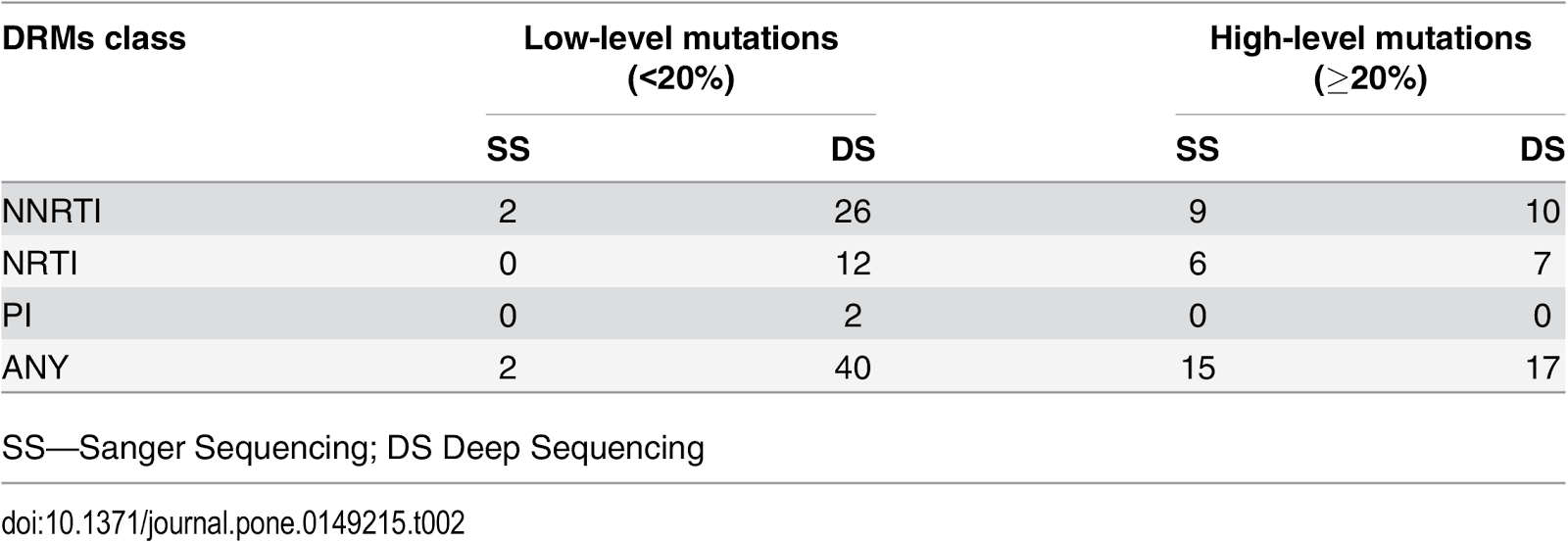
DS was performed on samples from 29 ART-experienced subjects; the median viral load 4.95×10⁴ c/ml; 82.76% subtype CRF01_AE. 58 DRMs were detected by DS. 18 DRMs were detected by SS. Of the 58 mutations detected by DS, 40 were at levels <20% frequency (26 NNRTI, 12 NRTI and 2 PI) and the majority of these 95.00% (38/40) were not detected by standard genotyping. Of these 40 low-level DRMs, 16 (40%) were detected at frequency levels of 1–4% and 24 (60%) at levels of 5–19%. SS detected 15 of 17 (88.24%) DRMs at levels ≥ 20% that were detected by DS. The only variable associated with the detection of DRMs by DS was ART adherence (missed doses in the prior 7 days); all patients that reported missing a dose in the last 7 days had DRMs detected by DS.

Conclusions
DS of VF samples from treatment experienced subjects infected with primarily AE subtype frequently identified Stanford HIVdb NRTI and NNRTI resistance mutations with an algorithm value 15. Low frequency level resistant variants detected by DS were frequently missed by standard genotyping in VF specimens from antiretroviral-experienced subjects.

Below:  Prevalence of ≥1% DRMs by Stanford HDRM (algorithm value ≥15)


Full article at:   http://goo.gl/ZY39t9

By:  
Xi Chen, Xiaobai Zou, Jianmei He, Jun Zheng
Hunan Provincial Center for Disease Control and Prevention, Changsha, China

Jennifer Chiarella, Michael J. Kozal
Yale School of Medicine, New Haven, United States of America


Transmission of HIV Drug Resistance and the Predicted Effect on Current First-line Regimens in Europe

Background. 
Numerous studies have shown that baseline drug resistance patterns may influence the outcome of antiretroviral therapy. Therefore, guidelines recommend drug resistance testing to guide the choice of initial regimen. In addition to optimizing individual patient management, these baseline resistance data enable transmitted drug resistance (TDR) to be surveyed for public health purposes. The SPREAD program systematically collects data to gain insight into TDR occurring in Europe since 2001.

Methods. 
Demographic, clinical, and virological data from 4140 antiretroviral-naive human immunodeficiency virus (HIV)–infected individuals from 26 countries who were newly diagnosed between 2008 and 2010 were analyzed. Evidence of TDR was defined using the WHO list for surveillance of drug resistance mutations. Prevalence of TDR was assessed over time by comparing the results to SPREAD data from 2002 to 2007. Baseline susceptibility to antiretroviral drugs was predicted using the Stanford HIVdb program version 7.0.

Results. 
The overall prevalence of TDR did not change significantly over time and was 8.3% (95% confidence interval, 7.2%–9.5%) in 2008–2010. The most frequent indicators of TDR were nucleoside reverse transcriptase inhibitor (NRTI) mutations (4.5%), followed by nonnucleoside reverse transcriptase inhibitor (NNRTI) mutations (2.9%) and protease inhibitor mutations (2.0%). Baseline mutations were most predictive of reduced susceptibility to initial NNRTI-based regimens: 4.5% and 6.5% of patient isolates were predicted to have resistance to regimens containing efavirenz or rilpivirine, respectively, independent of current NRTI backbones.

Conclusions. 
Although TDR was highest for NRTIs, the impact of baseline drug resistance patterns on susceptibility was largest for NNRTIs. The prevalence of TDR assessed by epidemiological surveys does not clearly indicate to what degree susceptibility to different drug classes is affected.

Below:  Overall weighted prevalence of transmitted drug resistance in patients with newly diagnosed human immunodeficiency virus (HIV) in Europe. The error bars indicate the standard error. Abbreviations: NNRTI, nonnucleoside reverse transcriptase inhibitor; NRTI, nucleoside reverse transcriptase inhibitor; PI, protease inhibitor; TDR, transmitted drug resistance.


Below:  Genotypic sensitivity scores (GSSs) of 8 recommended first-line regimens in patients in Europe newly diagnosed with human immunodeficiency virus in 2008–2010. Abbreviations: ATV, atazanavir; DRV, darunavir; EFV, efavirenz; KVX, Kivexa (abacavir + lamivudine); NNRTI, nonnucleoside reverse transcriptase inhibitor; PI, protease inhibitor; RPV, rilpivirine; TVD, Truvada (tenofovir +emtricitabine).


Full article at:   http://goo.gl/GF3BXW

1Luxembourg, Institute of Health, Luxembourg
2Department of Virology, University Medical Center Utrecht, The Netherlands
3Karolinska Institute, Solna
4Karolinska University Hospital, Stockholm, Sweden
5National Center of Infectious and Parasitic Diseases, Sofia, Bulgaria
6Complejo Hospitalario Universitario de Granada, Instituto de Investigación IBS Granada; on behalf of Cohorte de Adultos de la Red de Investigación en SIDA, Spain
7Erasmus MC, University Medical Center, Rotterdam, The Netherlands
8University of Bergen, Norway
9University College Dublin, Ireland
10AP-HP Groupe hospitalier Bichat-Claude Bernard, IAME INSERM UMR 1137, Université Paris Diderot Sorbonne Paris Cité, Paris, France
11Lithuanian AIDS Center, Vilnius, Lithuania
12Robert Koch Institute, Berlin, Germany
13Hospital of Infectious Diseases, Warsaw, Poland
14St Elisabeth Hospital, Tilburg, The Netherlands
15Infectiology Center of Latvia, Riga
16University of Cyprus, Nicosia
17Department of Infectious Diseases, National Institute for Health and Welfare, Helsinki, Finland
18National Reference Laboratory for HIV/AIDS, National Institute of Public Health, Prague, Czech Republic
19National HIV Reference Laboratory, Chaim Sheba Medical Center, Tel-Hashomer, Israel
20Statens Serum Institut, Copenhagen, Denmark
21National Institute for Infectious Diseases “Prof. dr. Matei Bals”, Bucharest, Romania
22National Retrovirus Reference Center, University of Athens, Greece
23IrsiCaixa Foundation, Badalona, Spain
24Faculty of Medicine, Slovenian HIV/AIDS Reference Centre, University of Ljubljana, Slovenia
25Medical University Vienna, Austria
26Slovak Medical University, Bratislava, Slovakia
27Faculty of Medicine, University of Belgrade, Serbia
28Rega Institute for Medical Research, KU Leuven, Belgium
29University of Siena, Italy
30University Hospital for Infectious Diseases “Dr. Fran Mihaljevic”, Zagreb, Croatia

1Luxembourg, Institute of Health, Luxembourg
2Department of Virology, University Medical Center Utrecht, The Netherlands
3Karolinska Institute, Solna
4Karolinska University Hospital, Stockholm, Sweden
5National Center of Infectious and Parasitic Diseases, Sofia, Bulgaria
6Complejo Hospitalario Universitario de Granada, Instituto de Investigación IBS Granada; on behalf of Cohorte de Adultos de la Red de Investigación en SIDA, Spain
7Erasmus MC, University Medical Center, Rotterdam, The Netherlands
8University of Bergen, Norway
9University College Dublin, Ireland
10AP-HP Groupe hospitalier Bichat-Claude Bernard, IAME INSERM UMR 1137, Université Paris Diderot Sorbonne Paris Cité, Paris, France
11Lithuanian AIDS Center, Vilnius, Lithuania
12Robert Koch Institute, Berlin, Germany
13Hospital of Infectious Diseases, Warsaw, Poland
14St Elisabeth Hospital, Tilburg, The Netherlands
15Infectiology Center of Latvia, Riga
16University of Cyprus, Nicosia
17Department of Infectious Diseases, National Institute for Health and Welfare, Helsinki, Finland
18National Reference Laboratory for HIV/AIDS, National Institute of Public Health, Prague, Czech Republic
19National HIV Reference Laboratory, Chaim Sheba Medical Center, Tel-Hashomer, Israel
20Statens Serum Institut, Copenhagen, Denmark
21National Institute for Infectious Diseases “Prof. dr. Matei Bals”, Bucharest, Romania
22National Retrovirus Reference Center, University of Athens, Greece
23IrsiCaixa Foundation, Badalona, Spain
24Faculty of Medicine, Slovenian HIV/AIDS Reference Centre, University of Ljubljana, Slovenia
25Medical University Vienna, Austria
26Slovak Medical University, Bratislava, Slovakia
27Faculty of Medicine, University of Belgrade, Serbia
28Rega Institute for Medical Research, KU Leuven, Belgium
29University of Siena, Italy
30University Hospital for Infectious Diseases “Dr. Fran Mihaljevic”, Zagreb, Croatia


Monday, February 1, 2016

Prevalence of Primary HIV Drug Resistance in Thailand Detected by Short Reverse Transcriptase Genotypic Resistance Assay

Background
HIV drug resistance (HIVDR) is the major cause of treatment failure after scaling up of antiretroviral therapy (ART). HIVDR testing prior to ART initiation is not routinely performed in resource-limited settings. We aimed to assess the prevalence of primary HIVDR by short reverse transcriptase (RT) genotypic resistance assay and evaluate of the impact of the mutations on the treatment outcomes.

Methods
A prospective cohort study was conducted in treatment-naïve HIV-infected patients. Fourteen major mutations of codon 99–191 on the RT gene were selected (K103N, V106A/M, V108I, Q151M, Y181C/I, M184V/I, Y188C/L/H, and G190S/A) at a cost of testing of 35 USD. The association between the presence of primary HIVDR and undetectable HIV RNA (<50 copies/mL) after 6 months of ART was determined.

Results
A total of 265 HIV-infected patients were included, with a median age of 35.2 (range, 16.8–75.2) years; 62.6% were males. The median (interquartile range) CD4 cell count at ART initiation was 216 (77–381) cells/mm3. The overall prevalence of primary HIVDR was 7.9%. The prevalence of each HIVDR mutation were K103N 6.0%, V106I 1.1%, V108I 0.4%, Y181C 2.3%, Y181I 0.7%, Y181V 0.4%, M184V 3.0%, M184I 1.5%, and G190A 2.3%. No associated factor of having primary HIVDR was determined. By multiple stepwise logistic regression, factors associated with undetectable HIV RNA after 6 months of ART were: having M184V/I (odds ratio [OR] 0.11; 95% confidence interval [CI] 0.02–0.62, p = 0.013), condom use (OR 2.38; 95% CI 1.12–5.06, p = 0.024), and adherence per 5% increase (OR 1.16; 95% CI 1.00–1.35, p = 0.044).

Conclusions
The prevalence of primary HIVDR is approximately 8%; it is associated with detectable HIV RNA at 6 months after ART initiation. Routine “short RT” genotypic resistance assay should be considered in resource-limited settings to maximize treatment outcome.

Below:  Prevalence of primary HIV drug resistance mutations, from short reverse transcriptase genotypic resistance assay


Full article at:   http://goo.gl/FKNQZJ

By:  
Sasisopin Kiertiburanakul, Subencha Pinsai, Somnuek Sungkanuparph
Department of Medicine, Faculty of Medicine Ramathibodi Hospital, Mahidol University, Bangkok, Thailand

Wasun Chantratita, Ekawat Pasomsub
Department of Pathology, Faculty of Medicine Ramathibodi Hospital, Mahidol University, Bangkok, Thailand

Manoon Leechawengwongs
Vichaiyut Hospital, Bangkok, Thailand

Wilawan Thipmontree, Nirada Siriyakorn
Department of Medicine, Maharat Nakhon Ratchasima Hospital, Nakhon Ratchasima, Thailand


Friday, January 22, 2016

Prevalence of Transmitted HIV Drug Resistance among Recently Infected Persons in San Diego, CA 1996-2013

BACKGROUND:
Transmitted drug resistance (TDR) remains an important concern when initiating antiretroviral therapy (ART). Here, we describe the prevalence and phylogenetic relationships of TDR among ART-naive, HIV-infected individuals in San Diego from 1996 to 2013.

METHODS:
Data were analyzed from 496 participants of the San Diego Primary Infection Cohort who underwent genotypic resistance testing before initiating therapy. Mutations associated with drug resistance were identified according to the WHO-2009 surveillance list. Network and phylogenetic analyses of the HIV-1 pol sequences were used to evaluate the relationships of TDR within the context of the entire cohort.

RESULTS:
The overall prevalence of TDR was 13.5% (67/496), with an increasing trend over the study period (P = 0.005). TDR was predominantly toward nonnucleoside reverse transcriptase inhibitors (NNRTIs) [8.5% (42/496)], also increasing over the study period (P = 0.005). By contrast, TDR to protease inhibitors and nucleos(t)ide reverse transcriptase inhibitors were 4.4% (22/496) and 3.8% (19/496), respectively, and did not vary with time. TDR prevalence did not differ by age, gender, race/ethnicity, or risk factors. Using phylogenetic analysis, we identified 52 transmission clusters, including 8 with at least 2 individuals sharing the same mutation, accounting for 23.8% (16/67) of the individuals with TDR.

CONCLUSIONS:
Between 1996 and 2013, the prevalence of TDR significantly increased among recently infected ART-naive individuals in San Diego. Around one-fourth of TDR occurred within clusters of recently infected individuals. These findings highlight the importance of baseline resistance testing to guide selection of ART and for public health monitoring.

Purchase full article at:  http://goo.gl/6HSEJT

By:  Panichsillapakit T1, Smith DM, Wertheim JO, Richman DD, Little SJ, Mehta SR.
  • 1*Department of Preventive and Social Medicine, Faculty of Medicine Siriraj Hospital, Mahidol University, Bangkok, Thailand; †Department of Medicine, University of California, San Diego, CA; ‡Veterans Affairs San Diego Healthcare System, San Diego, CA; and §Department of Pathology, University of California, San Diego, CA.


Saturday, January 9, 2016

Drug Resistance Characteristics & Cluster Analysis of M. Tuberculosis in Chinese Patients with Multiple Episodes of Anti-Tuberculosis Treatment

Background
Tuberculosis (TB) patients with multiple episodes of anti-TB treatment represent an important source of TB transmission, as well as a serious threat to the control of drug resistant TB, due to the high risk of multidrug and extensively drug resistance (MDR/XDR) and elongating infectiousness of this patient group. In this study we analyzed the possible risk of development and transmission of MDR and XDR in TB patients with multiple episodes of previous treatment history.

Methods
The study subjects were pulmonary TB patients who had at least two episodes of previous anti-TB treatment. A total of 166 eligible patients were identified from 10 counties/districts distributed in east, west, north, south and central China. Drug susceptibility test (DST) was performed by proportion method on LJ-media for the 1st line anti-TB drugs and a line probe assay was used to detect mutations related to resistance of the key 2nd-line drugs. Genotyping of M. tuberculosis (Mtb) was performed with MIRU-VNTR and Spoligotyping.

Results
Resistances to 1st-line drugs was observed in 122 (73.5 %) of the 166 Mtb isolates with 97 (58.4 %) being MDR-TB. Mutations relevant to 2nd-line drug resistance was seen in 63 isolates, including 35 MDR-TB isolates (30 pre-XDR, 5 XDR-TB). The Spoligotyping revealed 83.1 % Mtb isolates belonged to the Beijing family. The MIRU-VNTR based genotyping revealed 32 (19.3 %) of patients were infected with more than one strain. The number of previous TB treatment episode was found being significantly associated with the risk of MDR-TB and XDR-TB. Among the remaining 134 patients infected with a single Mtb strain, MIRU-VNTR revealed a high homogeneity of strain especially within Beijing family despite the polymorphic variations along with geographic locations.

Conclusions
The high genetic relatedness and risk of MDR-TB and subsequent pre-XDR and XDR-TB among repeatedly treated patients suggest the establishment of M/XDR Mtb in this specific patient population. It highlights the urgent needs of providing DST of both 1st- and 2nd-line drugs before and during the medication in China’s MDR-TB control program. Furthermore, the possibility of infection with multiple strains should also be considered to be associated with the drug resistance, which calls for the modification of treatment regimen.

Below:  The mini spanning tree analysis of the 134 M.tb isolates from the patient with single strain infection. Each circle represents a unique genotype and a single bigger circle represents the cluster containing more than two isolates. Different color indicated the different drug resistant pattern. Note: MDR, multidrug resistance; XDR, extensively drug resistance; FQR, fluoroquinolones resistance; INJR, injective drug resistance; DS, drug sensitive; DR, drug resistance


Full article at:   http://goo.gl/aJwpO4

By:  Yi Hu†, Qi Zhao†, Jim Werngren, Sven Hoffner, Vinod K. Diwan and Biao Xu
Affiliated with
Department of Epidemiology, School of Public Health, Fudan University
Key Laboratory of Public Health Safety, Fudan University, Ministry of Education


Monday, January 4, 2016

HIV Drug Resistance among Children Initiating First-Line Antiretroviral Treatment (ART) in Uganda

BACKGROUND:
There is limited data on primary HIV drug resistance (HIVDR) in pediatric populations. This study aimed to assess the prevalence of primary HIVDR and associated risk factors among children initiating first-line ART in Uganda.

METHODS:
At three Ugandan clinics children (age<12 years) requiring anti-retroviral therapy (ART) were recruited between January 2010-August 2011. Prior to ART start blood was collected for viral load and pol gene sequencing. Drug resistance mutations were determined using the 2010 IAS-USA mutation list. Risk factors for HIVDR were assessed with multivariate regression analysis.

RESULTS:
319 HIV-infected children with a median age 4.9 years were enrolled. Sequencing was successful for 279 (87.5%). HIVDR was present in 10% of all children and 15.2% of children <3 years. Nucleoside reverse transcriptase inhibitors (NRTI), non-NRTI (NNRTI) and dual-class resistance was present in 5.7%, 7.5% and 3.2% respectively. HIVDR occurred in 35.7% of PMTCT-exposed children, 15.6% in children with unknown PMTCT history and 7.7.% among ARV-naive children. History of PMTCT-exposure (AOR:2.6, 95%-CI:1.3-5.1) or unknown PMTCT status (AOR:3.8, 95%-CI:1.1-13.5), low CD4 (AOR:2.2, 95%-CI:1.3-3.6), current breastfeeding (AOR:7.4, 95%-CI:2.6-21) and current maternal ART use (AOR:6.4, 95%-CI: 3.4-11.9), emerged as risk factors for primary HIVDR in multivariate analysis.

CONCLUSION:
Pretreatment HIVDR is high, especially in children with PMTCT exposure. PI-based regimens are advocated by WHO, but availability in children is limited. Children with (unknown) PMTCT exposure, low CD4 count, current breastfeeding or maternal ART need to be prioritized to receive PI based regimens.

Purchase full article at: http://goo.gl/Ukdcng