Showing posts with label Medical Students. Show all posts

Monday, April 4, 2016

Future Healthcare Professionals’ Knowledge About the Argentinean Abortion Law

Objectives
We assessed healthcare students’ knowledge and opinions on Argentinian abortion law and identified differences between first- and final-year healthcare students.

Methods
In this cross-sectional study, self-administered anonymous questionnaires were administered to 760 first- and 695 final-year students from different fields of study (medicine, midwifery, nursing, radiology, nutrition, speech therapy, and physiotherapy) of the School of Medicine at the University of Buenos Aires, in 2011-2013.

Results
Compared to first-year students, a higher percentage of final-year students knew that abortion is legally restricted in Argentina (p < 0.001). A significantly higher percentage of final-year students could correctly identify the circumstances in which abortion is legal: woman´s life risk (87.4% last vs. 79.1% first year), rape of a woman with developmental disability (66.2% first vs. 85.4% last-year; p < 0.001). More final-year students chose severe foetal malformations (37.3% first year vs. 57.3% final year) despite its being illegal.

Conclusions
Although most final-year students knew that abortion is legally restricted in Argentina, misconceptions regarding circumstances of legal abortion were observed; this may be due to the fact that abortion is inadequately covered in the medical curricula. Medical schools should ensure that sexual and reproductive health topics are an integral part of their curricula. Healthcare providers who are aware of the legality of abortion are more likely to provide the public with sound information and ensure abortions are appropriately performed.

Below:  Healthcare students’ knowledge on current abortion law
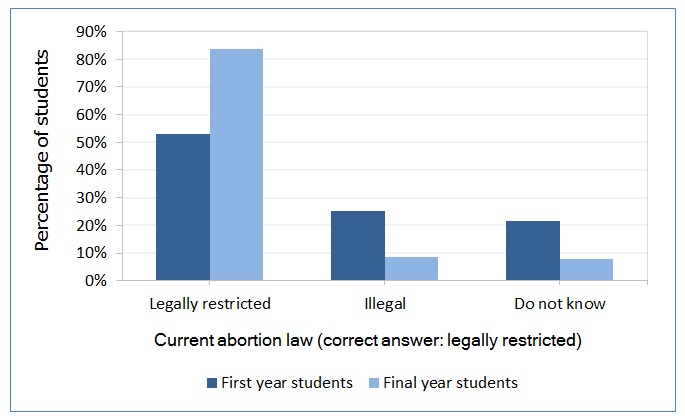


Below:  Percentage of healthcare students who chose the correct answer, by field of study


Below:  Healthcare students’ opinion on abortion legislation


Full article at:   http://goo.gl/8jzNqt

1Department of OB-GYN, Gynaecology Division, Faculty of Medicine, University of Buenos Aires, Argentina, Ciudad de Buenos Aires, Argentina
2Division of Gynaecology and Obstetrics, Institute of Clinical Medicine, University of Oslo, Norway
corresponding authorCorresponding author.
Correspondence: Belén Provenzano-Castro, Department of OB-GYN, Gynaecology Division, Faculty of Medicine, University of Buenos Aires, Argentina, Ciudad de Buenos Aires, Argentina.
Int J Med Educ. 2016; 7: 95–101.
Published online 2016 Mar 28. doi:  10.5116/ijme.56e0.74be


Tuesday, November 17, 2015

Medical School Experiences Associated with Change in Implicit Racial Bias Among 3547 Students: A Medical Student CHANGES Study Report

BACKGROUND
Physician implicit (unconscious, automatic) bias has been shown to contribute to racial disparities in medical care. The impact of medical education on implicit racial bias is unknown.

OBJECTIVE
To examine the association between change in student implicit racial bias towards African Americans and student reports on their experiences with 1) formal curricula related to disparities in health and health care, cultural competence, and/or minority health; 2) informal curricula including racial climate and role model behavior; and 3) the amount and favorability of interracial contact during school.

DESIGN
Prospective observational study involving Web-based questionnaires administered during first (2010) and last (2014) semesters of medical school.

PARTICIPANTS
A total of 3547 students from a stratified random sample of 49 U.S. medical schools.

MAIN OUTCOME(S) AND MEASURE(S)
Change in implicit racial attitudes as assessed by the Black-White Implicit Association Test administered during the first semester and again during the last semester of medical school.

KEY RESULTS
In multivariable modeling, having completed the Black-White Implicit Association Test during medical school remained a statistically significant predictor of decreased implicit racial bias (−5.34, p ≤ 0.001: mixed effects regression with random intercept across schools). Students' self-assessed skills regarding providing care to African American patients had a borderline association with decreased implicit racial bias (−2.18, p = 0.056). Having heard negative comments from attending physicians or residents about African American patients (3.17, p = 0.026) and having had unfavorable vs. very favorable contact with African American physicians (18.79, p = 0.003) were statistically significant predictors of increased implicit racial bias.

CONCLUSIONS
Medical school experiences in all three domains were independently associated with change in student implicit racial attitudes. These findings are notable given that even small differences in implicit racial attitudes have been shown to affect behavior and that implicit attitudes are developed over a long period of repeated exposure and are difficult to change.

Full article at: http://goo.gl/e8gt5Y

Mayo Clinic College of Medicine, Rochester, MN USA
University of Minnesota, Minneapolis, MN USA
Center for Chronic Disease Outcomes Research, Minneapolis Veterans Affairs Medical Center, Minneapolis, MN USA
Yale University, New Haven, CT USA
University of Vermont, Burlington, VT USA
Michelle van Ryn, Email: ude.oyam@ellehcim.nyrnav.
corresponding authorCorresponding author.
 

Saturday, November 7, 2015

Awareness & Low Uptake of Post Exposure Prophylaxis for HIV among Clinical Medical Students in a High Endemicity Setting - Cameroon

Adequate knowledge and practices on post exposure prophylaxis (PEP) for HIV among health care providers are crucial for HIV prevention. However there is limited data on PEP knowledge and practice from developing countries where the burden of HIV infection continues to increase. We assessed the knowledge of clinical medical students on PEP, their practices in response to occupational exposure to HIV, as well as the determinants of good knowledge on PEP.

A cross-sectional study was conducted in November 2014 involving 154 consecutively recruited clinical medical students (4 th -6 th year undergraduates). Data were acquired using a structured questionnaire. Knowledge on PEP was assessed using a questionnaire comprising 25 questions and categorized as: good (20 or more correct answers), moderate (13–19 correct answers) and poor (12 or fewer correct answers).

For the 154 students included (57.8 % being male), the mean age was 23.2 ± 2.4 years, and 89 % had heard about PEP for HIV. The majority of students had moderate (61.7 %) and poor (32.5 %) knowledge on PEP. Overall knowledge score increased with increasing level of studies (p < 0.05). Only 10 (6.5 %) had had previous training on PEP, most of whom were senior level students (p = 0.01). Fifty-four students (35.1 %) knew the appropriate duration of PEP and this awareness increased with level of studies (p = 0.001). Of the 81 (52.6 %) who reported occupational exposure to HIV in the past, only 4 (4.9 %) received PEP.

Overall, knowledge on PEP among clinical medical students in this setting was non-optimal with very low uptake PEP. Intensification of HIV curricula to involve PEP as well as continuous medical education programs and workshops are potential avenues to improve awareness in this vulnerable population.

Below:  Circumstances of exposure to HIV among clinical medical students at the University of Buea, Cameroon, 2014


Full article at: http://goo.gl/qJbxst

By: Leopold Ndemnge Aminde12*, Noah F. Takah13, Jean Jacques N. Noubiap45, Maxime Tindong6, Calypse Ngwasiri6, Ahmadou M. Jingi7, Andre Pascal Kengne1108 and Anastase Dzudie11069
1Clinical Research Education, Networking & Consultancy, Douala B.P. 3480, Cameroon
2Internal Medicine Unit & HIV Treatment Centre, District Hospital Nanga-Eboko, Nanga-Eboko, Cameroon
3Global Health Systems Solutions, Limbe, Cameroon
4Department of Medicine, Groote Schuur Hospital and University of Cape Town, Cape Town, South Africa
5Medical Diagnostic Center, Yaounde, Cameroon
6Faculty of Health Sciences, University of Buea, Buea, Cameroon
7Faculty of Medicine and Biomedical Sciences, University of Yaounde I, Yaounde, Cameroon
8Non-Communicable Disease Research Unit, South African Medical Research Council, Cape Town, South Africa
9Department of Medicine, General Hospital Douala, Douala, Cameroon
10Department of Medicine, Faculty of Health Sciences, University of Cape Town, Cape Town, South Africa