Showing posts with label Pregnancy Termination. Show all posts

Tuesday, April 5, 2016

Contextual Determinants of Induced Abortion: A Panel Analysis

OBJECTIVE
Analyze the contextual and individual characteristics that explain the differences in the induced abortion rate, temporally and territorially.

METHODS
We conducted an econometric analysis with panel data of the influence of public investment in health and per capita income on induced abortion as well as a measurement of the effect of social and economic factors related to the labor market and reproduction: female employment, immigration, adolescent fertility and marriage rate. The empirical exercise was conducted with a sample of 22 countries in Europe for the 2001-2009 period.

RESULTS
The great territorial variability of induced abortion was the result of contextual and individual socioeconomic factors. Higher levels of national income and investments in public health reduce its incidence. The following sociodemographic characteristics were also significant regressors of induced abortion: female employment, civil status, migration, and adolescent fertility.

CONCLUSIONS
Induced abortion responds to sociodemographic patterns, in which the characteristics of each country are essential. The individual and contextual socioeconomic inequalities impact significantly on its incidence. Further research on the relationship between economic growth, labor market, institutions and social norms is required to better understand its transnational variability and to reduce its incidence.

Below: Abortions per thousand live births in Europe during 2009


Full article at:   http://goo.gl/458IUb

Departamento de Economía Cuantitativa. Facultad de Economía y Empresa. Universidad de Oviedo. Oviedo, España
Correspondence: Mar Llorente-Marrón. Departamento de Economía Cuantitativa. Facultad de Economía y Empresa. Avda. del Cristo, s/n 33006 
Rev Saude Publica. 2016; 50: 8.
Published online 2016 Mar 10. doi:  10.1590/S1518-8787.2016050005917


Monday, April 4, 2016

Future Healthcare Professionals’ Knowledge About the Argentinean Abortion Law

Objectives
We assessed healthcare students’ knowledge and opinions on Argentinian abortion law and identified differences between first- and final-year healthcare students.

Methods
In this cross-sectional study, self-administered anonymous questionnaires were administered to 760 first- and 695 final-year students from different fields of study (medicine, midwifery, nursing, radiology, nutrition, speech therapy, and physiotherapy) of the School of Medicine at the University of Buenos Aires, in 2011-2013.

Results
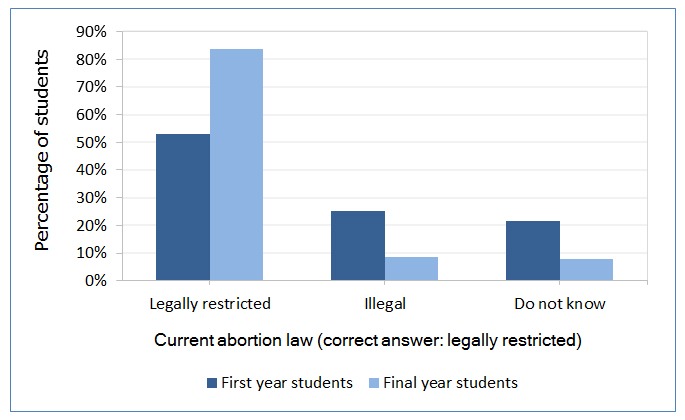
Compared to first-year students, a higher percentage of final-year students knew that abortion is legally restricted in Argentina (p < 0.001). A significantly higher percentage of final-year students could correctly identify the circumstances in which abortion is legal: woman´s life risk (87.4% last vs. 79.1% first year), rape of a woman with developmental disability (66.2% first vs. 85.4% last-year; p < 0.001). More final-year students chose severe foetal malformations (37.3% first year vs. 57.3% final year) despite its being illegal.

Conclusions
Although most final-year students knew that abortion is legally restricted in Argentina, misconceptions regarding circumstances of legal abortion were observed; this may be due to the fact that abortion is inadequately covered in the medical curricula. Medical schools should ensure that sexual and reproductive health topics are an integral part of their curricula. Healthcare providers who are aware of the legality of abortion are more likely to provide the public with sound information and ensure abortions are appropriately performed.

Below:  Healthcare students’ knowledge on current abortion law


Below:  Percentage of healthcare students who chose the correct answer, by field of study


Below:  Healthcare students’ opinion on abortion legislation


Full article at:   http://goo.gl/8jzNqt

1Department of OB-GYN, Gynaecology Division, Faculty of Medicine, University of Buenos Aires, Argentina, Ciudad de Buenos Aires, Argentina
2Division of Gynaecology and Obstetrics, Institute of Clinical Medicine, University of Oslo, Norway
corresponding authorCorresponding author.
Correspondence: Belén Provenzano-Castro, Department of OB-GYN, Gynaecology Division, Faculty of Medicine, University of Buenos Aires, Argentina, Ciudad de Buenos Aires, Argentina.
Int J Med Educ. 2016; 7: 95–101.
Published online 2016 Mar 28. doi:  10.5116/ijme.56e0.74be


Tuesday, March 29, 2016

Women’s Awareness and Knowledge of Abortion Laws: A Systematic Review

Background
Incorrect knowledge of laws may affect how women enter the health system or seek services, and it likely contributes to the disconnect between official laws and practical applications of the laws that influence women’s access to safe, legal abortion services.

Objective
To provide a synthesis of evidence of women’s awareness and knowledge of the legal status of abortion in their country, and the accuracy of women’s knowledge on specific legal grounds and restrictions outlined in a country’s abortion law.

Methods
A systematic search was carried for articles published between 1980–2015. Quantitative, mixed-method data collection, and objectives related to women’s awareness or knowledge of the abortion law was included. Full texts were assessed, and data extraction done by a single reviewer. Final inclusion for analysis was assessed by two reviewers. The results were synthesised into tables, using narrative synthesis.

Results
Of the original 3,126 articles, and 16 hand searched citations, 24 studies were included for analysis. Women’s correct general awareness and knowledge of the legal status was less than 50% in nine studies. In six studies, knowledge of legalization/liberalisation ranged between 32.3% - 68.2%. Correct knowledge of abortion on the grounds of rape ranged from 12.8% – 98%, while in the case of incest, ranged from 9.8% - 64.5%. Abortion on the grounds of fetal impairment and gestational limits, varied widely from 7% - 94% and 0% - 89.5% respectively.

Conclusion
This systematic review synthesizes literature on women’s awareness and knowledge of the abortion law in their own context. The findings show that correct general awareness and knowledge of the abortion law and legal grounds and restrictions amongst women was limited, even in countries where the laws were liberal. Thus, interventions to disseminate accurate information on the legal context are necessary.

Full article at:   http://goo.gl/GN3ps1

1WHO Department of Reproductive Health and Research, including UNDP/UNFPA/UNICEF/WHO/World Bank Special Programme of Research, Development and Research Training in Human Reproduction, World Health Organization, Geneva, Switzerland
2Department of Population, Family and Reproductive Health, Johns Hopkins University Bloomberg School of Public Health, Baltimore, Maryland, United States of America


Why Don’t Humanitarian Organizations Provide Safe Abortion Services?

Background
Although sexual and reproductive health services have become more available in humanitarian settings over the last decade, safe abortion services are still rarely provided. The authors’ observations suggest that four reasons are typically given for this gap: ‘There’s no need’; ‘Abortion is too complicated to provide in crises’; ‘Donors don’t fund abortion services’; and ‘Abortion is illegal’.

Discussion
However, each of these reasons is based on false premises. Unsafe abortion is a major cause of maternal mortality globally, and the collapse of health systems in crises suggests it likely increases in humanitarian settings. Abortion procedures can be safely performed in health centers by mid-level providers without sophisticated equipment or supplies. Although US government aid does not fund abortion-related activities, other donors, including many European governments, do fund abortion services. In most countries, covering 99 % of the world’s population, abortion is permitted under some circumstances; it is illegal without exception in only six countries. International law supports improved access to safe abortion.

Summary
As none of the reasons often cited for not providing these services is valid, it is the responsibility of humanitarian NGOs to decide where they stand regarding their commitment to humanitarian standards and women’s right to high quality and non-discriminatory health services. Providing safe abortion to women who become pregnant as a result of rape in war may be a more comfortable place for organizations to begin the discussion. Making safe abortion available will improve women’s health and human rights and save lives.

Full article at: http://goo.gl/fiLtJh


Heilbrunn Department of Population and Family Health, Mailman School of Public Health, Columbia University, 60 Haven Ave, New York, NY 10032 USA 


Wednesday, March 9, 2016

Sero-Prevalence of HBV & Associated Risk Factors among HIV Positive Individuals Attending ART Clinic at Mekelle Hospital, Tigray, Northern Ethiopia

BACKGROUND:
Because of the shared mean of transmission, hepatitis B virus (HBV) is one of an important cause of co-morbidity and mortality in peoples living with HIV/AIDS. Hence, the aim of this study was to determine the sero-prevalence of HBV infection and associated risk factors in HIV/AIDS positive individuals attending ART clinic at Mekelle hospital, Mekelle, Northern Ethiopia.

METHODS:
A cross sectional study was conducted from August to October 2014 in HIV/AIDS positive adult individuals. Socio-demographic data and other explanatory variables were collected from 508 study participants using pre-tested and structured questionnaire-based interviews. Serum hepatitis B surface antigen (HBsAg) was detected using commercially available rapid test and third generation enzyme-linked immunosorbent assay (ELISA). Bivariate and multivariate analysis, using SPSS V.20.0, were performed to assess the variables associated with HBV infection and P value less than 0.05 was considered as statistically significant.

RESULTS:
A total of 508 study participants, 305 females and 203 males were included in this study with the mean (+SD) age of 37.8 + 9.6. The sero-prevalence of HBsAg was 5.9 %. Male gender (AOR = 2.6, 95 % CI 1.2-5.7), multiple sexual partners (AOR = 4.2, 95 % CI 1.3-13.1) and CD4 count <200 cells/μl (AOR = 3.5, 95 % CI 1.1-11.2) were significantly associated with HBsAg positivity.

CONCLUSION:
The prevalence of HBsAg was similar to the general population. However, HIV/AIDS positive individuals with reduced CD4 count, <200 cells/μl, showed a significant association with HBsAg seropositivity. Therefore, we recommended, all HIV/AIDS positive individuals should be screened for HBsAg during their follow for better treatment outcome and minimize risks of HBV transmission.

Bivariate analysis of associated risk factors for HBV infection in Mekelle among HIV positive individuals
VariablesHBV sero status
Total = 508Yes = 30No = 478COR (95 % CI)P value
Total n (%)+ve N (%)−ve N (%)
Blood transfusion
 No467 (91.9)27 (5.8)440 (94.2)1
 Yes41 (8.1)3 (7.3)38 (92.7)1.3 (0.4–4.4)0.690
Unsafe injection
 No475 (83.5)26 (5.5)449 (94.5)1
 Yes33 (6.5)4 (12.1)29 (87.9)2.4 (0.8–7.3)0.128*
Multiple sexual partners
 No482 (94.9)25 (5.2)457 (94.8)1
 Yes26 (5.1)5 (19.2)21 (80.8)4.4 (1.5–12.5)0.006*
Surgical history
 No408 (80.3)20 (4.9)388 (95.1)1
 Yes100 (19.7)10 (10)90 (90)2.2 (1.0–4.8)0.058*
Tooth extraction
 No319 (62.8)20 (6.3)299 (93.7)1
 Yes189 (37.2)10 (5.3)179 (94.7)0.8 (0.4–1.8)0.651
Abortion
 No475 (93.5)29 (6.1)446 (93.9)1
 Yes33 (6.5)1 (3)32 (97.0)0.5 (0.1–3.6)0.478
Tattooing
 No447 (88)27 (6)420 (94)1
 Yes61 (12)3 (4.9)58 (95.1)0.8 (0.2–2.7)0.728
Family having liver disease
 No468 (92)28 (6)440 (94)1
 Yes40 (7.9)2 (5)38 (95)0.8 (0.2–3.6)0.800
CD4 count
 <200 cells/μl85 (16.5)9 (10.6)76 (89.4.)3.9 (1.3–12.1)0.018*
 200–350 cells/μl118 (23.2)7 (5.9)111 (94.1)2.1 (0.6–6.7)0.221
 351–499 cells/μl135 (26.6)9 (6.7)126 (93.3)2.4 (0.8–7.2)0.133*
 ≧500 cells/μl170 (33.5)5 (2.9)165 (97.1)1
ART status
 Pre ART65 (12.8)2 (3.1)63 (96.9)1
 ART443 (87.2)28 (6.3)415 (93.7)2.1 (0.5–9.1)0.311
ART drugs
 AZT,3T, Nuv106 (24.5)7 (6.6)99 (93.4)1.2 (0.5–3.4)0.678
 AZT,3T, Evf58 (13.4)6 (10.3)52 (89.7)2.0 (0.7–6.0)0.200
 TDF,3T, Nuv101 (23.4)6 (5.9)95 (94.1)1.1 (0.4–3.2)0.849
 TDF,3T, EFV167 (38.7)9 (5.4)158 (94.6)1
COR crude odds ratio
* Statistically significant at P < 0.2

Full article at:   http://goo.gl/fVPpuR

  • 1Medical Microbiology Laboratory, Mekelle Hospital, Mekelle, Ethiopia.
  • 2Department of Medical Microbiology and Immunology, College of Health Sciences, Mekelle University, Mekelle, Ethiopia.
  •  2016 Feb 4;13:6. doi: 10.1186/s12981-016-0090-2. eCollection 2016. 


Friday, March 4, 2016

‘Pregnancy Has Its Advantages’: The Voices of Street Connected Children and Youth in Eldoret, Kenya

Objective
Little is known about the reproductive health or family planning needs of street-connected children and youth in resource-constrained countries. The study objective was to describe how street-connected children and youth (SCCY) in Eldoret, Kenya, perceive pregnancy.

Methods
This qualitative study was conducted between August 2013 and February 2014. A total of 65 SCCY aged 11–24 years were purposively sampled from the three referral points: 1) A dedicated study clinic for vulnerable children and youth at Moi Teaching and Referral Hospital (MTRH); 2) Primary locations in which street children reside known as “bases/barracks”; and 3) Street youth community-based organizations. In-depth interviews and focus group discussions were audio recorded, transcribed, and translated into English. Content analysis was performed after thematic coding by 4 independent coders.

Results
The majority of SCCY interviewed were male (69%) and sexually active (81.5%). None had gone beyond primary level of education. The strong desire for SCCY to go through conventional life experiences including marriage and child bearing was evident. Sub-themes around desired pregnancies included: sense of identity with other SCCY, sense of hope, male ego, lineage, source of income, and avoiding stigmatization. The desire for children was highly gendered with male SCCY more focused on their social status in the street community, while for females it was primarily for survival on the street. Female SCCY generally lacked agency around reproductive health issues and faced gender-based violence. Abortions (either assisted or self-induced), infanticide, and child abandonment were reported. Respondents described a lucrative market for babies born to SCCY and alleged that healthcare workers were known to abduct these babies following hospital deliveries.

Conclusion
Our findings indicate gender differences in the reasons why SCCY become pregnant and have children. We also noted gender inequalities in reproductive health decisions. SCCY friendly interventions that provide tailored reproductive health services are needed.

Full article at:   http://goo.gl/3F7Dwx

By:  
Juddy Wachira, Violet Naanyu, Paula Braitstein 
Academic Model Providing Access to Healthcare (AMPATH), Eldoret, Kenya

Allan Kamanda 
Moi Teaching and Referral Hospital, Eldoret, Kenya

Lonnie Embleton, Paula Braitstein 
Dalla Lana School of Public Health, University of Toronto, Ontario, Canada

Violet Naanyu, David Ayuku, Paula Braitstein 
College of Health Sciences, School of Medicine, Moi University, Eldoret, Kenya

Paula Braitstein 
Indiana University, Fairbanks School of Public Health, Department of Epidemiology, Indianapolis, Indiana, United States of America

Paula Braitstein 
Regenstrief Institute, Inc., Indianapolis, Indiana, United States of America


Saturday, February 27, 2016

Impact of Parental Notification on Illinois Minors Seeking Abortion

PURPOSE:
To describe the impact of the Illinois Parental Notification of Abortion Act on minors presenting for first-trimester abortion at an urban clinic in Chicago, Illinois.

METHODS:
Descriptive, retrospective review looked at minors obtaining a first-trimester abortion at John H. Stroger Jr. Hospital Reproductive Health Services during the 12 months prior (August 15, 2012-August 14, 2013) and after (August 15, 2013-August 14, 2014) the Illinois Parental Notification Act was in effect. Young women, ages 18-21 years, unaffected by the law, served as the control group.

RESULTS:
Before the law, 320 minors of a total of 5,505 patients (5.8%) obtained a first-trimester abortion and after the law went into effect, 311 minors of a total of 6,311 patients (4.9%) obtained an abortion. This constituted a 2.8% decrease in procedures among minors before and after the law went into effect (p = .003). However, this decrease was not significant when compared to an 8.8% growth in procedures among the control group, ages 18-21 years (p = .079). Among minors, there was no difference in race/ethnicity, age, and mean gestational age at the time of abortion before and after the law (p = .189, p = .116, and p = .961). There was a trend toward a larger decline in the youngest minors, aged 12-15 years and in those with at least one prior abortion.

CONCLUSIONS:
The impact of a parental notification law on minors at an urban, public clinic is unclear. The 3% decrease warrants further study of both teen pregnancy rates and legislative barriers to minors' abortion access.

Purchase full article at:   http://goo.gl/qbVRIS


1Department of Obstetrics and Gynecology, Northwestern University Feinberg School of Medicine, Chicago, Illinois. Electronic address: Shanthi_Ramesh@med.unc.edu.
2Department of Obstetrics and Gynecology, John H. Stroger, Jr. Hospital of Cook County, Chicago, Illinois.
3Department of Obstetrics and Gynecology, Northwestern University Feinberg School of Medicine, Chicago, Illinois; Department of Obstetrics and Gynecology, John H. Stroger, Jr. Hospital of Cook County, Chicago, Illinois.
 2016 Mar;58(3):290-4. doi: 10.1016/j.jadohealth.2015.11.004. Epub 2016 Jan 13.