Showing posts with label Sex Workers - England. Show all posts

Friday, January 8, 2016

Prevalence & Factors Associated with Sex Trading in the Year Prior to Entering Treatment for Drug Misuse in England

BACKGROUND:
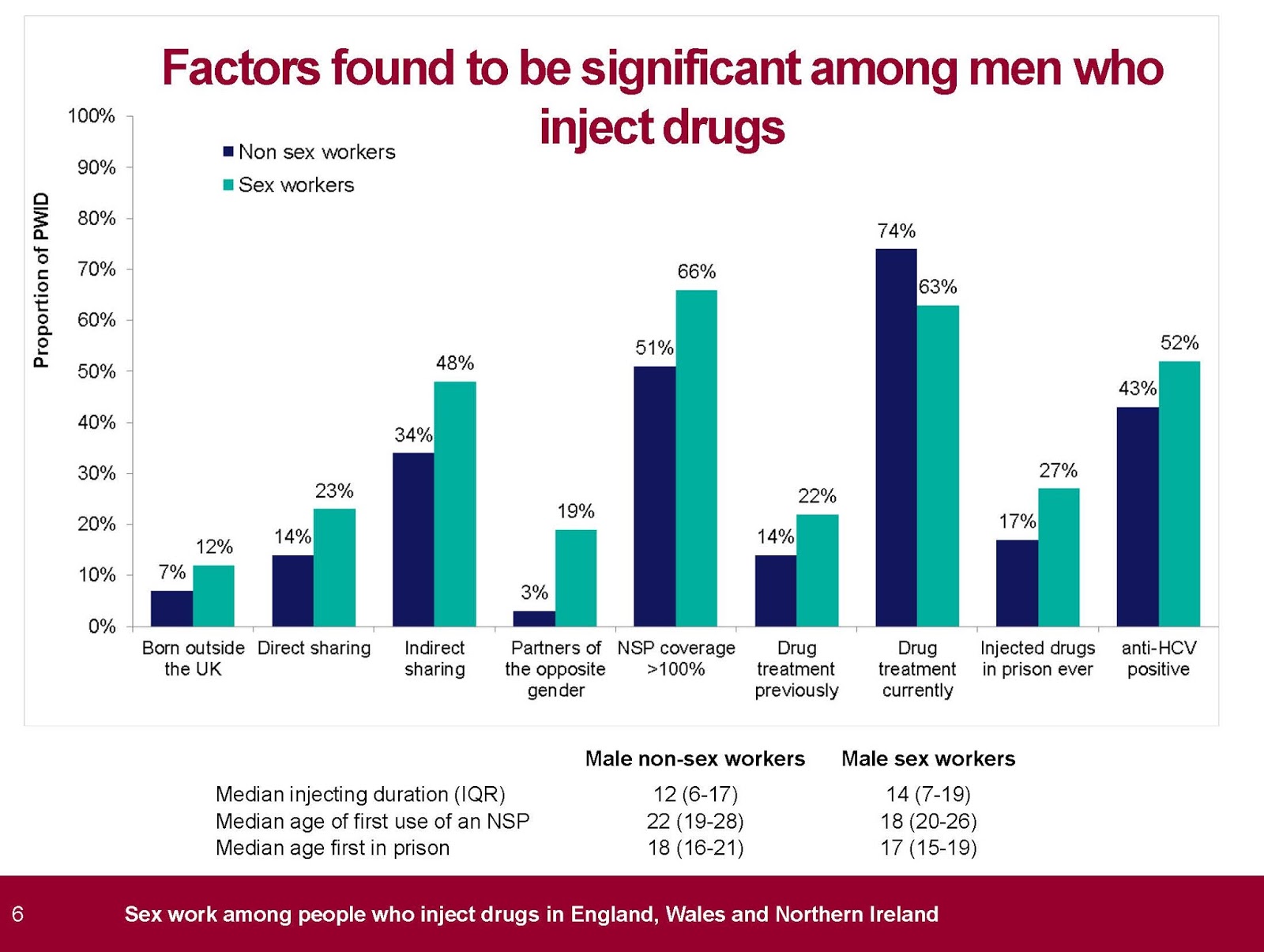
This study estimates the past year prevalence of and factors associated with sex trading (offering sex for money, drugs or something else) among 1796 men and women presenting to 342 drug misuse treatment agencies in England, and identifies service development and delivery implications.

METHODS:
Secondary analysis of baseline data from a prospective cohort was conducted. Short Form-12 measured mental and physical wellbeing, psychiatric diagnoses were self-reported and the circumstances, motivation and readiness tool assessed readiness for/pressure to enter treatment. Logistic regression models determined associations with sex trading separately by sex. Inverse probability population weights were calculated, utilising demographics from the National Drug Treatment Monitoring System and agency specific data collection windows.

RESULTS:
The estimated prevalence rate of sex trading in the past 12 months was 5.1% (15.0% for women and 2.1% for men). For women, adjusted models identified crack use, previous treatment and greater readiness for treatment  as independently associated with sex trading. For men, lower mental wellbeing was independently associated and marginal effects were identified for syringe sharing and unprotected sex.

CONCLUSIONS:
Sex trading among drug misusers is associated with additional health risks and specific treatment needs. Given the scale of the problem it is important that treatment providers have the competencies to adequately address the issue and provide accessible and appropriate services.

Purchase full article at:   http://goo.gl/4LJKF1

  • 1King's College London, National Addiction Centre, Institute of Psychiatry, Psychology and Neuroscience, 4 Windsor Walk, London SE5 8BB, United Kingdom. Electronic address: gail.gilchrist@kcl.ac.uk.
  • 2King's College London, National Addiction Centre, Institute of Psychiatry, Psychology and Neuroscience, 4 Windsor Walk, London SE5 8BB, United Kingdom. Electronic address: Nicola.Singleton@kcl.ac.uk.
  • 3National Drug Evidence Centre, Institute of Population Health, University of Manchester, Ellen Wilkinson Building, 4th Floor, Oxford Road, Manchester M13 9PL, United Kingdom. Electronic address: M.Donmall@manchester.ac.uk.
  • 4National Drug Evidence Centre, Institute of Population Health, University of Manchester, Ellen Wilkinson Building, 4th Floor, Oxford Road, Manchester M13 9PL, United Kingdom. Electronic address: Andrew.Jones@manchester.ac.uk.
  •  2015 Jul 1;152:116-22. doi: 10.1016/j.drugalcdep.2015.04.017. Epub 2015 Apr 30. 


Thursday, September 17, 2015

Quantifying Crime Associated with Drug Use among a Large Cohort of Sanctioned Offenders in England & Wales

To assess the relationship between testing positive for opiates and/or cocaine and prior offending.

139,925 persons (107,573 men) identified from a saliva test for opiate and cocaine metabolites following arrest in England and Wales, 1 April 2005-31 March 2009, were case-linked with 2-year recorded offending history. 
  • The relationship between testing positive for opiates and cocaine and prior two-year offending was greater for women than men. 
  • The association was weaker for those testing positive for opiates only. 
  • Men testing positive for cocaine only had a lower rate of prior offending, women had a higher rate. 
  • The strongest associations were for non-serious acquisitive crimes (e.g. dually-positive: prostitution (women-only); shoplifting; women). 
  • Testing positive for opiates and cocaine was associated with violent offences among women.

Among drug-tested offenders, opiate use is associated with elevated prior offending and the association is stronger for women than men. Cocaine use is associated with prior offending only among women.


Read more at: http://ht.ly/Sm1oW 

  • 1Centre for Mental Health and Risk, University of Manchester, 4th Floor, Ellen Wilkinson Building, Oxford Road, M13 9PL Manchester, UK.
  • 2Centre for Mental Health and Risk, University of Manchester, 4th Floor, Ellen Wilkinson Building, Oxford Road, M13 9PL Manchester, UK.
  • 3MRC Biostatistics Unit, Institute of Public Health, University Forvie Site, Robinson Way, CB2 0SR Cambridge, UK.
  • 4School of Social and Community Medicine, University of Bristol, Canynge Hall, 39 Whatley Road, BS8 2PS Bristol, UK.
  • 5School of Law, University of Manchester, 4.46A Williamson Building, Oxford Road, M13 9PL Manchester, UK.
  • 6Centre for Biostatistics, University of Manchester, Jean McFarlane Building (First Floor), Oxford Road, Manchester M13 9PL, UK
  • 7Centre for Mental Health and Risk, University of Manchester, 4th Floor, Ellen Wilkinson Building, Oxford Road, M13 9PL Manchester, UK 
    More at:  https://twitter.com/hiv_insight