Showing posts with label Unprotected Sex. Show all posts

Saturday, June 18, 2016

Micro-level social and structural factors act synergistically to increase HIV risk among Nepalese female sex workers

OBJECTIVES:
Sex workers face stigma, discrimination and violence across the globe and are almost 14 times more likely to be HIV infected than other women in low-and middle income countries. In Asia, condom campaigns at brothels have been effective in some settings, but for preventive interventions it is important to understand micro-level social and structural factors that influence sexual behaviors of sex workers to be sustainable. This study assesses the syndemic effects of micro-level social and structural factors of unprotected sex and the prevalence of HIV among female sex workers in Nepal.

METHODS:
This quantitative study included 610 female sex workers that were recruited using two-stage cluster sampling from September to November 2012 in 22 Terai highway districts of Nepal. Rapid HIV tests and face-to-face interviews were conducted to collect biological and behavioral information. A count of physical (sexual violence and other undesirable events), social (poor social support and condom negotiation skills) and economic (unprotected sex to make more money) factors that operate at the micro-level was calculated to test the additive relationship to unprotected sex.

RESULTS:
The HIV prevalence was 1% and this is presumably representative with a large sample of female sex workers in Nepal. The prevalence of unprotected sex with client was high (24%). For each additional adverse physical, social and economic condition, the probability of non-use of condoms with clients increased substantially: 1 problem=12%, p-value 0.005; 2 problems=19%, p-value <0.001; 3-5 problems= 38%, p-value <0.001.

CONCLUSIONS:
Interactions between two or more adverse conditions linked to physical, social and economic environment increased the risk of unprotected sex among Nepalese female sex workers.

Purchase full article at:   http://goo.gl/sza5PI

1Public Health and Environment Research Center, Kathmandu, Nepal; Department of Public Health Sciences, Karolinska Institutet, Stockholm, Sweden. Electronic address: deuba4k@gmail.com.
2Department of Public Health Sciences, Karolinska Institutet, Stockholm, Sweden.
3Department of Public Health Sciences, Karolinska Institutet, Stockholm, Sweden; Department of Infectious Diseases, Karolinska University Hospital, Stockholm, Sweden.
4FHI360, Kathmandu, Nepal.
5Centre for International Health, University of Bergen, Bergen, Norway.
6Department of Public Health, Nobel College, Pokhara University, Kathmandu, Nepal.
Int J Infect Dis. 2016 Jun 13. pii: S1201-9712(16)31091-8. doi: 10.1016/j.ijid.2016.06.007. [Epub ahead of print]


Friday, May 13, 2016

Syphilis among middle-aged female sex workers in China: A three-site cross-sectional study

OBJECTIVES:
This study addresses the lack of empirical studies about the epidemic of syphilis among middle-aged female sex workers (FSWs). The objectives of this study were to investigate prevalence of syphilis, and its potential risk factors among middle-aged FSWs in China.

DESIGN:
A cross-sectional study with respondent-driven sampling (RDS).

SETTING:
A multisite study conducted at three Chinese cites (Nanning, Hefei, and Qingdao) with different levels of sexually transmitted diseases in 2014.

PARTICIPANTS:
1245 middle-aged female sex workers who were over 35 years old (about 400 per study site).

MAIN OUTCOME MEASURES:
Unprotected commercial sex, and syphilis and HIV infection were biologically tested and measured.

RESULTS:
The RDS-adjusted prevalence of active syphilis was 17.3% in Hefei, 9.9% in Qingdao, and 5.4% in Nanning. The RDS-adjusted prevalence of prevalent syphilis was between 6.8% and 33.6% in the three cities. The proportion of unprotected sex in the past 48 h verified by the prostate-specific antigen test (PSA) was between 27.8% and 42.4%. Multiple log-binomial regression analyses indicate that middle-aged FSWs who had 5 or more clients in the past week prior to interviews and engaged in unprotected sex were more likely to be active syphilitic cases. Middle-aged FSWs who had rural residency were less likely to be active syphilitic cases.

CONCLUSIONS:
In contrast with previous studies that reported low prevalence of syphilis and high prevalence of protected sex among FSWs in China, both the prevalence of syphilis and unprotected sex were high among middle-aged FSWs. Evidence-based intervention programmes should be developed and evaluated among this vulnerable population in China and other countries with similar settings.

Below: Location of the three study sites (Qingdao, Hefei, and Nanning)


Full article at:   http://goo.gl/dcEcJy

By:  Liu H1Dumenci L2Morisky DE3Xu Y4Li X5Jiang B6.
1Department of Epidemiology and Biostatistics, School of Public Health, University of Maryland, College Park, Maryland, USA.
2Department of Epidemiology and Biostatistics, College of Public Health, Temple University, Philadelphia, Pennsylvania, USA.
3Department of Community Health Sciences, UCLA Fielding School of Public Health, Los Angeles, California, USA.
4Department of AIDS/STD Prevention, Nanning Center for Disease Control and Prevention, Nanning, Guangxi, China.
5Department of AIDS/STD Prevention, Hefei Center for Disease Control and Prevention, Hefei, Anhui, China.
6Department of Epidemiology, School of Public Health, Shandong University, Jinan, Shandon, China.
BMJ Open. 2016 May 10;6(5):e010420. doi: 10.1136/bmjopen-2015-010420.


Wednesday, May 11, 2016

HIV Disclosure and Transmission Risks to Sex Partners among HIV-Positive Men

Disclosure of HIV-positive status to sex partners is critical to protecting uninfected partners. In addition, people living with HIV often risk criminal prosecution when they do not inform sex partners of their HIV status. 

The current study examined factors associated with nondisclosure of HIV status by men living with HIV in Atlanta, GA (92% African African, mean age = 43.8), who engage in condomless sex with uninfected sex partners. 

Sexually active HIV-positive men (N = 538) completed daily electronic sexual behavior assessments over the course of 28 days and completed computerized interviews, drug testing, medication adherence assessments, and HIV viral load retrieved from medical records. 

Results showed that 
  • 30% men had engaged in condomless vaginal or anal intercourse with an HIV-uninfected or unknown HIV status sex partner to whom they had not disclosed their HIV status. 
  • Men who engaged in nondisclosed condomless sex were 
    • less adherent to their HIV treatment, 
    • more likely to have unsuppressed HIV, 
    • demonstrated poorer disclosure self-efficacy, 
    • enacted fewer risk reduction communication skills, and 
    • held more beliefs that people with HIV are less infectious when treated with antiretroviral therapy. 
We conclude that undisclosed HIV status is common and related to condomless sex with uninfected partners. Men who engage in nondisclosed condomless sex may also be more infectious given their nonadherence and viral load. 

Interventions are needed in HIV treatment as prevention contexts that attend to disclosure laws and enhance disclosure self-efficacy, improve risk reduction communication skills, and increase understanding of HIV infectiousness.

Purchase full article at: http://goo.gl/JF8GBM

  • 1Department of Psychology, University of Connecticut , Storrs, Connecticut.
  •  2016 May;30(5):221-8. doi: 10.1089/apc.2015.0333. 


Thursday, April 28, 2016

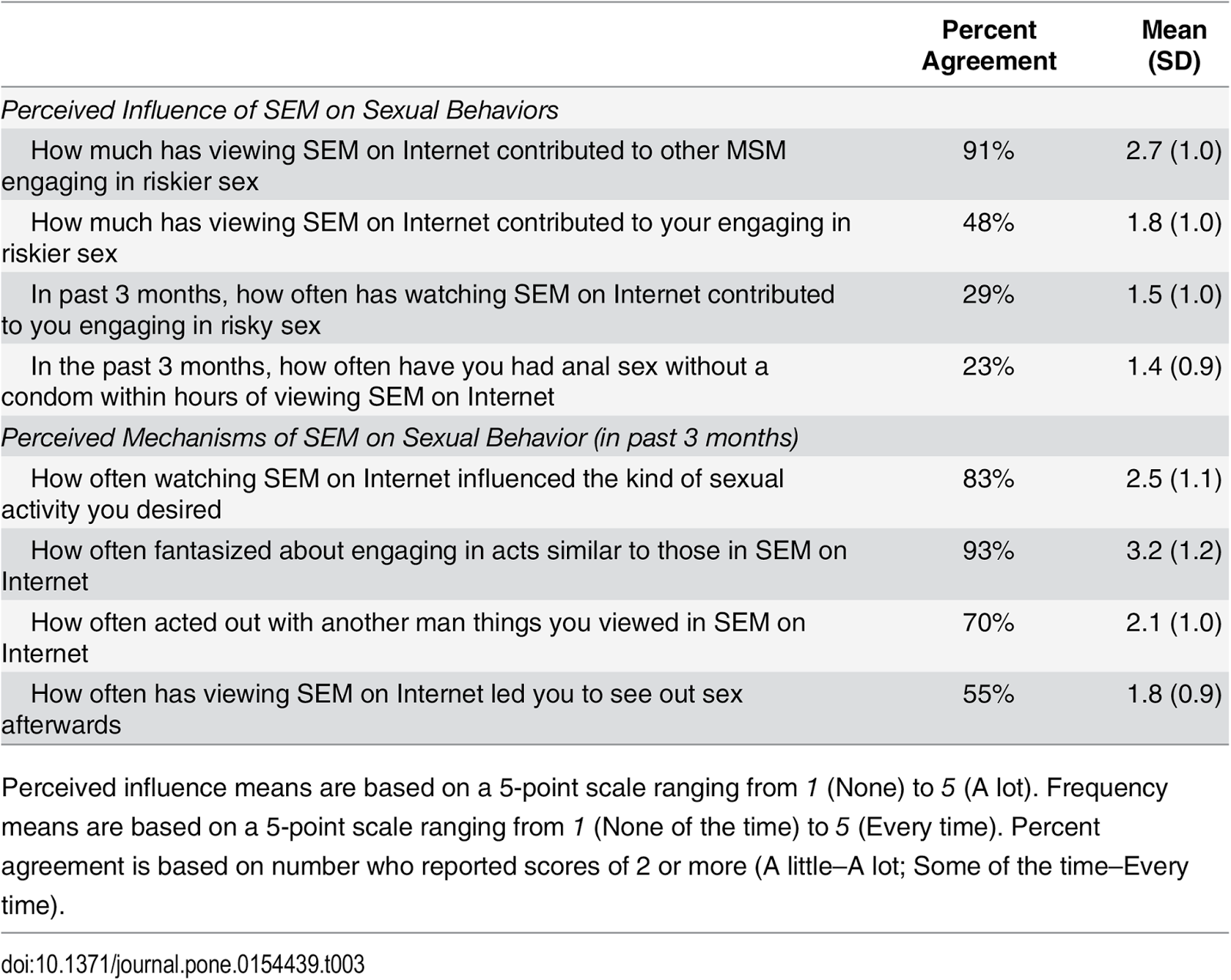
Viewing of Internet-Based Sexually Explicit Media as a Risk Factor for Condomless Anal Sex among Men Who Have Sex with Men in Four U.S. Cities

The last decade has seen a dramatic increase in the availability of sexually explicit media (SEM) on the Internet. Men who have sex with men (MSM) report near universal use of SEM. However, this widespread use of SEM among MSM may contribute to more condomless anal sex. 

To examine the association of viewing SEM on the Internet and the number of condomless anal sex encounters among MSM, in 2012, an online survey was conducted of 265 MSM from New York, Philadelphia, Baltimore, or Washington D.C. who reported viewing SEM online in the past 3 months. Analyses were performed using negative binomial regression. 

Nearly all men reported viewing SEM featuring anal sex with (91%) or without (92%) condoms in the past 3 months. Neither viewing more hours of SEM per week or compulsively viewing SEM were associated with more condomless anal sex encounters. Rather, viewing a greater proportion of SEM containing condomless anal sex was associated with engaging in more condomless anal encounters (IRR = 1.25), while viewing a greater proportion of SEM containing anal sex where condoms were used was associated with fewer condomless anal sex encounters (IRR = 0.62). MSM reported that viewing SEM caused changes in their sexual fantasies, desires, and behaviors. 

These findings provide important insights for health policy and the design of interventions addressing SEM and condomless sex among MSM. The findings suggest that condom use by SEM performers may benefit not only actor health, but also have health implications for SEM viewers.

Below:  Perceptions of the Influence of SEM (N = 265)


Full article at:   http://goo.gl/MNLVSE

By:
Eric W. Schrimshaw, Nadav Antebi-Gruszka
Department of Sociomedical Sciences, Mailman School of Public Health, Columbia University, New York, New York, United States of America

Martin J. Downing Jr.
Research and Evaluation, Public Health Solutions, Inc., New York, New York, United States of America


Saturday, April 23, 2016

Risk behaviours of an interrelated syphilis-infected sexual network of men who have sex with men

AIMS AND OBJECTIVES:
We examined the risk behaviours in an interrelated sexual network of 33 syphilis-infected men who have sex with men on the use of condoms, substances and websites to meet sexual partners. Our study used a descriptive exploratory design to investigate co-occurring high-risk behaviours in this interrelated sexual network to inform future health interventions and research directions.

BACKGROUND:
Although the risk behaviours for human immunodeficiency virus transmission in men who have sex with men have been studied, few have studied the high-risk population of men who already have syphilis, and even fewer have studied the risk behaviours in sexual networks of syphilis-infected men who have sex with men who were identified using contact tracing.

DESIGN/METHODS:
The data were collected from semi-structured, individual interviews at a not-for-profit lesbian, gay, bisexual and transgender health centre in a large city in the Midwestern USA.

RESULTS:
Inconsistent condom use was substantial during both insertive (92%) and receptive (88%) anal intercourse. Most participants (97%) reported using one or more substances prior to or during anal intercourse, and Internet websites were the most common place to meet sexual partners (88%).

CONCLUSIONS:
High-risk behaviours were significant within this syphilis-infected sexual network of men who have sex with men. The majority of our 33 participants were non-Hispanic Whites (n = 27, 82%), possessed a baccalaureate degree or higher (n = 23, 70%), and actively sought out unprotected anal intercourse [21 participants (64%) used BareBackRT.com, a website to seek out unprotected anal intercourse].

RELEVANCE TO CLINICAL PRACTICE:
Nurses should be more informed about the risk factors of a high-risk sexual network of syphilis-infected men who have sex with men. Interrelated sexual networks have high levels of similarity among participants' high-risk behaviours; contact tracing may be used to identify individual participants for relevant risk-reduction interventions.

Purchase full article at:   http://goo.gl/KK52WN

1School of Nursing, DePaul University, Chicago, IL, USA.
2Department of Psychology, DePaul University, Chicago, IL, USA.
3Department of Community, Systems, and Mental Health Nursing, Rush University, DePaul University, Chicago, IL, USA.
J Clin Nurs. 2016 Apr 22. doi: 10.1111/jocn.13209. [Epub ahead of print]


Wednesday, April 6, 2016

Social Support Quality & Availability Affects Risk Behaviors in Offenders

Background
People involved in the justice system are at 2.5 times the risk of HIV infection compared to the general population, which is further complicated by substance abuse. The purpose of this study was to evaluate the role of social network quality and quantity on unprotected sex, criminal risk, and substance use.

Methods
We used data from 330 drug-involved offenders. Structural equation modeling (SEM) was used to model and test path directionality and magnitude between the latent constructs of social support quality and quantity on risky behaviors.

Results
The SEM indicated the latent construct of social support quality was significantly associated with reduced sexual risk behavior (β = −0.27), criminal risk (β = −0.26), and reduced substance use (β = −0.33). Additionally, the proposed model found that social support quantity was significantly positively associated with increased sexual risk behavior (β = 0.40) and substance use (β = 0.20).

Conclusions
Social support quality is an important predictor of risky behaviors; as the quality of an offender’s social support increases, engagement in risky behaviors decreases. Probationers who had broader social support availability also had increased substance use and unprotected sex. Probation systems may be able to reduce substance use and STD/HIV infection risk in offenders by strengthening the quality of social support networks.

Below:  Structural Model of Social Support Quality and Quantity on Risk Taking Behaviors


Full article at:   http://goo.gl/VmUAv0

University of North Texas Health Science Center, Fort Worth, USA
George Mason University, Fairfax, VA USA


Tuesday, April 5, 2016

The Influence of Sensation-Seeking & Parental & Peer Influences in Early Adolescence on Risk Involvement through Middle Adolescence

This study examined the relationships between youth and parental sensation-seeking, peer influence, parental monitoring and youth risk involvement in adolescence using structural equation modeling. 

Beginning in grade-six, longitudinal data were collected from 543 students over three years. Youth sensation-seeking in grade six contributed to risk involvement in early adolescence (grades six and seven) indirectly through increased peer risk influence and decreased parental monitoring but did not have a direct contribution. It contributed directly and indirectly to risk involvement in middle adolescence (grades eight and nine). 

Parent sensation-seeking at baseline was positively associated with peer risk influence and negatively associated with parental monitoring; it had no direct effect on adolescent risk involvement. Parental monitoring buffers negative peer influence on adolescent risk involvement. 

Results highlight the need for intervention efforts to provide normative feedback about adolescent risky behaviors and to vary among families in which parents and/or youth have high sensation-seeking propensities.

Proportions of youth involved in risky behaviors at baseline, 12, 24, and 36 months
Risky behaviorsBaseline12 months24 months36 monthsz
Sample size543494458451
Delinquent behaviors
 Was suspended from school1.9%2.5%11.9%16.9%9.12c
 Was truant3.2%1.9%3.8%3.6%0.82
 Carried a weapon4.4%4.1%5.3%9.7%3.45c
 Engaged in a fight33.2%21.8%22.5%24.6%3.20b
Substance use behaviors
 Smoked cigarettes2.0%1.6%2.4%1.8%0.01
 Drank alcohol18.5%14.7%18.6%29.3%3.60c
 Used marijuana0.4%1.0%1.1%2.7%2.97b
 Sold or carried drugs1.1%0.6%1.3%2.2%1.58
 Been asked to sell drugs1.5%1.6%2.4%2.7%1.47
Sexual behaviors
 Ever had sex3.6%9.6%20.8%28.6%13.90c
 Had sex in the last 6 months1.0%3.1%7.9%13.7%9.15c
 Ever had anal sex0.8%2.1%6.8%8.7%8.14c
 Had multiple sex partners0.2%0.6%2.9%4.4%6.12c
 Did not use a condom during last sexual encounter66.7%59.6%44.0%27.3%5.04c

Full article at:   http://goo.gl/IZYp7q

1Pediatric Prevention Research Center, Department of Pediatrics, Wayne State University School of Medicine, Detroit, Michigan, USA
2Office of HIV/AIDS, the Bahamas Ministry of Health, Nassau, The Bahamas
Corresponding author: Bo Wang, Ph.D., Pediatric Prevention Research Center, Wayne State University School of Medicine, 4707 St. Antoine, Suite W534, Detroit, MI 48201, Phone: 313-966-2366, Fax: 313-745-4993
Youth Soc. 2016 Mar; 48(2): 220–241.
Published online 2013 May 6. doi:  10.1177/0044118X13487228


Relationships among Substance Use, Multiple Sexual Partners & Condomless Sex: Differences Between Male & Female U.S. High School Adolescents

Male and female students manifest different behaviors in condomless sex. This cross-sectional, exploratory, correlational study examined the differences in risk factors for condomless sex between male and female high school students, using secondary data from 4,968 sexually active males and females participating in the 2011 National Youth Risk Behavior Survey. 

Results in descriptive statistics and multivariate binary logistic regressions revealed that condomless sex was reported as 39.70% in general. A greater proportion of females engaged in condomless sex (23.26%) than did males (16.44%). 

Physical abuse by sex partners was a common reason for failure to use condoms regardless of gender. Lower condom use was found in 
  • those experiencing forced sex by a partner in males, 
  • female smokers, and 
  • female with multiple sex partners. 
Thus, sexual health education should address the different risk factors and consider gender characteristics to reduce condomless sex.

Purchase full article at:   http://goo.gl/vWtUHf

By:  Zhao YL1Kim H2Peltzer J3.
  • 1School of Nursing, University of Kansas, Kansas City, KS, USA School of Nursing, Boise State University, Boise, ID, USA.
  • 2College of Nursing, Yonsei University, Seoul, South Korea Mo-Im Kim Nursing Research Institute, Seoul, South Korea hkim80@yuhs.ac.
  • 3School of Nursing, University of Kansas, Kansas City, KS, USA. 
  •  2016 Mar 31. pii: 1059840516635712


Sunday, April 3, 2016

An Initial Typology of Contexts of Dyadic Sexual Encounters Between Men & Associations with Sexual Risk & Pleasure

Background:
Although many within-subjects comparisons conducted on samples of men who have sex with men have sought to understand the association between specific situational characteristics (e.g. drug use or location of sex) and sexual risk behaviour, none have considered the 'clustering' of patterns of situational characteristics. An initial typology of sexual encounters is derived and the relationship of this typology to condomless anal intercourse (CAI) and pleasure is tested.

Methods:
Data from a longitudinal survey of men who have sex with men living in England were used. Multilevel latent class analyses were estimated to determine an optimal class solution on the situational characteristics, and then pseudo-imputation was used to estimate the association between class and both CAI and pleasure.

Results:
A three-class solution fit the data best, with a scaled relative entropy of 92.4%. Classes were characterised as featuring: regular steady partners in private locations with low drug use
  • Class 1, casual partners with increased probability of sex occurring in a sex-on-premises venue 
  • Class 2, and high levels of polydrug use together with increased probability of casual partners
  • Class 3. Encounters were different both in pairwise comparisons and overall on probability of CAI. 
They were different overall but not necessarily pairwise on pleasure.

Conclusions:
These initial findings demonstrate the possibility of understanding sexual encounters in terms of the contexts, or classes, within which they occur. This may have implications for tailoring HIV prevention to specific encounter types. Future research should seek to extend encounter-level typologies to specific drug use variables.

Purchase full article at:   http://goo.gl/GbhgoY

By:  G. J. Melendez-Torres A D, Ford Hickson B, David Reid B, Peter Weatherburn B andChris Bonell C 

A Division of Health Sciences, Warwick Medical School, University of Warwick, Coventry. B Sigma Research, London School of Hygiene and Tropical Medicine. C Department of Social Science, UCL Institute of Education, University College London D Corresponding author. Email: G.Melendez-Torres@warwick.ac.uk 
 2016 Mar 9. doi: 10.1071/SH15218


Saturday, April 2, 2016

High Prevalence of Forced Sex among Non-Brothel Based, Wine Shop Centered Sex Workers in Chennai, India

Sexual violence has been shown to increase women’s risk of HIV infection. India is a country where the HIV epidemic is growing among women and intimate partner violence is pervasive. 

This study examined prevalence of and factors associated with forced sex among female sex workers (FSWs) in Chennai, India. We conducted a probability survey among FSWs in 24 slum venues and identified predictive factors for recent forced sex using univariate and multivariable proportional odds models. 

Among 522 FSWs, 28% reported having forced sex with 1 partner and 35% with 2+ partners. In the final multivariable model, women who had a high number of partners who had a strong tendency to drink alcohol before sex were more likely to have experienced forced sex, and women who had both unprotected sex with a nonspousal partner and > 20 days of alcohol consumption in the last 30 days were more likely to have experienced forced sex. 

Discussion about family violence with larger social networks was independently associated with lower odds of forced sex among FSWs. HIV interventions for FSWs and their clients aimed at reducing alcohol consumption and encouraging condom use could be enhanced by violence prevention interventions to facilitate discourse about sexual violence.

Multivariate Proportional Odds Model Results for Forced Sex (with 2 or more partners; with any partners) Among Sex Workers in Chennai, India
Independent Variable CombinationsOR [95% CI]
Any unprotected sex with non-spousal partner in last 3 mos?
No. days alcohol consumed in last 30 days
 No 0–9reference
 10–190.60 [0.24,1.48]
 20+0.36 [0.11,1.13]
 Yes 0–91.42 [0.82,2.46]
 10–191.71 [0.82,3.56]
 20+2.66 [1.13,6.29]
No. people spoke with about family violence in last 3 mos
0reference
1–50.61 [0.44,0.86]
6+0.41 [0.22,0.75]
No. partners with strong tendency to drink alcohol before sex
0reference
11.43 [0.91,2.25]
2+1.87 [1.38,2.54]
Under the proportional odds assumption, the odds ratios apply to either of the two odds ratios being modeled – the odds ratio for forced sex by 2 or more partners relative to forced sex by one or less partners and the odds ratio for forced sex by any partner relative to forced sex by no partners. A significant interaction was found between unprotected sex with a non-spousal partner and alcohol consumption of the sex worker.

Full article at:   http://goo.gl/Z1tmf1

1Department of Epidemiology, Johns Hopkins University Bloomberg School of Public Health, Baltimore, Maryland, USA
2YRG Centre for AIDS Research and Education, Chennai, India
3Research Triangle Institute, Research Triangle Park, North Carolina, USA
*Correspondence and request for reprints should be addressed to: Vivian Go, PhD, Johns Hopkins University Bloomberg School of Public Health, Infectious Diseases Program, Department of Epidemiology, 615 North Wolfe Street, Suite E-6610, Baltimore, Maryland 21205, USA, Fax: 1-410-955-1383, Tel: 1-410-614-4755