Showing posts with label schizophrenia. Show all posts

Saturday, March 12, 2016

The Recognition of Mental Illness, Schizophrenia Identification, and Help-Seeking from Friends in Late Adolescence

Objective
The recognition of mental illness without anticipating stigma might encourage adolescents’ help-seeking behavior. We aimed to identify the relationship between mental illness identification and adolescents’ intention to seek help if faced with mental illness.

Method
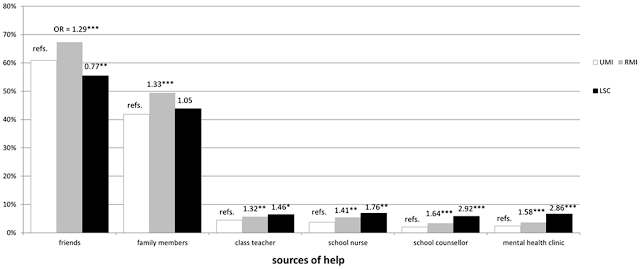
We examined the relationships between help-seeking intentions and recognition of mental illness (RMI) without correctly identifying the disease name, as well as correct labelling of schizophrenia (LSC) using a vignette about a person with schizophrenia in a cross-sectional survey of 9,484 Japanese high-school students aged 15–18 years.

Results
When compared with adolescents who were unable to recognize the mental illness (UMI) in the vignette, those in the RMI group reported they were significantly more likely to seek help from friends (odds ratio [OR] = 1.29; 95% confidence interval [CI] = 1.17–1.41; P < 0.001) and expressed an increased likelihood to seek help from professionals (all P < .05). Those in the LSC group reported they were significantly less likely to exhibit help-seeking behavior (OR = 0.77, 95% CI = 0.65–0.92, P = 0.003) and expressed an increased likelihood of help-seeking from health professionals than the UMI group (all P < .05).

Conclusion
The ability to recognize mental illness without identifying the disease may increase help-seeking from friends, while the ability to identify the disease as schizophrenia might decrease late adolescents’ help-seeking. To promote help-seeking behavior among adolescents, improving their ability to recognize mental illness generally is recommended.

Below:  Percentages of subjects in each group seeking help from different sources according to their responses to the case vignette of schizophrenia


Full article at:   http://goo.gl/Auastz

By:  
Syudo Yamasaki, Shuntaro Ando, Kaori Endo, Nozomu Asukai, Atsushi Nishida
Department of Psychiatry and Behavioral Science, Tokyo Metropolitan Institute of Medical Science, Tokyo, Japan

Shuntaro Ando, Kaori Endo
Department of Neuropsychiatry, Graduate School of Medicine, The University of Tokyo, Tokyo, Japan

Shinji Shimodera
Department of Neuropsychiatry, Kochi Medical School, Kochi University, Kochi, Japan

Yuji Okazaki
Kouseikai Michinoo Hospital, Nagasaki, Japan

Yuji Okazaki
Tokyo Metropolitan Matsuzawa Hospital, Tokyo, Japan

Nozomu Asukai
Aoyamakai Aoki Hospital, Tokyo, Japan

Satoshi Usami
Department of Psychology, University of Tsukuba, Ibaraki, Japan

Tsukasa Sasaki
Department of Physical and Health Education, Graduate School of Education, The University of Tokyo, Tokyo, Japan





Monday, February 22, 2016

The Profile of Psychiatric Symptoms Exacerbated by Methamphetamine Use

HIGHLIGHTS
  • Methamphetamine use was associated with a dose-related exacerbation of positive psychotic, affective and psychomotor symptoms.
  • We found evidence of a latent symptom profile, comprised of positive psychotic and affective symptoms, that aligned with a diagnosis of substance-induced psychosis.
  • Methamphetamine use did not significantly increase the severity of negative symptoms of schizophrenia.
BACKGROUND:
Methamphetamine use can produce symptoms almost indistinguishable from schizophrenia. Distinguishing between the two conditions has been hampered by the lack of a validated symptom profile for methamphetamine-induced psychiatric symptoms. We use data from a longitudinal cohort study to examine the profile of psychiatric symptoms that are acutely exacerbated by methamphetamine use.

METHODS:
164 methamphetamine users, who did not meet DSM-IV criteria for a lifetime primary psychotic disorder, were followed monthly for one year to assess the relationship between days of methamphetamine use and symptom severity on the 24-item Brief Psychiatric Rating Scale. Exacerbation of psychiatric symptoms with methamphetamine use was quantified using random coefficient models. The dimensions of symptom exacerbation were examined using principal axis factoring and a latent profile analysis.

RESULTS:
Symptoms exacerbated by methamphetamine loaded on three factors: positive psychotic symptoms (suspiciousness, unusual thought content, hallucinations, bizarre behavior); affective symptoms (depression, suicidality, guilt, hostility, somatic concern, self-neglect); and psychomotor symptoms (tension, excitement, distractibility, motor hyperactivity). Methamphetamine use did not significantly increase negative symptoms. Vulnerability to positive psychotic and affective symptom exacerbation was shared by 28% of participants, and this vulnerability aligned with a past year DSM-IV diagnosis of substance-induced psychosis (38% vs. 22%, χ2(df1)=3.66, p=0.056).

CONCLUSION:
Methamphetamine use produced a symptom profile comprised of positive psychotic and affective symptoms, which aligned with a diagnosis of substance-induced psychosis, with no evidence of a negative syndrome.

Purchase full article at:   http://goo.gl/ffAK5E

  • 1National Drug Research Institute, Faculty of Health Sciences, Curtin University, Perth, Australia; National Drug and Alcohol Research Centre, University of New South Wales, Sydney, Australia; Centre for Research on Ageing, Health and Wellbeing, Research School of Population Health, Australian National University, Canberra, Australia. Electronic address: rebecca.mcketin@curtin.edu.au.
  • 2School of Applied Psychology ​and Menzies Health Institute Queensland, Griffith University, Brisbane, Queensland, Australia.
  • 3Centre for Research on Ageing, Health and Wellbeing, Research School of Population Health, Australian National University, Canberra, Australia.
  • 4Centre for Youth Substance Abuse Research, School of Psychology and Counselling, and Institute of Health & Biomedical Innovation, Queensland University of Technology (QUT), Brisbane, Queensland, Australia.
  • 5National Drug and Alcohol Research Centre, University of New South Wales, Sydney, Australia.
  • 6Centre for Youth Substance Abuse Research, University of Queensland, Brisbane, Queensland, Australia; Disciplines of Psychiatry and Addiction Medicine, Faculty of Medicine, University of Sydney, New South Wales, Australia. 
  •  2016 Jan 30. pii: S0376-8716(16)00046-6. doi: 10.1016/j.drugalcdep.2016.01.018


Wednesday, February 17, 2016

Murder & Psychosis: Neuropsychological Profiles of Homicide Offenders with Schizophrenia

BACKGROUND:
Neurocognitive dysfunction, a core feature of schizophrenia, is thought to contribute to the impulsive violent aggression manifested by some individuals with schizophrenia, but not enough is known about how homicidal individuals with schizophrenia perform on neuropsychological measures.

AIMS:
The primary aim of our study was to describe the neuropsychological profiles of homicide offenders with schizophrenia. Supplementary analyses compared the criminal, psychiatric and neuropsychological features of schizophrenic homicide offenders with and without God/Satan/demon-themed psychotic symptoms.

METHODS:
Twenty-five men and women diagnosed with schizophrenia who had killed another person - 21 convicted of first-degree murder and 4 found not guilty by reason of insanity - completed neuropsychological testing during forensic evaluations.

RESULTS:
The sample was characterised by extensive neurocognitive impairments, involving executive dysfunction (60%), memory dysfunction (68%) and attentional dysfunction (50%), although those with God/Satan/demon-themed psychotic symptoms performed better than those with nonreligious psychotic content.

CONCLUSIONS:
Our findings indicate that impaired cognition may play an important role in the commission of homicide by individuals with schizophrenia. A subgroup with God/Satan/demon delusions seem sufficiently less impaired that they might be able to engage in metacognitive treatment approaches, aimed at changing their relationship to their psychotic symptoms, thus reducing the perception of power and omnipotence of hallucinated voices and increasing their safety

Purchase full article at:   http://goo.gl/lat1a1

By:  Stratton J1Brook M1Hanlon RE1,2.
  • 1Department of Psychiatry and Behavioral Sciences, Northwestern University, Feinberg School of Medicine, Chicago, IL, USA.
  • 2Neuropsychological Associates of Chicago, Chicago, IL, USA. 
  •  2016 Feb 10. doi: 10.1002/cbm.1990.


Saturday, February 13, 2016

Associations with Violent and Homicidal Behaviour among Men with Schizophrenia

Objective 
We aimed to assess the risk factors associated with homicidal behaviour in male patients diagnosed with schizophrenia. 

Methods 
In a period of 1 year, male schizophrenia cases between 18-65 years of age (n = 210) were included. The clinical evaluation included the Positive and Negative Syndrome Scale (PANSS) and Overt Aggression Scale (OAS). The patients were divided into three groups in terms of violent behaviour history: (1) homicide group (n = 30), (2) a violent act resulting in serious injury (n = 71), (3) control group (patients without a history of a violent act) (n = 109). 

Results 
Lower level of education, rural residence, being unemployed and living alone were found to be significantly more common in patients who had committed a violent act compared to the schizophrenia patients in the control group. In order to explore the predictive value of several factors associated with violent behaviour, a logistic regression model was used, and variables (shorter duration of education, living alone, and lack of insight) significantly predicted the presence of violent behaviour (murder and/or injury) (χ2=31.78, df = 12, p = 0.001). 

Conclusions 
In order to be able to determine causality of homicidal acts in schizophrenia patients, our significant findings between homicidal violence, non-homicidal violence and the control group would merit further attention and exploration in further studies.

Purchase full article at:   http://goo.gl/81CrDF

  • 1 Department of Psychiatry , Training and Research Hospital , Samsun , Turkey ;
  • 2 Sokrates Psychiatry and Psychotherapy Center , İzmir , Turkey ;
  • 3 Department of Child and Adolescent Psychiatry , Ondokuz Mayis University Medical Faculty , Samsun , Turkey ;
  • 4 Department of Psychiatry , Ondokuz Mayis University Medical Faculty , Samsun , Turkey ;
  • 5 Department of Psychiatry , Dogubeyazit Hospital , Agri , Turkey.
  •  2015 Dec 4:1-6.  


Monday, January 25, 2016

The Relationship Between Schizotypy and Reactive Aggression in Western Adults Is Mediated by Victimization

A large body of literature suggests that schizophrenia and nonclinical schizotypal personality traits, or "schizotypy," are associated with increased aggression. However, recent studies focused on school-aged Asian samples have examined the relationship between schizotypal personality and 2 distinct forms of aggression: reactive and proactive aggression. 

This study aimed to investigate whether schizotypal personality traits would be associated more strongly with reactive, compared with proactive, aggression in an adult Western sample and whether victimization experiences mediated the schizotypy-reactive aggression relation. 

One hundred twenty-one Australian university undergraduates completed self-report inventories measuring levels of schizotypal personality, reactive and proactive aggression, and victimization. Results showed that, as hypothesized, schizotypal personality traits were more strongly associated with reactive than proactive aggression and that victimization experiences mediated the schizotypy-reactive aggression relationship. 

While acknowledging the limitations of nonclinical schizotypy research, the findings are discussed with regard to possible implications for the treatment of aggression in schizophrenia.

Purchase full article at:   http://goo.gl/YIg6de

  • 1*Department of Psychology and †ARC Centre of Excellence in Cognition and Its Disorders and Department of Cognitive Science, Macquarie University, Sydney, New South Wales, Australia. 


Substance Use among Homeless Individuals with Schizophrenia and Bipolar Disorder

Mental illness and substance use are over represented within urban homeless populations. This paper compared substance use patterns between homeless individuals diagnosed with schizophrenia spectrum (SS) and bipolar disorders (BD) using the Mini-International Neuropsychiatric Interview. 

From a sample of 497 subjects drawn from Vancouver, Canada who participated in the At Home/Chez Soi study, 146 and 94 homeless individuals were identified as BD and SS, respectively. In the previous 12 months, a greater proportion of BD homeless reported greater use of cocaine, amphetamines, opiates, hallucinogens, cannabinoids, and tranquilizers compared to SS. Cocaine and opiates were significantly associated with BD homeless. 

The present study illustrates the relationship between substance use and BD in a vulnerable urban population of homeless, affected by adverse psychosocial factors and severe psychiatric conditions.

Purchase full article at:   http://goo.gl/fRdZi9

  • 1*"Vincent P. Dole" Dual Diagnosis Unit, Department of Clinical and Experimental Medicine, University of Pisa; †Association for the Application of Neuroscientific Knowledge to Social Aims (AU-CNS), Pietrasanta, Lucca, Italy; ‡Department of Pediatrics, Faculty of Medicine and Dentistry, University of Alberta, Edmonton, AB, Canada; §Medical University of Vienna, Neuroimaging Labs, Austria; ∥Institute of Mental Health, Department of Psychiatry, and ¶Department of Psychiatry, University of British Columbia; #Centre for Health Evaluation and Outcome Sciences, St. Paul's Hospital; and **School of Population and Public Health, University of British Columbia, Vancouver, BC, Canada. 


Friday, January 22, 2016

Hearing the Unheard: An Interdisciplinary, Mixed Methodology Study of Women’s Experiences of Hearing Voices (Auditory Verbal Hallucinations)

This paper explores the experiences of women who “hear voices” (auditory verbal hallucinations). We begin by examining historical understandings of women hearing voices, showing these have been driven by androcentric theories of how women’s bodies functioned leading to women being viewed as requiring their voices be interpreted by men. 

We show the twentieth century was associated with recognition that the mental violation of women’s minds (represented by some voice-hearing) was often a consequence of the physical violation of women’s bodies. 

We next report the results of a qualitative study into voice-hearing women’s experiences (n = 8). This found similarities between women’s relationships with their voices and their relationships with others and the wider social context. 

Finally, we present results from a quantitative study comparing voice-hearing in women (n = 65) and men (n = 132) in a psychiatric setting. Women were more likely than men to have certain forms of voice-hearing (voices conversing) and to have antecedent events of trauma, physical illness, and relationship problems. Voices identified as female may have more positive affect than male voices. 

We conclude that women voice-hearers have and continue to face specific challenges necessitating research and activism, and hope this paper will act as a stimulus to such work.

Properties of voices.
VariableMen (n = 132)Women (n = 65)
Affecta
Positive voice affect5.78 (4.72)4.78 (4.57)
Negative voice affect15.70 (7.80)16.65 (7.77)
Properties of voice(s)
Form of addressb
 First person24%36%
 Second person68%81%
 Third person62%72%
 Does not address30%25%
Voices conversinga
 Never49%31%
 Rarely5%11%
 Sometimes26%23%
 Often23%35%
Interpretation of voices
Voices reflect own thoughts
 No39%22%
 Unsure8%5%
 Maybe9%12%
 Yes44%62%
Antecedent eventsc
Stress78%83%
Friendship/relationship problem55%78%
Family problems54%64%
Physical illness15%38%
Medication/recreational drugs39%22%
Major trauma32%47%
Divorce11%6%
Change job/finance/location57%57%
Loneliness69%78%
Tiredness59%77%
Death of significant other30%36%
aMissing data for one male participant.
bMissing data for three male participants and one female participant.
cMissing data for men ranged from 12 to 31 participants, depending on the question, and from 5 to 12 female participants.

Full article at:   http://goo.gl/fUFfsd

1Department of Psychiatry, Trinity College Dublin, Dublin, Ireland
2Department of Cognitive Science, ARC Centre of Excellence in Cognition and Its Disorders, Macquarie University, Sydney, NSW, Australia
3School of Psychology, University of East London, London, UK
4Independent Scholar, Dublin, Ireland
5Department of English, Utah State University, Logan, UT, USA
6Hill Centre for Women, McLean Hospital, Boston, MA, USA
7Department of Psychiatry, Harvard Medical School, Boston, MA, USA
8Department of Media and Communications, Goldsmith’s College, London, UK
Edited by: Gretchen Hermes, Yale University, USA
Reviewed by: Bernhard J. Mitterauer, Volitronics-Institute for Basic Research Psychopathology and Brain Philosophy, Austria; Thomas Whitford, University of New South Wales, Australia
*Correspondence: Simon McCarthy-Jones,  moc.liamg@senojyhtraccm.s


Thursday, January 21, 2016

From Positive Screen to Engagement in Treatment: A Preliminary Study of ihe Impact of a New Model of Care for Prisoners with Serious Mental Illness

BACKGROUND:
The high prevalence of serious mental illness (SMI) in prisons remains a challenge for mental health services. Many prisoners with SMI do not receive care. Screening tools have been developed but better detection has not translated to higher rates of treatment. In New Zealand a Prison Model of Care (PMOC) was developed by forensic mental health and correctional services to address this challenge. The PMOC broadened triggers for referrals to mental health teams. Referrals were triaged by mental health nurses leading to multidisciplinary team assessment within specified timeframes. This pathway for screening, referral and assessment was introduced within existing resources.

METHOD:
The PMOC was implemented across four prisons. An AB research design was used to explore the extent to which mentally ill prisoners were referred to and accepted by prison in-reach mental health teams and to determine the proportion of prison population receiving specialist mental health care.

RESULTS:
The number of prisoners in the study in the year before the PMOC (n = 19,349) was similar to the year after (n = 19,421). 24.6 % of prisoners were screened as per the PMOC in the post period. Referrals increased from 491 to 734 in the post period (Z = -7.23, p < 0.0001). A greater number of triage assessments occurred after the introduction of the PMOC (pre = 458; post = 613, Z = 4.74, p < 0.0001) leading to a significant increase in the numbers accepted onto in-reach caseloads (pre = 338; post = 426, Z = 3.16, p < 0.01). Numbers of triage assessments completed within specified time frames showed no statistically significant difference before or after implementation. The proportion of prison population on in-reach caseloads increased from 5.6 % in the pre period to 7.0 % in the year post implementation while diagnostic patterns did not change, indicating more prisoners with SMI were identified and engaged in treatment.

CONCLUSIONS:
The PMOC led to increased prisoner numbers across screening, referral, treatment and engagement. Gains were achieved without extra resources by consistent processes and improved clarity of professional roles and tasks. The PMOC described a more effective pathway to specialist care for people with SMI entering prison.

Below:  The Prison Model of Care Referral and Treatment Pathway


Below:  Diagnostic cumulative composition of in-reach case load under treatment over 12 month study period


Purchase full article at:   http://goo.gl/K2aCxo