Showing posts with label Media Campaign. Show all posts

Friday, January 15, 2016

Exploring the Linkage Between Exposure to Mass Media & HIV Testing among Married Women & Men in Ghana

Although HIV testing is critical to the treatment and prevention of HIV/AIDS, utilization rate of HIV testing services among married women and men remains low in Ghana. Mass media, as a tool to increase overall HIV testing turnouts, has been considered one of the important strategies in promoting and enhancing behavioural changes related to HIV/AIDS prevention. 

Using the 2014 Ghana Demographic and Health Survey, the current study examines the relationship between levels of exposure to print media, radio, and television and the uptake of HIV testing among married women and men in Ghana. Results show that HIV testing is more prevalent among married women than their male counterparts. 

We also find that higher levels of exposure to radio is associated with HIV testing among women, while higher levels of exposure to print media and television are associated with HIV testing among men. 

Implications of these findings are discussed for Ghana's HIV/AIDS strategic framework, which aims to expanding efforts at dealing with the HIV/AIDS epidemic. Specifically, it is important for health educators and programme planners to deliver HIV-related messages through television, radio, and print media to increase the uptake of HIV testing particularly among married women and men in Ghana.

Purchase full article at:   http://goo.gl/vl03Ct

  • 1 Department of Sociology , University of Western Ontario (http://sociology.uwo.ca/), Room 5306, Social Science Centre, London , ON , Canada.
  • 2 Department of Gender Studies , Memorial University of Newfoundland , Science Building 4082, St. John's , NL , Canada.
  • 3 Department of Geography , University of Western Ontario , Room 1424, Social Science Centre, London , ON , Canada.
  • 4 Arthur Labatt Family School of Nursing, Health Sciences Addition , University of Western Ontario , London , ON , Canada. 


Tuesday, December 29, 2015

#TestMeEast: A Campaign to Increase HIV Testing in Hospitals & to Reduce Late Diagnosis

Late diagnosis occurs in almost half of those diagnosed in the UK (HIV Prevention England, 2013. Retrieved June 22, 2014, from HIV Prevention England: http://www.hivpreventionengland.org.uk/Campaigns-Current/National-HIV-Testing-Week). Testing occurs mainly in sexual health and antenatal clinics despite recommendations to test more broadly 

We report the findings of an HIV-testing week campaign to offer testing to those who have blood tests as part of routine care within outpatient clinics and emergency departments of six London hospitals. The campaign target was to test 500 patients a day during the 2013 National HIV Testing Week (NHTW). Clinic staff and medical students were trained to offer routine HIV testing. Linkage to care was arranged for those who tested HIV-positive. 

During NHTW we tested 2402 of the planned 2500 test target. 2402/4317 (55.6% 95% CI 54.1-57.1%) of those who had routine blood tests were tested for HIV. There were eight HIV-positive tests; three were new diagnoses (all linked to care). The campaign hashtag #TestMeEast achieved a total Twitter "reach" of 238, 860 and the campaign had widespread news coverage. Our campaign showed that staff and students could be trained and mobilised to do thousands of routine HIV tests during a campaign.

Purchase full article at:   http://goo.gl/BVVLLG

  • 1 Barts Health NHS Trust , London , UK.
  • 2 London School of Hygiene and Tropical Medicine , London , UK.
  • 3 Positively UK , London , UK.
  • 4 HIV Medicine, Infection and Immunity , Royal London Hospital , London , UK. 


Talk Radio as the Soundtrack of Our Lives: Participatory HIV/AIDS Communication, Public Self-Expression & Positive Talk

Despite the many HIV/AIDS communication initiatives, combined with support and infrastructural support in South Africa, risky behaviour associated with the spread of the epidemic is increasing amongst many groups. This calls for a re-evaluation of endeavours aimed at curbing the spread of the epidemic. This article is only concerned with the communicational aspects of the epidemic, but does not negate the interaction of these with other measures taken to address the epidemic. 

As is the case with most health communication initiatives, HIV/AIDS communication initiatives have evolved to favour the participatory approach above one-directional transmission of information to the public. The participatory approach rests on the assumption that an HIV/AIDS communication initiative stands the best chance of resulting in behaviour change if members of the target community participate in the communication initiative. The assumption is that as many people as possible should be involved in the maximum number of phases of the communicative initiative (such as initial research, planning, implementation and evaluation of the project). Some research has recently started to explore new forms of community participation, including inviting community participation through, for example, internet-based platforms such as social media, and mobile phone platforms such as WhatsApp and BBM. However, the reality broadcast genre - more specifically, talk radio - has been neglected, as only a few research investigations focused on talk radio and most of these are not exclusively about HIV/AIDS communication but focus on other health topics. 

From a participatory communication perspective, two sets of critique against the existing HIV/AIDS communication projects hold water: firstly, they do not make the maximum use of participatory communication principles and, secondly, they are externally initiated projects and emanate from outside the target community. To address both of these concerns, this article explores a wider range of participatory principles and the potential workings of these in an internally initiated communication initiative aimed at addressing the epidemic. More specifically, this article investigates ways in which radio listeners experience the reality broadcast genre - the talk radio show, Positive Talk - as participatory communication. 

Positive Talk is not an externally initiated project, as it is not part of a pre-planned, goal-oriented project that is owned and controlled outside the target community. In contrast, it has been initiated by Criselda Kananda, an individual not linked to any of the existing initiatives outside the community. She started the show to earn a living. She became a well-known person, is fairly knowledgeable in the field and was granted this opportunity as she is HIV-positive. In order to investigate how radio listeners use the show to engage in HIV/AIDS communication, 20 in-depth interviews were held with avid listeners of the show. 

The respondents indicated that they appreciate ordinary people phoning in. When expressing their opinions about the show, they found Kananda's life story credible, believed her public and private life to be congruent, valued Kananda's personality and respectful manner and could identify with the views expressed. In the article, it is argued that these ideas are largely in line with the principles of participatory communication tied to democracy, the participatory turn, the ordinary, validation of identity and respectful dialogue. 

Although the findings of this qualitative study cannot be generalised to the whole listening population of the show, they indicate that it is worth investigating the value of communication initiatives that emerge spontaneously from communities (instead of those strategically engineered from outside the general population) as a future direction of HIV/AIDS communication in the country.

Full article at:   http://goo.gl/sRPZp0

By:   Burger M1.
  • 1a D Litt et Phil is affiliated to the Department of Communication Studies , University of Johannesburg , Johannesburg , South Africa, *Email: mburger@uj.ac.za. 


¡NYC se divierte con protección!


Via:  http://goo.gl/RU9Bmw  By:  https://twitter.com/nycHealthy

Monday, December 21, 2015

Economics of Mass Media Health Campaigns with Health-Related Product Distribution: A Community Guide Systematic Review

Context
The objective of this systematic review was to determine the costs, benefits, and overall economic value of communication campaigns that included mass media and distribution of specified health-related products at reduced price or free of charge.

Evidence Acquisition
Economic evaluation studies from a literature search from January 1980–December 2009 were screened and abstracted following systematic economic review methods developed by The Community Guide. Data were analyzed in 2011.

Evidence Synthesis
The economic evidence was grouped and assessed by type of product distributed and health risk addressed. A total of 15 evaluation studies were included in the economic review, involving campaigns promoting the use of child car seats or booster seats, pedometers, condoms, recreational safety helmets, and nicotine replacement therapy (NRT).

Conclusion
Economic merits of the intervention could not be determined for health communication campaigns associated with use of recreational helmets, child car seats, and pedometers, primarily because available economic information and analyses were incomplete. There is some evidence that campaigns with free condom distribution to promote safer sex practices were cost-effective among high-risk populations and the cost per quit achieved in campaigns promoting tobacco cessation with NRT products may translate to a cost per quality-adjusted life year (QALY) less than $50,000. Many interventions were publicly funded trials or programs, and the failure to properly evaluate their economic cost and benefit is a serious gap in the science and practice of public health.

Table 2

Details of included studies
Study and Year
Location
Population
Design
Type of economic
analysis
Intervention
components
Length of intervention
Volunteers and in-kind
contributions
EffectivenessIntervention
cost and
components
Economic
benefits
considered
Summary
economic outcome
Child safety seat use
St Louis 200819
Oakland County, MI

Area Pop: 197,846
Low-income
community pop: Not
reported
Hispanic community
pop: 11,355

Pre-Post with
Comparison

Funded amount
TV, radio, print, small
media, community
mobilization,
child seats, small group
education

15 months

Used volunteers
No difference for low-
income community

Hispanic community:
Before - 9.7%
After - 14.9%
(Control: Before-
18.2%, After-14.8%)
358 free seats
distributed
$53,209 grant to
each of two
communities

No details about
number of
vouchers
redeemed
NoneNone
Pedometer distribution
Brown 20069
Eakin 200711
Rockhampton,
Australia

Pop: 60,000 (40,000
adults)

Pre-Post with
Comparison

Funded amount and
partial intervention
cost
TV, radio, print, small
media, pedometers,
phone support, website,
small group education,
improved municipal
signage and footpaths,
formative research

2 years

Volunteers and in-kind
contributions
No significant effectGrant plus
in-kind
contributions:
$530,700

Includes paid
advertising and
event marketing:
$17,400, with
additional
$43,500
in-kind
NoneNone
Condom distribution
Alstead 19996
Seattle, WA

Pop size not reported
15-17-year-olds in
three communities
within Seattle

Pre-Post

Partial intervention
cost
Radio, small media,
community mobilization,
condoms,
small group education,
formative research

7 months

Volunteers used
No significant
difference in condom
use at last intercourse
between those
exposed and
unexposed to
campaign
$276,617 for
formative
research, media
and placement,
professional
advertising and
vending services
plus $15,000 for
condoms

None

None
Kahn 200113
Intervention: Eugene,
OR
Control: Santa
Barbara, CA

Target gay men aged
18-27 years (approx
1,100 in area)

Pre-Post with
Comparison
Modeled cost-
effectiveness
(Print, small media,
community mobilization,
small group education,
formative research,
condoms)

8 months

Modeled 1, 5, 20 years

Volunteers used
27% reduction in risk
sex behavior
(measured as
reduction in
unprotected anal sex)
Assumed reduction in
risk translates directly
to same percent
reduction in HIV
incidence. Authors
provide rationale for
assumption based in
literature.
$113,641 or $676
per person
(For personnel,
computers and
supplies,
publicity and
communications,
condoms, travel,
workspace)
Health care
averted based
on lifetime
medical care
cost for
treating HIV
infections
using
estimates
from
literature
Societal net
savings=
intervention cost
minus averted
medical costs:
1 year: $265K
5 years: $875K
20 years: $1,714K
Kennedy 200014
Sacramento, CA


About 6,000–10,000
sexually active
adolescents

Pre-Post with series
of surveys

Funded amount
Radio, small media,
community mobilization,
phone support, small
peer-led group education,
condoms

1 year
OR of condom use
with main partner at
last intercourse: 1.26

OR of condom
carrying: 1.27
Funding:
$335,358
(~$42 per target
person)

No component
details provided

None

None
Rebchook 200616
Multiple sites, U.S.

Young gay men

Cross-section of 26
community-based
organizations (CBOs)

Program budgets
Print, small media,
community mobilization,
small group education,
formative research

NA – data collected
during 2002–2005
NA26 CBOs
provided data

Annual operating
budget:
>$171K: 19%;
$79,800-$171K:
19%; $22,800-
$79,800: 5%;
≤$22,800: 23%;
Don’t know: 23%

Avg: $112,570;
Median: $80,370;
Range: $7,980–
$394,349
NANA
Recreational helmets distribution
Bergman 19908
Seattle, WA

Elementary school
children and parents
(N=56,179)

Pre-Post with
Comparison

Product discount
information
TV, radio, print, small
media, community
mobilization, helmets,
phone support

3 years

Volunteers used
At 16 months:
Intervention (Seattle):
– 5% to 16%;
Control (Portland): 1%
to 3%;
Difference: 9%
Only intervention
cost was $5K
contribution to
small media.
Usual price of
helmets $40–$60.

Round 1: $19.95
helmets with
coupons (5,155
of 109,450
coupons
redeemed)

Round 2: $25
helmet sales
increasing from
1986-1.5K; 1987-
5K; 1988-22K;
Partial 1989-30K
NoneNone
Levy 200715
Denver, CO

Pop. size not reported
Skiers and
snowboarders in area

Pre-Post with
Comparison

Product discount
information
TV (newscast), print,
small media, community
mobilization, helmets,
formative
research

4 ski seasons starting
1998-1999

Volunteers used
Helmet acceptance
among renters:
1998-99:13.8%
2001-2002: 33.5%
For control stores,
corresponding
percentages were
1.38% and
4.48%

Observations of
helmet days/rental
days:
98-99: 2,150/15,567
99-00:55,581/179,705
00-01: 44,351/132,219
01-02: 75,037/224,008

Observed helmet use
on slopes by skiers:
98-99: 7.7% to
01-02: 20.3%
Usual helmet
rental cost: $3.74
to $12.46
provided free to
renters of
package.
Based on helmet
days from effect
size and lower
estimate for
rental cost, 4-year
outlay was
$662,425 with
annual average of
$165,606
NoneNone
Rouzier 199517
Grand Junction, CO

8,600 elementary
school children and
parents

Pre-Post

Product discount
information
Radio (news), print, small
media, community
mobilization, helmets,
small group education

2 years

Volunteers used
Observed helmet use
over 3 years:
1992: 5.6%
1993: 12.5%
1994: 30%
Phase 1: Helmets
purchased for
18.36-$26.01.
1,080 sold for
$7.65; 1,080 for
$22.95; and 240
for $26.01

Phase 2: 4,000
sold for $19.87
NoneNone
Smith 199118
Oakland County, MI

3,100 middle and
junior high students
and parents from six
schools

Pre-Post

Funded amount and
partial intervention
cost
TV, small media,
community mobilization,
phone support, small
group education,
formative research

5 months
Self-reported helmet
ownership increased
from 5% to 18.5%.
From pre to post,
parent-reported helmet
use 50% of time
increased ~2% to
~4% for low-intensity
group and ~2% to
~11% for high-
intensity group
Grant $358,355
fully financed
intervention.
200 helmets
given away in
low-intensity
group at cost of
$14681.28
63 helmets given
away in high-
intensity group
for cost of
$4624.80
NoneNone
Wood 198821
Victoria, Australia

Statewide population

Pre-Post

Partial intervention
cost
TV, radio, print, small
media, reduced price,
formative research

1 year

Volunteers used
Metro Melbourne:
Observed helmeted:
Primary school
students: 4.6% in 1983
to 38.6% in 1985

Secondary school
students: 1.6% in 1983
to 14.0% in 1985

Adults: 26.1% in 1983
to 42% in 1985

20% reduction in
bicycle-related motor
vehicle crash head
injury in Victoria in
1982-1983 combined,
compared to 1984
Partial cost
provided as cost
of TV/radio
campaign was
$294,286;
total cost of
rebates for
helmets of
$745,200
(calculated by
reviewers)
NoneNone
Nicotine replacement therapy (NRT) distribution
Bauer 20067
Western NY

All callers to quitline

Pre-Post with
Comparison

Cost per additional
quitline caller
Print, small media,
community mobilization,
phone support, NRT,
supplies

3-4 weeks

3 Treated Arms:
Arm 1: Newspaper and
magazine ad with NRT
Arm 2: Newspaper ad
Arm 3: Newspaper ad
with cigarette look-alike
Arm 1:
Incremental calls –
4724
Quit (7-day
abstinence): 22% for
those redeeming NRT
versus 12% pre-NRT,
implying OR=1.77

Arm 2: Incremental
calls – 14

Arm 3: Not reported


Treated quits: 20%
Controls: 24%
Arm1: $58,487
(For newspaper
and magazine ad
and NRT)


Arm 2: $3,810
for newspaper ad

Arm 3: Not
reported
(For newspaper
ad and plastic
cigarette at $1.71
each)
NoneCost per incremental
call
Arm 1: $12.54.
Arm 2: $272.46
Arm 3: $93.48
Cummings 2006a10
(linked to Miller
200522 and
Cummings 2006b23)
4 regions of New
York
Region I: Buffalo
area, n=1,099
Region II: 8 counties,
n=1,334
Region III: 15
counties, n=2,323
Region IV: NYC,
n=35,334

All callers to quitline

Pre-Post with Treated
Comparison

Cost per additional
quit
Radio, print, small media,
NRT, phone support

4 regions with varying
durations of free NRT
and type of media
Region I: 2 weeks with
earned media
Region II: 2 months with
earned media and paid
radio
Region III: 4 weeks with
earned media and print
ads
Region IV: 6 weeks with
earned media
Daily call volume by
region
Region: Before/After
I: 312/63=5.0
II: 393/79=4.97
III: 931/60=15.5
IV: 7,213/552=13.1

Region: Percent quits
(risk ratio)
Pre-NRT: 12% (1.0)
I: 27% (2.9)
II: 21% (2.0)
III: 24% (2.4)
IV: 33% (3.8)
Intervention cost
(per enrollee) by
region:

I: $52,856 ($48)
II: $43,823 ($33)
III: $110,382
($48)
IV: $3.08 Mil
($87)
NoneCost per quit due to
NRT by region:

I: $312(n=169)
II: $349(n=125)
III: $396(n=279)
IV: $396(n=7770)
Fellows 200712
State of Oregon

Pop. size not reported
All callers to quitline

Pre-Post

Cost per LYS
TV, radio, NRT, phone
support, counseling

3 months
Calls to quitline Jan-
June (monthly avg):
Pre-Patch: 3,214 (136)
Patch Period: 6,823
(1,137);
Difference: 3,609
(602)

Quits defined as 30-
day abstinence at 6
months:
Pre-Patch: 8.2%
Patch:15.7%
Note: 2 months
of paid ads
assumed for post-
patch period for
cost-effectiveness
analysis.

Pre vs patch
period
Total cost:
$224,5897 vs
$256,5552
Media cost:
$1,579,056 vs
$483,789
NRT+counseling
cost: $666,841 vs
$2,081,763
Quits
converted to
LYS based
on age-
specific
estimates
from
literature
Pre vs. patch period
Callers: 6,428 vs
13646
Quits (%): 527 (8.2)
vs 2,142 (15.7)
LYS: 1,246 vs 4,502
Cost/quit: $4,261 vs
$1,197
Incremental
cost/quit: NA vs
$198
Incremental
cost/LYS: NA vs
$98
(Bounds of $25 to
$402 per LYS based
on sensitivity
analysis on quit rate,
intervention cost,
and discount rate)
Tinkelman 200720
State of Ohio

All callers to quitline

Pre-Post with
Comparison

Partial intervention
cost
NRT, phone support,
formative research

Multimillion $ media
campaign but no details
about channels.

NRT became available in
July 2005; 4-week supply
plus another 4 weeks if
continuing in program.
NRT promoted through
media Sept 2005–April
2006 (7 months).
Call volume per day:
increase from 78 per
day pre-NRT to 188
post-NRT

Quit (7-day
abstinence) 10.3% pre
NRT and 14.9% post
NRT, measured at 6-
month follow-up. Post
NRT quit rate 11.2%
for Counseling Only
and 20.2% for
Counseling + NRT.
Pre-NRT (Jul
2004-Apri 2005)
media costs
$4,620,000;
Post-NRT (Sept
2005–Apr 2006)
$3,180,000.
No cost of NRTs
provided.
Reviewers
assumed
difference went
to finance free
NRT.
NoneNone
Avg, average; K, thousand (000); LYS, life-years saved; NRT, nicotine replacement therapy

Full article at:   http://goo.gl/KEZeVX

By:   Verughese Jacob, PhD, MPH, Sajal K. Chattopadhyay, PhD, Randy W. Elder, PhD, MEd, Maren N. Robinson, MPH,Kristin A. Tansil, MSW, Robin E. Soler, PhD, Magdala P. Labre, PhD, Shawna L. Mercer, MSc, PhD, and Community Preventive Services Task Force
Community Guide Branch, Division of Epidemiology, Analysis, and Library Services (Jacob, Chattopadhyay, Elder, Robinson, Tansil, Soler, Labre, Mercer), CDC, Atlanta, Georgia.
Address correspondence and reprint requests to: Verughese Jacob, Community Guide Branch, Centers for Disease Control and Prevention, 1600 Clifton Road, Mailstop E69, Atlanta, GA 30333. vog.cdc@0rih Phone: 404-498-6884 FAX: 404-498-0989
  

Sunday, December 20, 2015

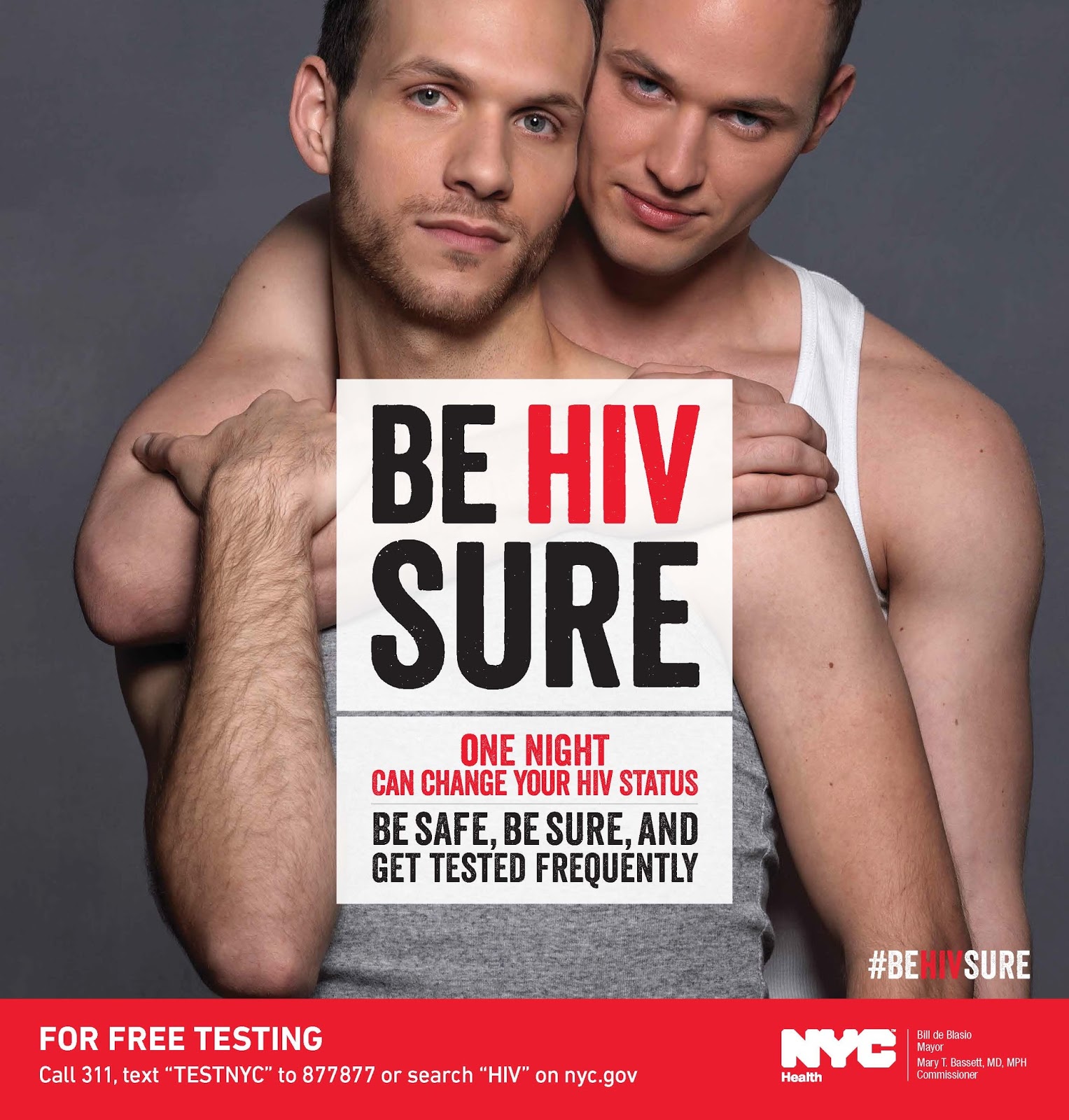
New York City HIV Prevention Campaign - #PlaySure


Via:  http://goo.gl/RU9Bmw  By:  https://twitter.com/nycHealthy

New York City HIV Prevention Advertisement


Via:  http://goo.gl/PkR5O1  By:  https://twitter.com/nycHealthy

New York City HIV Prevention Advertisement


Via:  http://goo.gl/PkR5O1  By:  https://twitter.com/nycHealthy

New York City HIV Prevention Advertisement


Via:  http://goo.gl/PkR5O1  By:  https://twitter.com/nycHealthy

New York City HIV Prevention Advertisement


Via:  http://goo.gl/PkR5O1  By:  https://twitter.com/nycHealthy

New York City HIV Prevention Advertisement


Via:  http://goo.gl/PkR5O1  By:  https://twitter.com/nycHealthy

It's Never Just HIV: Exposure to an HIV Prevention Media Campaign and Behavior Change among Men Who Have Sex with Men Participating in the National HIV Behavioral Surveillance System in New York City

PURPOSE:
The aim of this study was to assess the exposure to and impact of the It's Never Just HIV mass media campaign aimed at HIV negative men who have sex with men (MSM) in New York City.

METHODS:
Questions about the campaign were included in the local questionnaire of the Centers for Disease Control and Prevention (CDC)-sponsored National HIV Behavioral Surveillance (NHBS) study of MSM in NYC conducted in 2011. Participants of this cross-sectional study were recruited using venue-based sampling.

RESULTS:
Among 447 NYC National HIV Behavioral Surveillance study participants who self-reported HIV negative or unknown status and answered questions about the NYC Department of Health and Mental Hygiene's It's Never Just HIV campaign, more than one-third (n = 173, 38.7%) reported having seen the campaign. Latinos (34.8%) and blacks (34.4%) were less likely to report seeing the campaign compared to whites (47.7%). Most of those who reported seeing the campaign saw it on the subway (80.1%). Only 9.4% of those who saw the campaign reported having changed their sexual or health behaviors in response to the campaign.

CONCLUSIONS:
These data suggest that thousands of HIV-uninfected MSM in NYC have been reached by the campaign and recalled its message.

Purchase full article at:   http://goo.gl/8AhKhS

  • 1 Bureau of HIV/AIDS Prevention and Control , New York City Department of Health and Mental Hygiene, New York, New York.
  • 2 Gillings School of Global Public Health, University of North Carolina at Chapel Hill , Chapel Hill, North Carolina.
  • 3 Department of Epidemiology, University of Washington , Seattle, Washington.
  • 4 Department of Anthropology, John Jay College of Criminal Justice , New York, New York.
  • 5 College of Nursing, New York University , New York, New York.