Showing posts with label nursing. Show all posts

Monday, April 4, 2016

Future Healthcare Professionals’ Knowledge About the Argentinean Abortion Law

Objectives
We assessed healthcare students’ knowledge and opinions on Argentinian abortion law and identified differences between first- and final-year healthcare students.

Methods
In this cross-sectional study, self-administered anonymous questionnaires were administered to 760 first- and 695 final-year students from different fields of study (medicine, midwifery, nursing, radiology, nutrition, speech therapy, and physiotherapy) of the School of Medicine at the University of Buenos Aires, in 2011-2013.

Results
Compared to first-year students, a higher percentage of final-year students knew that abortion is legally restricted in Argentina (p < 0.001). A significantly higher percentage of final-year students could correctly identify the circumstances in which abortion is legal: woman´s life risk (87.4% last vs. 79.1% first year), rape of a woman with developmental disability (66.2% first vs. 85.4% last-year; p < 0.001). More final-year students chose severe foetal malformations (37.3% first year vs. 57.3% final year) despite its being illegal.

Conclusions
Although most final-year students knew that abortion is legally restricted in Argentina, misconceptions regarding circumstances of legal abortion were observed; this may be due to the fact that abortion is inadequately covered in the medical curricula. Medical schools should ensure that sexual and reproductive health topics are an integral part of their curricula. Healthcare providers who are aware of the legality of abortion are more likely to provide the public with sound information and ensure abortions are appropriately performed.

Below:  Healthcare students’ knowledge on current abortion law
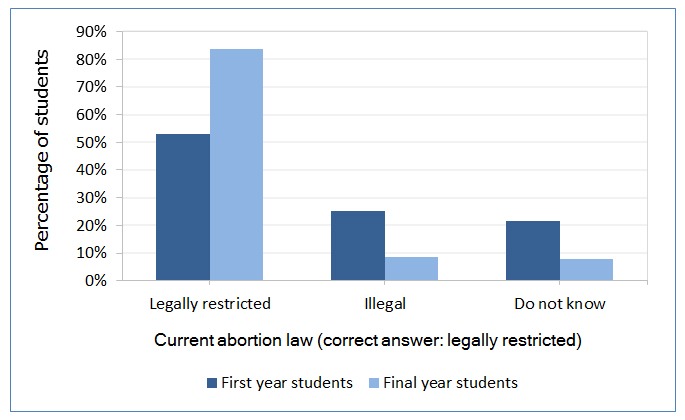


Below:  Percentage of healthcare students who chose the correct answer, by field of study


Below:  Healthcare students’ opinion on abortion legislation


Full article at:   http://goo.gl/8jzNqt

1Department of OB-GYN, Gynaecology Division, Faculty of Medicine, University of Buenos Aires, Argentina, Ciudad de Buenos Aires, Argentina
2Division of Gynaecology and Obstetrics, Institute of Clinical Medicine, University of Oslo, Norway
corresponding authorCorresponding author.
Correspondence: Belén Provenzano-Castro, Department of OB-GYN, Gynaecology Division, Faculty of Medicine, University of Buenos Aires, Argentina, Ciudad de Buenos Aires, Argentina.
Int J Med Educ. 2016; 7: 95–101.
Published online 2016 Mar 28. doi:  10.5116/ijme.56e0.74be


Thursday, January 28, 2016

Knowledge, Attitude & Practice of HIV/AIDS-Related Stigma & Discrimination Reduction among Nursing Students in Southwest Nigeria

BACKGROUND:
One of the reported obstacles to the achievement of universal access to Human Immunodeficiency Virus (HIV) prevention, treatment, care, and support programs includes stigma and discrimination from health workers, particularly nurses. Since nursing students would become future practising nurses and are most likely exposed to caring for people living with HIV/AIDS (PL WHA) during their training, it is of great importance to assess the knowledge, attitude, and practice of student nurses toward the reduction of HIV/AIDS-related stigma and discrimination.

MATERIALS AND METHODS:
A descriptive survey research design was used. A total of 150 nursing students were selected using the simple random sampling technique of fish bowl method with replacement. Data were obtained using a self-administered (33-item) validated questionnaire to assess the knowledge, attitude, and practice of student nurses with regard to HIV/AIDS-related stigma and discrimination reduction strategies. Reliability of the tool was tested using Cronbach alpha (R) yielding a reliability value of 0.72. Data collected were analyzed with descriptive statistics of frequencies and percentages.

RESULTS:
Majority (76.0%) of the respondents were females and 82.7% were married. Respondents were found to have high knowledge (94.0%) of strategies for reducing HIV/AIDS-related stigma and discrimination. Also, 64% had moderate discriminatory attitude, 74% engaged in low discriminatory practice, while 26% engaged in high discriminatory practice.

CONCLUSIONS:
Student nurses had adequate knowledge about strategies for reducing HIV/AIDS-related stigma and discrimination; negative discriminatory attitude toward PLWHA and some form of discriminatory practices exist in participants' training schools. It is, therefore, recommended that an educational package on reduction of HIV/AIDS-related stigma and discrimination be developed and implemented for the participants.

Full article at:   http://goo.gl/JXqCu8

  • 1Department of Adult Health, School of Nursing, Babcock University, Ilishan Remo, Ogun, Nigeria.
  • 2Department of Community/Maternal and Child Health Nursing, Babcock University, Ilishan Remo, Ogun, Nigeria. 
  •  2015 Nov-Dec;20(6):705-11. doi: 10.4103/1735-9066.170011.


Friday, November 13, 2015

Sexual Harassment Against Nursing Staff in Tanta University Hospitals, Egypt

Sexual harassment against nurses is a major workplace problem causing adverse psychological effects and may affect the occupational performance of the nurses. This study aimed to assess the magnitude of this problem, and its characteristics and consequences among the nursing staff in Tanta University Hospitals, Gharbeia Governorate, Egypt.

A descriptive cross-sectional study was carried out on 430 nurses at Tanta University Hospitals using a semistructured, self-administered questionnaire to collect the data concerning the exposure and characteristics of harassment situations. A representative sample of the nurses was taken randomly from the emergency, medical and surgical departments.

Overall, 70.2% of the studied nurses were ever exposed to sexual harassment at the workplace; 43.7% of the harassed nurses were working in both day and night shifts. Staring in a suggestive manner emerged as the most common form of harassment, followed by hearing sexual words and comments or jokes (70.9, 58.6 and 57.3%, respectively). The relatives of the patients were the most common perpetrators, followed by the hospital staff other than the doctors (61.9, 45.4%, respectively). During the harassment situation, astonishment and shock were the most frequent responses in 65.2% of the harassed nurses, while after its occurrence 38.4% ignored the situation. About 95% of the harassed nurses were left with psychological effects, mostly in the form of disappointment and depression (76.5 and 67.9%, respectively).

The prevalence of sexual harassment among nurses at the workplace was high with relation to certain occupational factors, and it led to marked psychological effects on the victims. Hence, protective legislations and measures should be taken by the hospital management for prevention of this problem in the future.

Purchase full article at:  http://goo.gl/J3CFlW

  • 1Public Health and Community Medicine Department bIndustrial Medicine and Occupational Health, Public Health and Community Medicine Department, Tanta Faculty of Medicine, Tanta University, Tanta, Egypt.


Friday, October 30, 2015

Nurses' Perceptions of the Vulnerabilities to STD/AIDS In Light of the Process of Adolescence

OBJECTIVE:
To understand the perception of nurses on the vulnerabilities to STD/AIDS in light of the process of adolescence.

METHOD:
Qualitative research conducted with 15 nurses in a centre for the studies of adolescent healthcare of a university hospital in Rio de Janeiro/Brazil. The adopted theoretical and methodological frameworks were the Complexity Theory and the Grounded Theory, respectively. The semi-structured interview was used to collect data from January to August 2012.

RESULTS:
This research presents the category: Nurses' perceptions of the vulnerabilities to STD/AIDS in light of the process of adolescence, and the subcategories: Risks and uncertainties of the process of adolescence: paths to STD/AIDS; Age-adolescence complex: expanding knowledge from the perception of nurses.

CONCLUSION:
Once the nurses understand the complexity of adolescence, they create strategies to reduce the vulnerability of adolescents to STD/AIDS. This signals the need to invest in education, assistance and the management of nursing care for adolescents...

Nurses perceive the vulnerabilities to STD/AIDS in the context of adolescence as a multidimensional phenomenon that involves aspects related to feelings of invulnerabilities to sex, gender iniquities, and knowledge gaps. This perception is cross sectional to the intervention context of nurses because it covers several areas of healthcare, oriented toward complementarity.

Based on the field of perception, the nurses identify, create and develop strategies to reduce the vulnerabilities of adolescents to STD/AIDS. In this sense, the complexity of the phenomenon lies in recognizing it beyond the linear cause-and-effect relationship. Consequently, nursing care for adolescents that aims to promote sexual health and strategies that reduce vulnerabilities to STD/AIDS among this population should consider, within the field of perception, the process of adolescence as plural and singular. This recommendation calls for investments in the education process of adolescent healthcare and, as a complementary factor, the provision of assistance and the management of care for this population.

A possible limitation of this study is the scenario in which it was conducted, since it represents a specific context for the promotion of adolescent healthcare. Other scenarios and realities may provide further evidence to the evidence presented in these results. The replication of this study in different scenarios and the conduction of studies that include a multi-professional health team and adolescents as the subjects of research are therefore recommended, considering that the process of adolescence and vulnerabilities to STD/AIDS are complex phenomena...

Full article at: http://goo.gl/jcU866

1Universidade Federal do Rio de Janeiro, Rio de Janeiro, Rio de Janeiro, Brasil.
2Faculdade de Enfermagem, Universidade do Estado do Rio de Janeiro, Rio de Janeiro, Rio de Janeiro, Brasil.
3Escola de Enfermagem Anna Nery, Universidade Federal do Rio de Janeiro, Rio de Janeiro, Rio de Janeiro, Brasil.