Showing posts with label Argentina. Show all posts

Monday, April 4, 2016

Future Healthcare Professionals’ Knowledge About the Argentinean Abortion Law

Objectives
We assessed healthcare students’ knowledge and opinions on Argentinian abortion law and identified differences between first- and final-year healthcare students.

Methods
In this cross-sectional study, self-administered anonymous questionnaires were administered to 760 first- and 695 final-year students from different fields of study (medicine, midwifery, nursing, radiology, nutrition, speech therapy, and physiotherapy) of the School of Medicine at the University of Buenos Aires, in 2011-2013.

Results
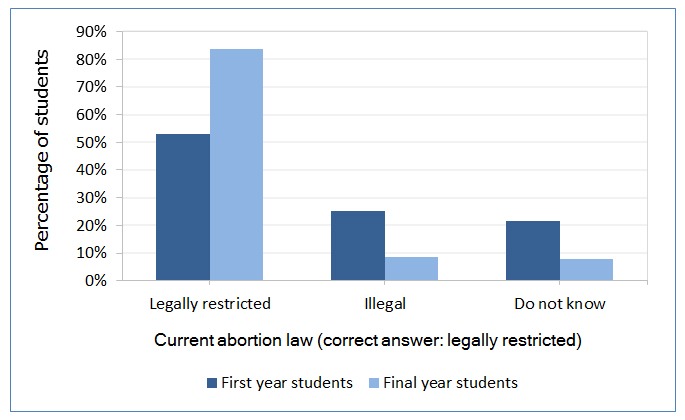
Compared to first-year students, a higher percentage of final-year students knew that abortion is legally restricted in Argentina (p < 0.001). A significantly higher percentage of final-year students could correctly identify the circumstances in which abortion is legal: woman´s life risk (87.4% last vs. 79.1% first year), rape of a woman with developmental disability (66.2% first vs. 85.4% last-year; p < 0.001). More final-year students chose severe foetal malformations (37.3% first year vs. 57.3% final year) despite its being illegal.

Conclusions
Although most final-year students knew that abortion is legally restricted in Argentina, misconceptions regarding circumstances of legal abortion were observed; this may be due to the fact that abortion is inadequately covered in the medical curricula. Medical schools should ensure that sexual and reproductive health topics are an integral part of their curricula. Healthcare providers who are aware of the legality of abortion are more likely to provide the public with sound information and ensure abortions are appropriately performed.

Below:  Healthcare students’ knowledge on current abortion law


Below:  Percentage of healthcare students who chose the correct answer, by field of study


Below:  Healthcare students’ opinion on abortion legislation


Full article at:   http://goo.gl/8jzNqt

1Department of OB-GYN, Gynaecology Division, Faculty of Medicine, University of Buenos Aires, Argentina, Ciudad de Buenos Aires, Argentina
2Division of Gynaecology and Obstetrics, Institute of Clinical Medicine, University of Oslo, Norway
corresponding authorCorresponding author.
Correspondence: Belén Provenzano-Castro, Department of OB-GYN, Gynaecology Division, Faculty of Medicine, University of Buenos Aires, Argentina, Ciudad de Buenos Aires, Argentina.
Int J Med Educ. 2016; 7: 95–101.
Published online 2016 Mar 28. doi:  10.5116/ijme.56e0.74be


Sunday, December 6, 2015

Healthcare Students' Knowledge and Opinions About the Argentinean Abortion Law

Highlights
  • In Argentina, around 400,000 abortions are performed every year, resulting in one third of the maternal deaths.
  • High quality sexual and reproductive healthcare services are a key strategy to improve adolescents' and women's health.
  • We surveyed first year healthcare students in Argentina to determine their knowledge and opinions of Argentina's abortion law.
  • Half were unaware of the current regulations and did not recognize allowable circumstances, which could affect their practice.
  • It is crucial that medical schools include sexual and reproductive health issues in their curricula.
  • Including these issues in the curricula will ensure better quality healthcare services in the future.
Objective
Abortion is legally restricted in Argentina. Although this law is almost 100 years old, most women who meet the criteria for legal abortion are not informed of or offered this possibility within the healthcare system. Healthcare students' knowledge and opinions on abortion may influence their future practice. They may deny a woman with an unwanted pregnancy a practice to which she is legally entitled, resulting in an unsafe abortion. This study assessed knowledge and personal opinions on the abortion law among first year healthcare students in order to design adequate educational strategies.

Study design
In this descriptive, analytical, cross-sectional study, structured self-administered questionnaires were administered to 781 first year medical, nursing, midwifery, and other healthcare students from the Faculty of Medicine, University of Buenos Aires from 2011 to 2013. Data were recorded anonymously in SPSS 20. Student samples were adjusted for gender and fields of study using the University statistics.

Results
Of the students, 48.8% did not know the current regulations. Most of the students thought abortion was legally restricted and failed to recognize the circumstances in which it is allowed. Over 75% of the students were pro-abortion, especially those with sexual experience.

Conclusion
Students lack sound knowledge on the abortion law that may affect their personal lives and influence their future professional practice. It is crucial that medical schools include sexual and reproductive health issues in their curricula in order to ensure better quality healthcare services in the future.

Implications
In Argentina, approximately 400,000 abortions are performed every year, many under unsafe conditions, resulting in one third of the maternal deaths for the past decade. High quality sexual and reproductive healthcare services are a key strategy to improve adolescents' and women's health, thereby lowering maternal mortality.

Purchase full article at:  http://goo.gl/w1LYcq

Affiliations

  • Department of OB-GYN, Gynaecology Division, Faculty of Medicine, University of Buenos Aires, 2351 Córdoba Av., C1120AAR Ciudad de Buenos Aires, Argentina
  • Institute of Clinical Medicine, Faculty of Medicine, University of Oslo, Sognsvannsveien 20, 0372 Oslo, Norway

Correspondence

  • Corresponding author. 2454 Beruti St., C1117AAD Ciudad de Buenos Aires, Argentina. Tel.: +54 911 5840 8101.


Wednesday, November 4, 2015

Cholesterol Levels in HIV- and/or HCV-Infected Drug Users Living in Argentina

Improved understanding of cholesterol levels in HIV- and hepatitis C virus (HCV)-infected persons in Argentina will guide optimal antiretroviral therapy. The authors conducted a cross-sectional study in Argentina to describe associations between HIV, HCV, and cholesterol. 

Of the 202 participants, 21 were HIV infected, 15 were HCV infected, 46 were HIV/HCV coinfected, and 120 were HIV/HCV uninfected. HIV/HCV-uninfected participants had the highest total cholesterol (TC) and low-density lipoprotein (LDL) levels. 

Multivariate modeling revealed that HIV/HCV-coinfected patients had the lowest TC levels (-28.7 mg/dL, P < .001) compared to the HIV/HCV-uninfected reference group. Hepatitis C virus and HIV/HCV coinfection were associated with lower LDL levels (-21.4 mg/dL, P = .001 and -20.3 mg/dL, P < .0001, respectively). HIV and HIV/HCV coinfection, but not HCV alone, were associated with lower high-density lipoprotein levels (-9.1 mg/dL, P = .0008 and -6.8 mg/dL, P = .0006, respectively). 

Further study is needed to examine whether the more favorable lipid profile observed in HIV/HCV-coinfected persons is associated with a reduction in cardiovascular risk.

Purchase full article at: http://goo.gl/PjqTCq

  • 1Division of Geographic Medicine and Infectious Diseases, Tufts Medical Center, Boston, MA, USA rkohli@tuftsmedicalcenter.org.
  • 2Division of Gastroenterology, Tufts Medical Center, Boston, MA, USA.
  • 3Department of Public Health and Community Medicine, Tufts University School of Medicine, Boston, MA, USA.
  • 4Centro Nacional de Reeducación Social, Buenos Aires, Argentina.
  • 5Fundación de Ayuda al Inmunodeficiente, Buenos Aires, Argentina.
  • 6Academia Nacional de Medicina, Buenos Aires, Argentina.
  • 7Division of Geographic Medicine and Infectious Diseases, Tufts Medical Center, Boston, MA, USA Department of Public Health and Community Medicine, Tufts University School of Medicine, Boston, MA, USA.
  • 8Division of Gastroenterology, Tufts Medical Center, Boston, MA, USA Department of Public Health and Community Medicine, Tufts University School of Medicine, Boston, MA, USA.  

Thursday, October 29, 2015

Factors Associated with Healthcare Avoidance among Transgender Women in Argentina

Transgender (TG) women in many settings continue to contend with barriers to healthcare, including experiences of stigma and discrimination. Argentina has a universal health care system and laws designed to promote healthcare access among TG women. However, little is known about barriers to healthcare access among TG women in this setting. The aim of this study was to explore individual, social-structural and environmental factors associated with healthcare avoidance among TG women in Argentina.

Data were derived from a 2013 nation-wide, cross-sectional study involving TG women in Argentina. We assessed the prevalence and factors associated with avoiding healthcare using multivariable logistic regression.

Among 452 TG women included in the study, 184 (40.7%) reported that they avoided seeking healthcare because of their transgender identity. In multivariable analysis, factors positively associated with avoiding seeking healthcare were: having been exposed to police violence, internalized stigma, having experienced discrimination by healthcare workers or patients, and currently living in the Buenos Aires metropolitan area. In contrast, TG women with extended health insurance were less likely to report avoiding healthcare.

A high proportion of TG women in our sample reported avoiding healthcare. Avoiding healthcare was associated with stigma and discrimination in healthcare settings, as well as police violence experiences. Although further research is warranted, these finding suggests that socio-structural interventions tailored TG women needs are needed to improve access to healthcare among this population.

Table 1

Baseline characteristics of transgender women included in the study, by whether they reported avoiding healthcare (N = 452)
CharacteristicTotal (%)Healthcare avoidancep - value
( n  = 452)*Yes ( % )No (%)
( n  = 184)*( n  = 268)*
Individual level factors
   Age (median, IQR)30 (25 – 37)30 (25 – 27)31 (24 – 37)0.861
   Foreign born45 (10.0)17 (9.2)28 (10.5)0.673
   High school education or greater152 (33.8)54 (29.5)98 (36.7)0.113
   Extended health insurance81 (18.5)25 (13.8)56 (21.7)0.036
   Currently employed (other than sex work)108 (23.9)35 (19.0)73 (27.2)0.044
   History of sex work involvement378 (84.6)163 (89.1)215 (81.4)0.028
   Self-reported HIV infection104 (27.4)41 (26.8)63 (27.8)0.838
   Any internalized stigma245 (54.2)118 (64.1)127 (47.4)<0.001
Social-structural factors
   Police-related experiences
   Experienced police violence ever243 (53.8)128 (69.6)115 (42.9)<0.001
   Ever arrested354 (79.0)157 (85.8)197 (74.3)0.003
   Experiences of perceived discrimination in healthcare settings
   By healthcare workers ever302 (66.8)155 (84.2)147 (54.9)<0.001
   By other patients ever143 (32.1)84 (46.4)59 (22.4)<0.001
Environmental factors
   Current residency in Buenos Aires140 (31.0)69 (37.5)71 (26.5)0.013
   Stable housing355 (78.6)143 (77.7)212 (79.1)0.724
*Totals may differ due to non-response on some questions.
IQR: interquartile range.

Full article at: http://goo.gl/LqUbyL

Fundación Huésped, Angel Peluffo 3932, Buenos Aires, C1202ABB Argentina
Department of Epidemiology, Brown University School of Public Health, 121 South Main Street, Box G-S-121-2, Providence, RI 02912 USA
Center for Psychology Research, School of Social Sciences, University of Palermo, Mario Bravo 1259, Buenos Aires, C1175ABW Argentina
Association of Transvestites, Transsexuals, and Transgenders of Argentina (A.T.T.T.A.), Callao 339 6th floor, Buenos Aires, C1022AAD Argentina
British Columbia Centre for Excellence in HIV/AIDS, St. Paul’s Hospital, 608-1081 Burrard Street, Vancouver, BC V6Z 1Y6 Canada
Department of Medicine, University of British Columbia, St. Paul’s Hospital, 608-1081 Burrard Street, Vancouver, BC V6Z 1Y6 Canada
María Eugenia Socías, Email: ra.gro.depseuh@saicos.ainegue.


Tuesday, October 6, 2015

Monitoring of HIV treatment in Seven Countries in the WHO Region of the Americas

To determine the prevalence of adequate monitoring and the costs of measuring CD4+ T-lymphocytes (CD4+ cell) and human immunodeficiency virus (HIV) viral load in people receiving antiretroviral therapy (ART) in seven countries in the WHO Region of the Americas. Methods We obtained retrospective, longitudinal data for 14 476 adults who started a first ART regimen at seven HIV clinics in Argentina, Brazil, Chile, Haiti, Honduras, Mexico and Peru between 2000 and 2011. We estimated the proportion of 180-day periods with adequate monitoring, which we defined as at least one CD4+ cell count and one viral load measurement. Factors associated with adequate monitoring were analysed using regression methods. The costs of the tests were estimated.

The median follow-up time was 50.4 months; the proportion of 180-day periods with adequate CD4+ cell counts was 69% while the proportion with adequate monitoring was 62%. Adequate monitoring was more likely in participants who were older, who started ART more recently, whose first regimen included a non-nucleoside reverse transcriptase inhibitor or who had a CD4+ cell count less than 200 cells/µl at ART initiation. The cost of one CD4+ cell count ranged from 7.37 United States dollars (US$) in Argentina to US$ 64.09 in Chile; the cost of one viral load measurement ranged from US$ 20.34 in Brazil to US$ 186.28 in Haiti.

In HIV-infected participants receiving ART in the WHO Region of the Americas, CD4+ cell count and viral load monitoring was often carried out less frequently than regional guidelines recommend. The laboratory costs of monitoring varied greatly.

Table 1 Antiretroviral treatment programmes in seven countries in the WHO Region of the Americas, 2000-2011 
CharacteristicSite of adult HIV clinica
ArgentinaBrazilChileHaitiHondurasMexicoPeru
No. of participants in study12852446108056967897722408
Start of universal access to ART, year20001991b20032003200320022004
Type of clinicPrivatePublicPublicNGOPublicPublicPublic
Guidelines used for monitoring ART efficacySADI, MOHMOHMOHMOH, PAHOMOHMOHMOH
Recommended periodicity of CD4+ cell count monitoring3-4 months3-6 months3-4 monthsc6 months6 months4-6 months6 months
Cost of one CD4+ cell count, US$d7.3717.6264.0932.614.31 33.3959.6738.12e
Source of funding for CD4+ cell count monitoringRefund from Argentine government, social insuranceBrazilian governmentChilean governmentPEPFAR, GFATMHonduran government, social insuranceMexican governmentPeruvian government
Cost of one HIV viral load measurement, US$d55.2620.34119.14186.28f33.39g160.19h119.2786.32
Source of funding for HIV viral load monitoringRefund from Argentine government, social insuranceBrazilian governmentChilean governmentResearchfundedHonduran government, social insuranceMexican governmentPeruvian government


Table 2 Characteristics of participants receiving ART in seven countries in the WHO Region of the Americas, 2000-2011 
Participants' characteristicSite of adult HIV clinica
ArgentinaBrazilChileHaitiHonduras MexicoPeruTotal (n = 14 476)
(n= 2446) (n=1080) (n=5696)(n = 789) (n = 772)(n = 2408)
Age in years, median (IQR)(33-46)38 38 39(32-45)(32-46)36 34 (30-43) (29-42)(29-43)3537
(31-45)
Male sex, no. (%)925 (72)1611 (66)952 (88)2480 (44) 422 (53) 673 (87)1691 (70)8754 (60)
Probable cause of infection, no. (%) Heterosexual sex340 (26)1136 (46)285 (26)0 (0) 471 (60) 219 (28)1562 (65)4013 (28)
Homosexual sex181 (14)833 (34)785 (73)0 (0) 49 (6) 514 (67)831 (35)3193 (22)
Other55 (4)81 (3)9 (1)0 (0) 3 (0) 17 (2)13 (1)178 (1)
Unknown709 (55)396 (16)1 (0)5696 (100) 266 (34) 22 (3)2 (0)7092 (49)
CD4+ cell count at ART initiation, no. (%) Data missing306 (24)426 (17)302 (28)772 (14) 151 (19) 132 (17)326 (14)2415 (17)
200-350 cells/µL < 200 cells/µL306 (24)771 (32)373 (35)3035 (53) 447 (57) 355 (45)1222 (51)6509 (45)
200-350 cells/µL349 (27)650 (27)234 (22)1537 (27) 146 (19) 184 (24)526 (22)3626 (25)
350 cells/µL324 (25)599 (24)171 (16)352 (6) 45 (6) 101 (13)334 (14)1926 (13)
Prior AIDS-defining eventb at ART initiation, no. (%)54 (4)172 (7)292 (27)1223 (21) 252 (32) 332 (43)848 (35)3173 (22)
Prior AIDS-defining event or CD4+ cell count < 200 cells/µL at ART initiation335 (26)871 (36)541 (50)3423 (60) 536 (68) 486 (63)1515 (63)7707 (53)
NNRTI-based ART regimen, no. (%)869 (68)1270 (52)858 (79)5279 (93) 745 (94) 607 (79)2024 (84)11 652 (80)

Full article at: http://goo.gl/QBS4Ey

By: 
Pablo F Belaunzarán-Zamudioa, Yanink N Caro-Vegaa, Bryan E Shepherdb, Brenda E Crabtree-Ramíreza, Paula M Luzc, Beatriz Grinsztejnc, Carina Cesard, Pedro Cahnd, Claudia Cortése, Marcelo Wolffe, Jean W Papef, Denis Padgettg, Eduardo Gotuzzoh, Catherine McGowani, Juan G Sierra-Maderoa
a Clínica de Inmuno-Infectología, Departamento de Infectología, Instituto Nacional de Ciencias Médicas y Nutrición Salvador Zubirán, Calle Vasco de Quiroga 15, Colonia Belisario Domínguez Sección XVI, Delegación Tlalpan, México Distrito Federal, CP 14080, Mexico.
b Department of Biostatistics, Vanderbilt University, Nashville, United States of America (USA).
c Instituto de Pesquisa Clínica Evandro Chagas, Fundacão Oswaldo Cruz, Rio de Janeiro, Brazil.
d Fundación Huésped, Buenos Aires, Argentina.
e Fundación Arriarán, Universidad de Chile, Santiago, Chile.
f Le Groupe Haitien d'Etude du Sarcome de Kaposi et des Infections Opportunistes, Port-au-Prince, Haiti.
g Instituto Hondureño de Seguridad Social and Hospital Escuela, Tegucigalpa, Honduras.
h Instituto de Medicina Tropical Alexander von Humboldt, Lima, Peru.
iDepartment of Medicine, Vanderbilt University, Nashville, USA.