Showing posts with label Virological Failure. Show all posts

Saturday, February 20, 2016

HIV Drug Resistance Mutations (DRMs) Detected by Deep Sequencing in Virologic Failure Subjects on Therapy from Hunan Province, China

Objective
Determine HIV drug resistance mutations (DRMs) prevalence at low and high levels in ART-experienced patients experiencing virologic failure (VF).

Methods
29 subjects from 18 counties in Hunan Province that experienced VF were evaluated for the prevalence of DRMs (Stanford DRMs with an algorithm value ≥15, include low-, intermediate and high-level resistance) by both Sanger sequencing (SS) and deep sequencing (DS) to 1% frequency levels.

Results
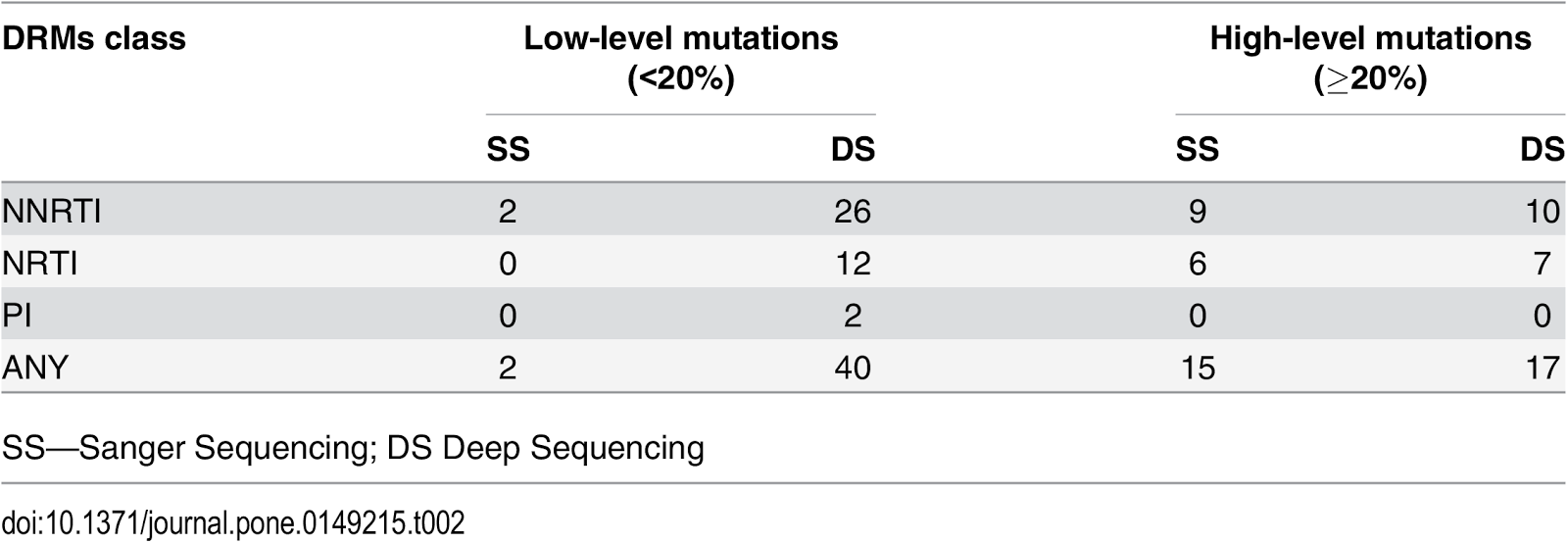
DS was performed on samples from 29 ART-experienced subjects; the median viral load 4.95×10⁴ c/ml; 82.76% subtype CRF01_AE. 58 DRMs were detected by DS. 18 DRMs were detected by SS. Of the 58 mutations detected by DS, 40 were at levels <20% frequency (26 NNRTI, 12 NRTI and 2 PI) and the majority of these 95.00% (38/40) were not detected by standard genotyping. Of these 40 low-level DRMs, 16 (40%) were detected at frequency levels of 1–4% and 24 (60%) at levels of 5–19%. SS detected 15 of 17 (88.24%) DRMs at levels ≥ 20% that were detected by DS. The only variable associated with the detection of DRMs by DS was ART adherence (missed doses in the prior 7 days); all patients that reported missing a dose in the last 7 days had DRMs detected by DS.

Conclusions
DS of VF samples from treatment experienced subjects infected with primarily AE subtype frequently identified Stanford HIVdb NRTI and NNRTI resistance mutations with an algorithm value 15. Low frequency level resistant variants detected by DS were frequently missed by standard genotyping in VF specimens from antiretroviral-experienced subjects.

Below:  Prevalence of ≥1% DRMs by Stanford HDRM (algorithm value ≥15)


Full article at:   http://goo.gl/ZY39t9

By:  
Xi Chen, Xiaobai Zou, Jianmei He, Jun Zheng
Hunan Provincial Center for Disease Control and Prevention, Changsha, China

Jennifer Chiarella, Michael J. Kozal
Yale School of Medicine, New Haven, United States of America


Sunday, February 7, 2016

Clinical Evaluation of an Affordable Qualitative Viral Failure Assay for HIV Using Dried Blood Spots in Uganda

BACKGROUND:
WHO recommends regular viral load (VL) monitoring of patients on antiretroviral therapy (ART) for timely detection of virological failure, prevention of acquired HIV drug resistance (HIVDR) and avoiding unnecessary switching to second-line ART. However, the cost and complexity of routine VL testing remains prohibitive in most resource limited settings (RLS). We evaluated a simple, low-cost, qualitative viral-failure assay (VFA) on dried blood spots (DBS) in three clinical settings in Uganda.

METHODS:
We conducted a cross-sectional diagnostic accuracy study in three HIV/AIDS treatment centres at the Joint Clinical Research Centre in Uganda. The VFA employs semi-quantitative detection of HIV-1 RNA amplified from the LTR gene. We used paired dry blood spot (DBS) and plasma with the COBASAmpliPrep/COBASTaqMan, Roche version 2 (VLref) as the reference assay. We used the VFA at two thresholds of viral load, (>5,000 or >1,000 copies/ml).

RESULTS:
496 paired VFA and VLref results were available for comparative analysis. Overall, VFA demonstrated 78.4% sensitivity, (95% CI: 69.7%-87.1%), 93% specificity (95% CI: 89.7%-96.4%), 89.3% accuracy (95% CI: 85%-92%) and an agreement kappa = 0.72 as compared to the VLref. The predictive values of positivity and negativity among patients on ART for >12 months were 72.7% and 99.3%, respectively.

CONCLUSIONS:
VFA allowed 89% of correct classification of VF. Only 11% of the patients were misclassified with the potential of unnecessary or late switch to second-line ART. Our findings present an opportunity to roll out simple and affordable VL monitoring for HIV-1 treatment in RLS.

Below:  Receiver Operating Characteristics Curve for VFA compared to Cobas-Ampliprep


Below:  Receiver Operating Characteristics Curve for VFA comparing ART–naïve and treated PLWHAs (VL threshold ≥ 5,000 cp/mL)


Full article at:   http://goo.gl/67wjmT

  • 1Joint Clinical Research Center, P.O. Box 10005, Kampala, Uganda.
  • 2Amsterdam Institute for Global Health and Development, Department of Global Health, Academic medical Center, Trinity C Building, Pietersbergweg 17, 1105 BM, Amsterdam, the Netherlands.
  • 3PharmAccess International, Amsterdam, Trinity Building C Pietersbergweg 17, 1105 BM, Amsterdam, the Netherlands.
  • 4Wits Health Consortium, University of the Witwatersrand, 1 Jan Smuts Avenue, Braamfontein 2000, Johannesburg, South Africa.
  • 5University Medical Centre Utrecht, P.O. Box 80125, 3508 TC, Utrecht, the Netherlands. 
  •  2016 Jan 29;11(1):e0145110. doi: 10.1371/journal.pone.0145110. eCollection 2016.


Wednesday, December 30, 2015

Durability & Effectiveness of Maraviroc-Containing Regimens in HIV-1-Infected Individuals with Virological Failure in Routine Clinical Practice

Introduction
Limited data are available on the durability and effectiveness of maraviroc in routine clinical practice. We assessed the durability of maraviroc-containing regimens during a 30-month period, as well as their immunovirological and clinical efficacy, according to viral tropism in treatment-experienced individuals with viral load (VL) >50 copies/ml in the French Hospital Database on HIV.

Methods
Virological success was defined as VL<50 copies/ml, immunological success as a confirmed increase of at least 100 CD4 cells/mm3 measured twice at least one month apart, and clinical failure as hospitalization for a non-AIDS event, an AIDS event, or death. Multivariable Cox regression models adjusted for potential confounders were used to assess the influence of viral tropism on durability, the immunovirological responses, and clinical outcome.

Results
356 individuals started maraviroc with VL>50 copies/ml of whom 223 harbored R5 viruses, 44 non-R5 viruses and 89 viruses of unknown tropism. Individuals with non-R5 viruses were more likely than individuals with R5 viruses to discontinue maraviroc (75% vs 34%, p<0.0001). At 30 months, the estimated rates of virological and immunological success were respectively 89% and 51% in individuals with R5 viruses and 48% and 23% in individuals with non-R5 viruses. In multivariable analysis, non-R5 viruses were associated with a lower likelihood of both virological success (hazard ratio (HR): 0.42; 95% confidence interval (CI), 0.25–0.70) and immunological success (HR: 0.37; 95% CI, 0.18–0.77). No difference in clinical outcome was found between individuals with R5 and non-R5 viruses. The effectiveness of maraviroc-containing regimens in individuals with unknown viral tropism was not significantly different from that in individuals with R5 viruses. A limitation of the study is the absence of genotypic susceptibility score.

Conclusion
In this observational study, maraviroc-containing regimens yielded high rates of viral suppression and immunological responses in individuals with R5 viruses in whom prior regimens had failed.

Below:  Discontinuations


Full article at:   http://goo.gl/CzAKjI

By:   
Valérie Potard, Dominique Costagliola
Sorbonne Universités, UPMC Univ Paris 06, UMR_S 1136, Paris, France

Valérie Potard, Dominique Costagliola
INSERM, UMR_S 1136, Institut Pierre Louis d'Epidémiologie et de Santé Publique, Paris, France

Valérie Potard
Inserm Transfert, Paris, France

Jacques Reynes
Université Montpellier, Montpellier, France

Jacques Reynes
IRD, UMI233 TransVIHMI Montpellier, France

Jacques Reynes
Département de Maladies Infectieuses et Tropicales, CHU Montpellier, France

Tristan Ferry
Services de Maladies Infectieuses et Tropicales, Hospices Civils de Lyon; Université Claude Bernard Lyon1; CIRI, International Center for Infectiology Research, INSERM U1111, Lyon, France

Céline Aubin
Laboratoire GSK, Marly-Le-Roi, France

Laurent Finkielsztejn
Laboratoire ViiVHealthcare, Marly-Le-Roi, France

Yazdan Yazdanpanah
Université Paris Diderot 7, Paris, France

Yazdan Yazdanpanah
INSERM, UMR_S 1137, ATIP-Avenir Inserm: "Modélisation, Aide à la Décision, et Coût-Efficacité en Maladies Infectieuses”, Paris, France

Yazdan Yazdanpanah
Service des Maladies Infectieuses et Tropicales, Hôpital Bichat, France


Friday, November 13, 2015

Factors Associated with Low-Level Viraemia and Virological Failure: Results from the Austrian HIV Cohort Study

In human immunodeficiency virus treatment adequate virological suppression is warranted, nevertheless for some patients it remains a challenge. We investigated factors associated with low-level viraemia (LLV) and virological failure (VF) under combined antiretroviral therapy (cART).

We analysed patients receiving standard regimens between 1st July 2012 and 1st July 2013 with at least one viral load (VL) measurement below the quantification limit (BLQ) in their treatment history. After a minimum of 6 months of unmodified cART, the next single VL measurement within 6 months was analysed. VF was defined as HIV RNA levels ≥200 copies/mL and all other quantifiable measurements were classified as LLV. Factors associated with LLV and VF compared to BLQ were identified by logistic regression models.

Of 2276 participants, 1972 (86.6%) were BLQ, 222 (9.8%) showed LLV and 82 (3.6%) had VF. A higher risk for LLV and VF was shown in patients with cART interruptions and in patients with boosted PI therapy. The risk for LLV and VF was lower in patients from centres using the Abbott compared to the Roche assay to measure VL. A higher risk for LLV but not for VF was found in patients with a higher VL before cART [for >99.999 copies/mL: aOR (95% CI): 4.19 (2.07–8.49); for 10.000–99.999 copies/mL: aOR (95% CI): 2.52 (1.23–5.19)] and shorter cART duration [for <9 months: aOR (95% CI): 2.59 (1.38–4.86)]. A higher risk for VF but not for LLV was found in younger patients [for <30 years: aOR (95% CI): 2.76 (1.03–7.35); for 30–50 years: aOR (95% CI): 2.70 (1.26–5.79)], people originating from high prevalence countries [aOR (95% CI): 2.20 (1.09–4.42)] and in male injecting drug users [aOR (95% CI): 2.72 (1.38–5.34)].

For both VF and LLV, factors associated with adherence play a prominent role. Furthermore, performance characteristics of the diagnostic assay used for VL quantification should also be taken into consideration.

Full article at:  http://goo.gl/sIOuWp

By: 
Gisela Leierer, Mario Sarcletti, Michaela Rappold, Robert Zangerle
Department of Dermatology and Venereology, Medical University of Innsbruck, Innsbruck, Austria

Gisela Leierer, Michaela Rappold
Austrian HIV Cohort Study, Innsbruck, Austria

Katharina Grabmeier-Pfistershammer
Department of Dermatology, Medical University of Vienna, Vienna, Austria

Andrea Steuer
Otto-Wagner Hospital, Department of Pulmonology, Vienna, Austria

Maria Geit
Department of Dermatology, General Hospital Linz, Linz, Austria

Bernhard Haas
Department of Internal Medicine, General Hospital Graz-West, Graz, Austria

Manfred Kanatschnig
1st Medical Department, General Hospital Klagenfurt, Klagenfurt, Austria

Bruno Ledergerber
Division of Infectious Diseases and Hospital Epidemiology, University Hospital Zurich, University of Zurich, Zurich, Switzerland

Ninon Taylor
Department of Internal Medicine III with Hematology, Medical Oncology, Hemostaseology, Infectious Diseases, Rheumatology, Oncologic Center, Laboratory of Immunological and Molecular Cancer Research, Paracelsus Medical University, Salzburg, Austria