Showing posts with label Men Who Have Sex with Men. Show all posts

Tuesday, June 21, 2016

Exchange Sex and HIV Infection among Men Who Have Sex with Men: 20 US Cities, 2011

This study assessed the prevalence of exchanging sex for money or drugs among men who have sex with men (MSM) in the 2011 US National HIV Behavioral Surveillance system. Prevalence of HIV, being HIV-positive but unaware (HIV-positive-unaware), risk behaviors and use of services were compared between MSM who did and did not receive money or drugs from one or more casual male partners in exchange for oral or anal sex in the past 12 months. 

Among 8411 MSM, 7.0 % exchanged sex. MSM who exchanged sex were more likely to be non-Hispanic black, live in poverty, have injected drugs, have multiple condomless anal sex partners, be HIV-positive and be HIV-positive-unaware. 

In multivariable analysis, exchange sex was associated with being HIV-positive-unaware (aPR 1.34, 95 % CI 1.05-1.69) after adjusting for race/ethnicity, age, education, poverty, and injecting drugs. 

MSM who exchange sex represent an important group to reach with HIV prevention, testing, and care services as they were more likely to report behavioral risk factors that put them at risk of HIV.

Purchase full article at:  http://goo.gl/ptrrEk

1Division of HIV/AIDS Prevention, Centers for Disease Control and Prevention, 1600 Clifton Road, MS-E46, Atlanta, GA, 30329, USA. vif7@cdc.gov.
2Department of Public Health Sciences, Karolinska Institutet, Stockholm, Sweden. vif7@cdc.gov.
3Division of HIV/AIDS Prevention, Centers for Disease Control and Prevention, 1600 Clifton Road, MS-E46, Atlanta, GA, 30329, USA.
4Department of Public Health Sciences, Karolinska Institutet, Stockholm, Sweden.
AIDS Behav. 2016 Jun 15. [Epub ahead of print]


Sunday, June 12, 2016

Is Involvement in Sex Work Associated with Engagement in HIV-Related Medical Care in Latin American Men Who Have Sex with Men? Results of a Large, Multinational Internet Survey

Men who have sex with men (MSM) who engage in transactional sex are at increased HIV risk, and face complex barriers to care seeking. Among 2,035 men recruited through an MSM social/sexual networking website in Latin America and who reported being HIV-infected, 186 (9.1%) reported being paid for sex with another man in the past year. Engagement in transactional sex was associated with decreased odds of receiving medical care for HIV (AOR=0.57, 95% CI=0.37–0.85). No significant differences were seen in being on antiretroviral therapy (ART) or ART adherence once in care. Interventions in this population should focus on reducing barriers to engagement in care.

...Results of this analysis suggest that there are disparities in receipt of HIV medical care associated with recent engagement in transactional sex among HIV-infected MSM in Latin America. The ability to access HIV-related medical care is related not only to availability of care facilities, but also barriers and facilitators to engagement and retention in care, and these factors may be compounded for MSM who engage in transactional sex. For example, stigma and discrimination may limit care seeking to a greater extent among men who engage in transactional sex, given multiple sources of stigma. Previous research suggests that MSM may face sexual stigma from multiple dimensions. Stigma from healthcare providers may limit disclosure of sexual orientation or sexual behaviors among MSM, if they anticipate discrimination following disclosure.Among people living with HIV, HIV and healthcare stigma has been associated with decreased care-seeking behavior., MSM who engage in transactional sex may experience additional stigma due to being involved in sex work, which is illegal and/or socially unacceptable across most of Latin America, and which has been described as a barrier to care seeking among female sex workers., Although experienced and/or perceived stigma could act as a mechanism through which MSM who engage in transactional sex in Latin America have decreased engagement in HIV care, we were unable to quantify experiences of stigma in this study. Future work should consider the role of experienced and/or perceived stigma specifically as a barrier to engaging in care in this population.

...Interestingly, although participants who engaged in transactional sex were less likely to be engaged in HIV-related medical care, prior research by this team and by others in other regions indicates that MSM who engage in transactional sex are more likely to have a history of HIV testing and of HIV diagnosis., This may indicate that men who engage in transactional sex are aware of their increased risk and thus are more likely to test for HIV, but that there are structural, interpersonal, and individual factors—including differential power dynamics due to social or economic position, physical or sexual violence, substance use, and/or psychological distress—which are major barriers to linkage and continued engagement in care if diagnosed...
  
Full article at:  http://goo.gl/5RWUOC

By: Katie B. Biello, PhD, MPH, 1,,2 Catherine E. Oldenburg, MPH,1 Joshua Rosenberger, PhD,3 Kenneth H. Mayer, MD,2,,4,,5 David Novak, MSW,6 and Matthew J. Mimiaga, ScD, MPH1,,2,,7,,8
1Department of Epidemiology, Harvard School of Public Health, Boston, Massachusetts.
2The Fenway Institute, Fenway Health, Boston, Massachusetts.
3Department of Global and Community Health, George Mason University, Fairfax, Virginia.
4Division of Infectious Diseases, Beth Israel Deaconess Medical Center, Boston, Massachusetts.
5Department of Global Health and Population, Harvard School of Public Health, Boston, Massachusetts.
6OLB Research Institute, Online Buddies, Inc., Cambridge, Massachusetts.
7Department of Psychiatry, Harvard Medical School, Boston, Massachusetts.
8Department of Psychiatry, Massachusetts General Hospital, Boston, Massachusetts.
1Department of Epidemiology, Harvard School of Public Health, Boston, Massachusetts.
2The Fenway Institute, Fenway Health, Boston, Massachusetts.
3Department of Global and Community Health, George Mason University, Fairfax, Virginia.
4Division of Infectious Diseases, Beth Israel Deaconess Medical Center, Boston, Massachusetts.
5Department of Global Health and Population, Harvard School of Public Health, Boston, Massachusetts.
6OLB Research Institute, Online Buddies, Inc., Cambridge, Massachusetts.
7Department of Psychiatry, Harvard Medical School, Boston, Massachusetts.
8Department of Psychiatry, Massachusetts General Hospital, Boston, Massachusetts.
LGBT Health. 2016 Jun 1; 3(3): 233–237. doi:  10.1089/lgbt.2015.0006


Tuesday, May 17, 2016

"We Might Get Some Free Beers": Experience and Motivation for Transactional Sex among Behaviorally Bisexual Men in Vientiane, Laos

People engaging in transactional sex are considered a key population for HIV prevention. Prior quantitative surveys demonstrated that behaviorally bisexual men in Vientiane, Laos commonly transact sex. 

In 2013, we conducted a qualitative study to explore behaviorally bisexual men's experience, motivations, and perceptions related to transactional sex in Vientiane. Behaviorally bisexual men were recruited from bars, nightclubs, and dormitories for five focus group discussions (FGDs) and 11 in-depth interviews (n = 31). Additionally, young women were recruited from a university, garment factory, and nightclub for four FGDs (n = 22). Transcripts were translated and thematically coded. 

Bisexual male participants most commonly described being paid for sex by male-to-female transgender people and buying sex from women. Both male and female participants reported that older, single women pay younger men for sex. Negotiation and direction of sexual transactions are influenced by age, attraction, and wealth. Common motivations for selling sex included the need for money to support family or fund school fees, material gain, or physical pleasure. Transactional sex was often opportunistic. Some behaviorally bisexual men reported selling sex in order to pay another more desirable sex partner or to buy gifts for their regular sex partner. Participants perceived high risk associated with intercourse with female sex workers but not with other transactional sex partners. 

Health interventions are needed to improve knowledge, risk perception, and health behaviors, but must recognize the diversity of transactional sex in Vientiane. Both physical and virtual settings may be appropriate for reaching behaviorally bisexual men and their partners.

Purchase full article at:   http://goo.gl/l44wEW

  • 1Centre for Population Health, Burnet Institute, 85 Commercial Rd., Melbourne, VIC, 3004, Australia. annab@burnet.edu.au.
  • 2Department of Epidemiology and Preventive Medicine, Monash University, Melbourne, Australia. annab@burnet.edu.au.
  • 3Burnet Institute, Vientiane, Lao PDR.
  • 4Centre for International Health, Burnet Institute, Melbourne, Australia.
  • 5Centre for Population Health, Burnet Institute, 85 Commercial Rd., Melbourne, VIC, 3004, Australia.
  • 6Department of Epidemiology and Preventive Medicine, Monash University, Melbourne, Australia.
  • 7Faculty of Health Sciences, National Drug Research Institute, Curtin University, Fitzroy, Melbourne, Australia.
  • 8Faculty of Postgraduate Studies, University of Health Sciences, Vientiane, Lao PDR.
  • 9Melbourne School of Population and Global Health, University of Melbourne, Melbourne, Australia.
  •  2016 Mar 23.  


Monday, May 16, 2016

Risk Factors Associated with HIV among Men Who Have Sex With Men (MSM) in Ecuador

The Joint United Nations Program on HIV/AIDS estimates that between 0.3% and 0.7% of adults aged 15 to 49 years were living with HIV in Ecuador in 2013. However, very little is known about the HIV prevalence rate among men who have sex with men (MSM) in that country. 

A cross-sectional survey was conducted to investigate the knowledge, attitudes, and practices regarding HIV/AIDS as well as to estimate the prevalence of HIV among MSM in one of the cities with high HIV prevalence rates in Ecuador. In this study, questionnaires were administered to 307 adult MSM. 

An HIV prevalence of 10% was observed. Knowledge about HIV was high; 91% of participants could identify how HIV is transmitted. Although consistent condom use for anal sex was relatively high (89%) among participants who reported having pay-for-service clients, only 64% reported using a condom during oral sex with a client. Participants who had multiple male sexual partners (i.e., their stable male partners plus other partner[s]) had 3.7 times higher odds of testing positive for HIV compared with those who did not. They also had reduced odds of condom use. Participants who were forced to have anal receptive sex had 3 times higher odds of testing positive for HIV

Despite the finding that participants exhibited high knowledge about HIV/AIDS, a high prevalence rate of HIV was observed, which warrants targeted behavioral interventions. These data are consistent with MSM being one of the highest at-risk population groups for HIV in this region of Ecuador.

Purchase full article at:   http://goo.gl/x5I05a

  • 1Pontificia Universidad Católica del Ecuador, Quito, Ecuador.
  • 2University of South Florida, Tampa, FL, USA Fundación Raíces, Esmeraldas, Ecuador.
  • 3University of South Florida, Tampa, FL, USA.
  • 4Universidad San Francisco de Quito, Quito, Ecuador.
  • 5Baylor College of Medicine, Houston, TX, USA.
  • 6Universidad San Francisco de Quito, Quito, Ecuador eteran@usfq.edu.ec.
  •  2016 May 8. pii: 1557988316646757 


Sexual Positioning among Men Who Have Sex with Men: A Narrative Review

Sexual positioning practices among men who have sex with men (MSM) have not received a thorough discussion in the MSM and HIV literature, given that risks for acquiring or transmitting HIV and STIs via condomless anal sex vary according to sexual positioning. MSM bear a disproportionate burden of HIV compared to the general population in the United States; surveillance efforts suggest that HIV and STIs are increasing among domestic and international populations of MSM. 

We conducted a narrative review, using a targeted literature search strategy, as an initial effort to explore processes through which sexual positioning practices may contribute to HIV/STI transmission. Peer-reviewed articles were eligible for inclusion if they contained a measure of sexual positioning identity and/or behavior (i.e., "top", "bottom," etc.) or sexual positioning behavior (receptive anal intercourse or insertive anal intercourse), or assessed the relationship between sexual positioning identity withHIV risk, anal sex practice, masculinity, power, partner type, or HIV status. 

A total of 23 articles met our inclusion criteria. This review highlights dynamic psychosocial processes likely underlying sexual decision making related to sexual positioning identity and practices among MSM and MSM who have sex with women (MSMW), and ways these contexts may influence HIV/STI risk. 

Despite limited focus in the extant literature, this review notes the important role the contextual factors (masculinity stereotypes, power, partner type, and HIV status) likely to play in influencing sexual positioning identity and practices. Through this review we offer an initial synthesis of the literature describing sexual positioning identities and practices and conceptual model to provide insight into important areas of study through future research.

Purchase full article at:   http://goo.gl/A6HQwX

  • 1Department of Preventive Medicine, Keck School of Medicine, University of Southern California, Los Angeles, CA, 90032, USA. ddangerf@usc.edu.
  • 2Division of Global Public Health, University of California, San Diego, La Jolla, CA, USA.
  • 3Department of Preventive Medicine, Keck School of Medicine, University of Southern California, Los Angeles, CA, 90032, USA.
  •  2016 May 13. 


Sunday, May 15, 2016

Correlates of Sexual Violence among Men Who Have Sex with Men in Tijuana, Mexico

Sexual violence among men who have sex with men (MSM) is prevalent in developing countries and is associated with increased HIV/STI risk. Despite high HIV prevalence (20 %) among MSM in Tijuana, Mexico, little attention has been paid to the occurrence of sexual violence in this high-risk group. 

The present study used a syndemic conditions framework to examine correlates of sexual violence victimization in a sample of 201 MSM surveyed in Tijuana, Mexico during 2012 and 2013. Participants were recruited through respondent-driven sampling and underwent a 2-h baseline interview and testing for HIV and syphilis. Sexual violence was defined as any incident during the past year in which the participant had been raped, sexually molested, or sexually harassed. 

The majority of participants self-identified as gay or bisexual, had never married, were employed, and had a high school education or greater. The average age was 29.7 years. Thirty-nine percent reported sexual violence in the past year. A hierarchical multiple linear regression model predicting more experiences of sexual violence was tested. In a final model, a higher number of experiences of sexual violence was associated with a history of childhood sexual abuse, more adult experiences of homophobia, more depression and hostility symptoms, and not living with a spouse or steady partner. 

The findings from this study support a model of co-occurring psychosocial factors that increase the likelihood of sexual violence experiences among MSM. Multi-level approaches to the prevention of childhood and adult experiences of sexual violence and homophobia are needed to avert the development of adverse mental and physical health outcomes associated with sexual violence victimization.

Purchase full article at:   http://goo.gl/Oj9nkp

  • 1Department of Psychiatry, University of California San Diego, Mail Code 0680, 9500 Gilman Drive, La Jolla, CA, 92093-0680, USA.
  • 2Division of Global Public Health, Department of Medicine, University of California San Diego, La Jolla, CA, USA.
  • 3Department of Medicine, Jacobi Medical Center, Albert Einstein College of Medicine, Bronx, NY, USA.
  • 4US-Mexico Border Health Commission, Tijuana, Mexico.
  • 5Agencia Familiar Binacional, A.C., Tijuana, Mexico.
  • 6Department of Psychiatry, University of California San Diego, Mail Code 0680, 9500 Gilman Drive, La Jolla, CA, 92093-0680, USA. tpatterson@ucsd.edu. 
  •  2016 May 13. 


Wednesday, May 11, 2016

Availability and Quality of Size Estimations of Female Sex Workers, Men Who Have Sex with Men, People Who Inject Drugs and Transgender Women in Low- and Middle-Income Countries

Objective
To assess the availability and quality of population size estimations of female sex workers (FSW), men who have sex with men (MSM), people who inject drug (PWID) and transgender women.

Methods
Size estimation data since 2010 were retrieved from global reporting databases, Global Fund grant application documents, and the peer-reviewed and grey literature. Overall quality and availability were assessed against a defined set of criteria, including estimation methods, geographic coverage, and extrapolation approaches. Estimates were compositely categorized into ‘nationally adequate’, ‘nationally inadequate but locally adequate’, ‘documented but inadequate methods’, ‘undocumented or untimely’ and ‘no data.’

Findings
Of 140 countries assessed, 41 did not report any estimates since 2010. Among 99 countries with at least one estimate, 38 were categorized as having nationally adequate estimates and 30 as having nationally inadequate but locally adequate estimates. Multiplier, capture-recapture, census and enumeration, and programmatic mapping were the most commonly used methods. Most countries relied on only one estimate for a given population while about half of all reports included national estimates. A variety of approaches were applied to extrapolate from sites-level numbers to national estimates in two-thirds of countries.

Conclusions
Size estimates for FSW, MSM, PWID and transgender women are increasingly available but quality varies widely. The different approaches present challenges for data use in design, implementation and evaluation of programs for these populations in half of the countries assessed. Guidance should be further developed to recommend: a) applying multiple estimation methods; b) estimating size for a minimum number of sites; and, c) documenting extrapolation approaches.

Below:  Categorization of population size estimates of female sex workers, men who have sex with men, people who inject drugs, and transgender women in low- and middle-income countries, 2010–2014


Full article at:   http://goo.gl/wG4uNP

By:  
Keith Sabin, Sonia Arias Garcia 
Strategic Information and Evaluation Department, the Joint United Nations Programme on HIV/AIDS, Geneva, Switzerland

Jinkou Zhao, Yaou Sheng, Annette Reinisch 
Technical Advice and Partnerships Department, The Global Fund to fight AIDS, Tuberculosis and Malaria, Geneva, Switzerland

Jinkou Zhao
Jiangsu Provincial Center for Disease Control and Prevention, Nanjing, China

Jesus Maria Garcia Calleja 
Department of HIV/AIDS, World Health Organization, Geneva, Switzerland

Ryuichi Komatsu 
Technical Evaluation Reference Group Support Team, The Global Fund to fight AIDS, Tuberculosis and Malaria, Geneva, Switzerland


Friday, April 29, 2016

Intimate partner violence and condom negotiation efficacy among gay and bisexual men in Atlanta

Background:
The experience of intimate partner violence (IPV) has been shown to decrease condom negotiation efficacy among women; however, studies of this association among gay and bisexual men (GBM) are lacking.

Methods:
A venue-recruited sample of 745 GBM was recruited in Atlanta, GA, USA in 2012-13. Participants self-completed a survey including questions on recent (previous 12 month) experience and perpetration of IPV using the IPV-GBM Scale. Multivariate regression analysis examined the association between reporting low condom negotiation efficacy with the respondent's most recent sex partner (19.2% of respondents) and recent experience of IPV with the same or another partner.

Results:
Nearly half the sample (49.1%) reported recent receipt of IPV, although prevalence varied considerably across the forms of IPV. GBM who reported recent IPV experience were significantly less likely to report having felt able to negotiate condom use.

Conclusions:
These findings suggest that IPV may be a significant risk factor for HIV acquisition and transmission among GBM.

Purchase full article at:   http://goo.gl/kIR4sK

By:  Rob Stephenson A B D, Ryan Freeland B and Catherine Finneran C 

A Department of Health Behavior and Biological Sciences, School of Nursing, University of Michigan, 400 North Ingalls, Ann Arbor, MI 48104, USA. B The Center for Sexuality and Health Disparities, University of Michigan, Ann Arbor, MI 48104, USA. C Hubert Department of Global Health, Rollins School of Public Health, Atlanta, GA 30322, USA. D Corresponding author. Email: rbsteph@umich.edu 
 2016 Apr 28. doi: 10.1071/SH15212. 


Thursday, April 28, 2016

Viewing of Internet-Based Sexually Explicit Media as a Risk Factor for Condomless Anal Sex among Men Who Have Sex with Men in Four U.S. Cities

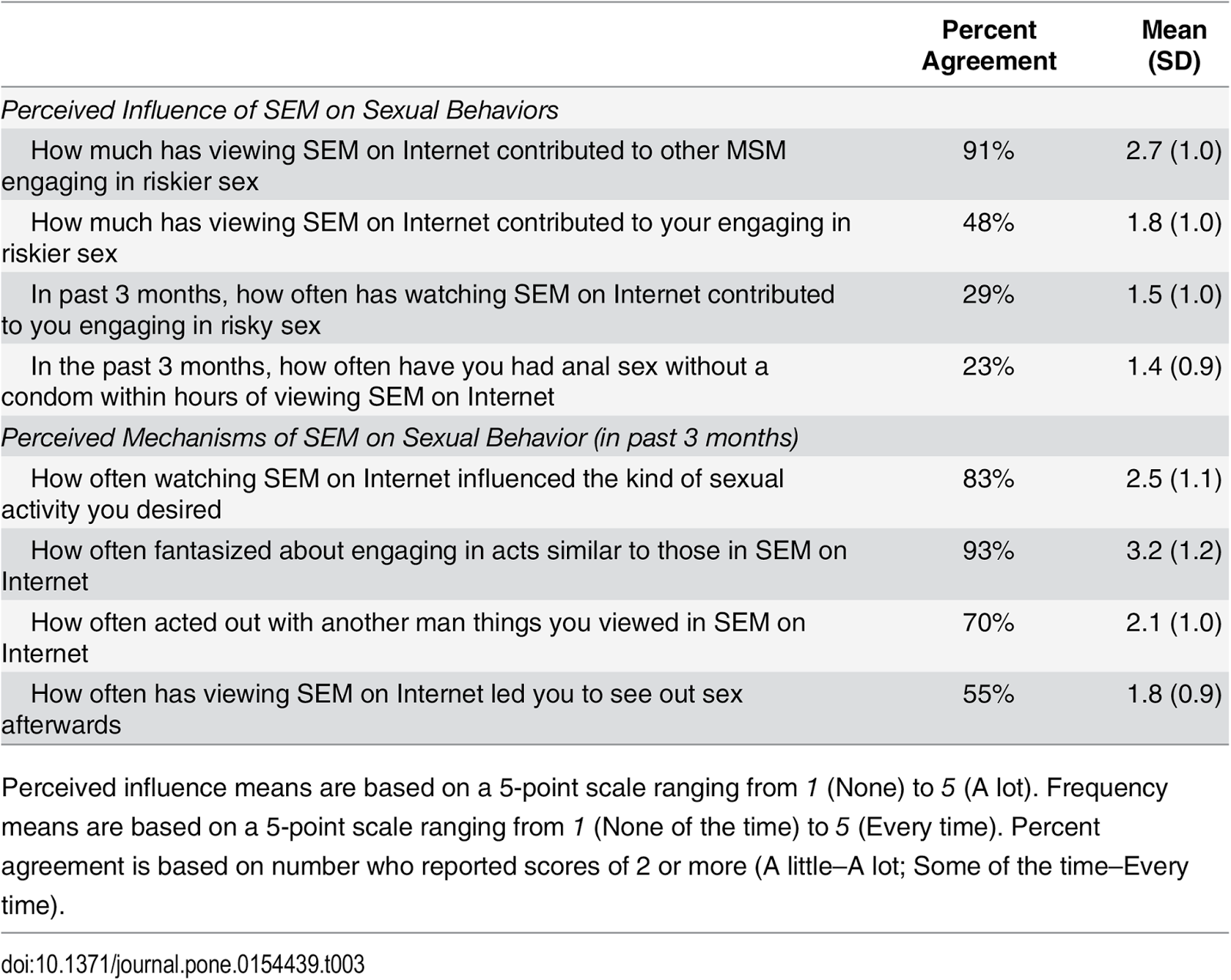
The last decade has seen a dramatic increase in the availability of sexually explicit media (SEM) on the Internet. Men who have sex with men (MSM) report near universal use of SEM. However, this widespread use of SEM among MSM may contribute to more condomless anal sex. 

To examine the association of viewing SEM on the Internet and the number of condomless anal sex encounters among MSM, in 2012, an online survey was conducted of 265 MSM from New York, Philadelphia, Baltimore, or Washington D.C. who reported viewing SEM online in the past 3 months. Analyses were performed using negative binomial regression. 

Nearly all men reported viewing SEM featuring anal sex with (91%) or without (92%) condoms in the past 3 months. Neither viewing more hours of SEM per week or compulsively viewing SEM were associated with more condomless anal sex encounters. Rather, viewing a greater proportion of SEM containing condomless anal sex was associated with engaging in more condomless anal encounters (IRR = 1.25), while viewing a greater proportion of SEM containing anal sex where condoms were used was associated with fewer condomless anal sex encounters (IRR = 0.62). MSM reported that viewing SEM caused changes in their sexual fantasies, desires, and behaviors. 

These findings provide important insights for health policy and the design of interventions addressing SEM and condomless sex among MSM. The findings suggest that condom use by SEM performers may benefit not only actor health, but also have health implications for SEM viewers.

Below:  Perceptions of the Influence of SEM (N = 265)


Full article at:   http://goo.gl/MNLVSE

By:
Eric W. Schrimshaw, Nadav Antebi-Gruszka
Department of Sociomedical Sciences, Mailman School of Public Health, Columbia University, New York, New York, United States of America

Martin J. Downing Jr.
Research and Evaluation, Public Health Solutions, Inc., New York, New York, United States of America


Saturday, April 23, 2016

Risk behaviours of an interrelated syphilis-infected sexual network of men who have sex with men

AIMS AND OBJECTIVES:
We examined the risk behaviours in an interrelated sexual network of 33 syphilis-infected men who have sex with men on the use of condoms, substances and websites to meet sexual partners. Our study used a descriptive exploratory design to investigate co-occurring high-risk behaviours in this interrelated sexual network to inform future health interventions and research directions.

BACKGROUND:
Although the risk behaviours for human immunodeficiency virus transmission in men who have sex with men have been studied, few have studied the high-risk population of men who already have syphilis, and even fewer have studied the risk behaviours in sexual networks of syphilis-infected men who have sex with men who were identified using contact tracing.

DESIGN/METHODS:
The data were collected from semi-structured, individual interviews at a not-for-profit lesbian, gay, bisexual and transgender health centre in a large city in the Midwestern USA.

RESULTS:
Inconsistent condom use was substantial during both insertive (92%) and receptive (88%) anal intercourse. Most participants (97%) reported using one or more substances prior to or during anal intercourse, and Internet websites were the most common place to meet sexual partners (88%).

CONCLUSIONS:
High-risk behaviours were significant within this syphilis-infected sexual network of men who have sex with men. The majority of our 33 participants were non-Hispanic Whites (n = 27, 82%), possessed a baccalaureate degree or higher (n = 23, 70%), and actively sought out unprotected anal intercourse [21 participants (64%) used BareBackRT.com, a website to seek out unprotected anal intercourse].

RELEVANCE TO CLINICAL PRACTICE:
Nurses should be more informed about the risk factors of a high-risk sexual network of syphilis-infected men who have sex with men. Interrelated sexual networks have high levels of similarity among participants' high-risk behaviours; contact tracing may be used to identify individual participants for relevant risk-reduction interventions.

Purchase full article at:   http://goo.gl/KK52WN

1School of Nursing, DePaul University, Chicago, IL, USA.
2Department of Psychology, DePaul University, Chicago, IL, USA.
3Department of Community, Systems, and Mental Health Nursing, Rush University, DePaul University, Chicago, IL, USA.
J Clin Nurs. 2016 Apr 22. doi: 10.1111/jocn.13209. [Epub ahead of print]