Showing posts with label unprotected anal sex. Show all posts

Thursday, April 28, 2016

Viewing of Internet-Based Sexually Explicit Media as a Risk Factor for Condomless Anal Sex among Men Who Have Sex with Men in Four U.S. Cities

The last decade has seen a dramatic increase in the availability of sexually explicit media (SEM) on the Internet. Men who have sex with men (MSM) report near universal use of SEM. However, this widespread use of SEM among MSM may contribute to more condomless anal sex. 

To examine the association of viewing SEM on the Internet and the number of condomless anal sex encounters among MSM, in 2012, an online survey was conducted of 265 MSM from New York, Philadelphia, Baltimore, or Washington D.C. who reported viewing SEM online in the past 3 months. Analyses were performed using negative binomial regression. 

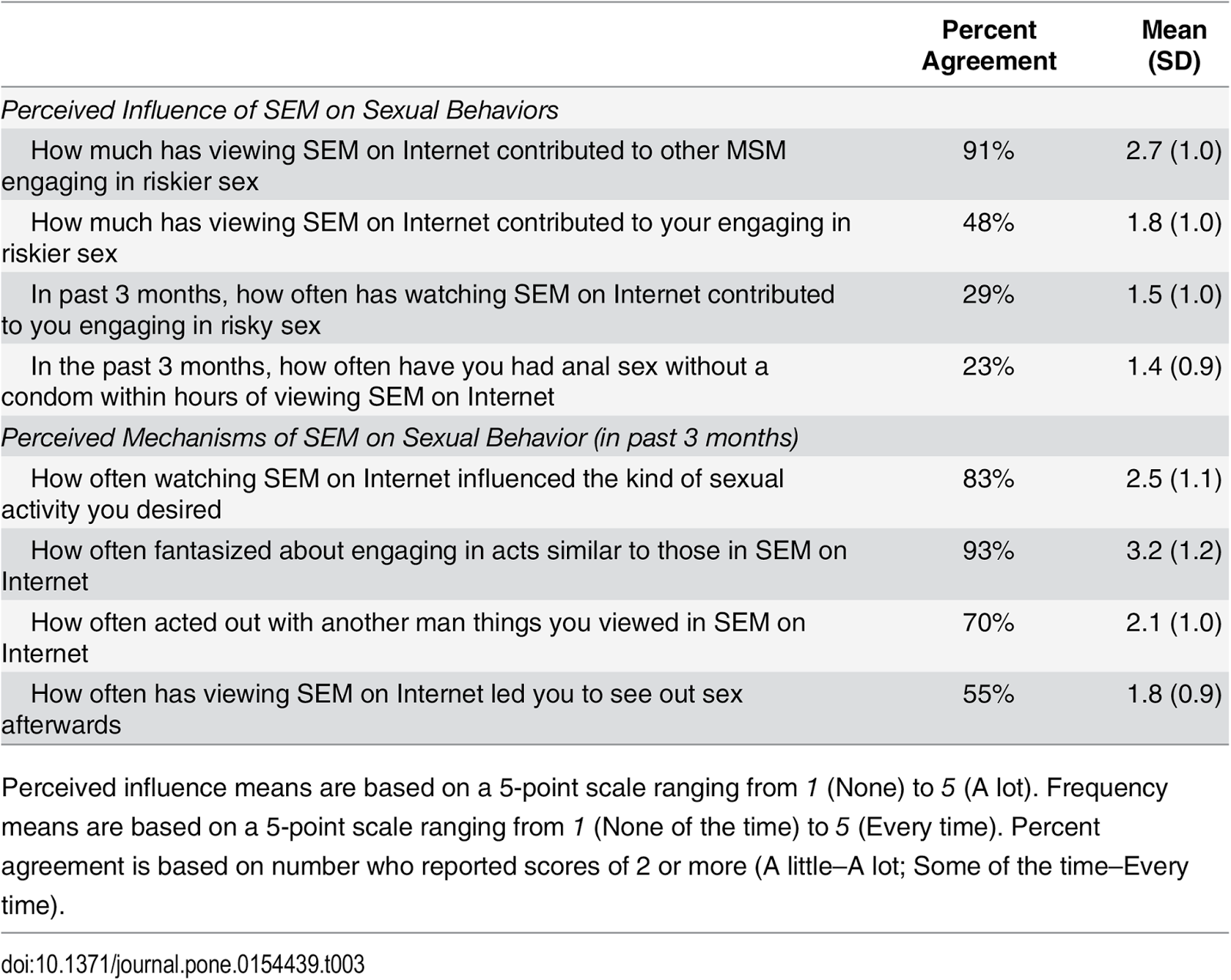
Nearly all men reported viewing SEM featuring anal sex with (91%) or without (92%) condoms in the past 3 months. Neither viewing more hours of SEM per week or compulsively viewing SEM were associated with more condomless anal sex encounters. Rather, viewing a greater proportion of SEM containing condomless anal sex was associated with engaging in more condomless anal encounters (IRR = 1.25), while viewing a greater proportion of SEM containing anal sex where condoms were used was associated with fewer condomless anal sex encounters (IRR = 0.62). MSM reported that viewing SEM caused changes in their sexual fantasies, desires, and behaviors. 

These findings provide important insights for health policy and the design of interventions addressing SEM and condomless sex among MSM. The findings suggest that condom use by SEM performers may benefit not only actor health, but also have health implications for SEM viewers.

Below:  Perceptions of the Influence of SEM (N = 265)


Full article at:   http://goo.gl/MNLVSE

By:
Eric W. Schrimshaw, Nadav Antebi-Gruszka
Department of Sociomedical Sciences, Mailman School of Public Health, Columbia University, New York, New York, United States of America

Martin J. Downing Jr.
Research and Evaluation, Public Health Solutions, Inc., New York, New York, United States of America


Saturday, April 23, 2016

Risk behaviours of an interrelated syphilis-infected sexual network of men who have sex with men

AIMS AND OBJECTIVES:
We examined the risk behaviours in an interrelated sexual network of 33 syphilis-infected men who have sex with men on the use of condoms, substances and websites to meet sexual partners. Our study used a descriptive exploratory design to investigate co-occurring high-risk behaviours in this interrelated sexual network to inform future health interventions and research directions.

BACKGROUND:
Although the risk behaviours for human immunodeficiency virus transmission in men who have sex with men have been studied, few have studied the high-risk population of men who already have syphilis, and even fewer have studied the risk behaviours in sexual networks of syphilis-infected men who have sex with men who were identified using contact tracing.

DESIGN/METHODS:
The data were collected from semi-structured, individual interviews at a not-for-profit lesbian, gay, bisexual and transgender health centre in a large city in the Midwestern USA.

RESULTS:
Inconsistent condom use was substantial during both insertive (92%) and receptive (88%) anal intercourse. Most participants (97%) reported using one or more substances prior to or during anal intercourse, and Internet websites were the most common place to meet sexual partners (88%).

CONCLUSIONS:
High-risk behaviours were significant within this syphilis-infected sexual network of men who have sex with men. The majority of our 33 participants were non-Hispanic Whites (n = 27, 82%), possessed a baccalaureate degree or higher (n = 23, 70%), and actively sought out unprotected anal intercourse [21 participants (64%) used BareBackRT.com, a website to seek out unprotected anal intercourse].

RELEVANCE TO CLINICAL PRACTICE:
Nurses should be more informed about the risk factors of a high-risk sexual network of syphilis-infected men who have sex with men. Interrelated sexual networks have high levels of similarity among participants' high-risk behaviours; contact tracing may be used to identify individual participants for relevant risk-reduction interventions.

Purchase full article at:   http://goo.gl/KK52WN

1School of Nursing, DePaul University, Chicago, IL, USA.
2Department of Psychology, DePaul University, Chicago, IL, USA.
3Department of Community, Systems, and Mental Health Nursing, Rush University, DePaul University, Chicago, IL, USA.
J Clin Nurs. 2016 Apr 22. doi: 10.1111/jocn.13209. [Epub ahead of print]


Monday, April 11, 2016

A Pilot Trial of a Sexual Health Counseling Intervention for HIV-Positive Gay and Bisexual Men Who Report Anal Sex without Condoms

BACKGROUND:
Even in the presence of promising biomedical treatment as prevention, HIV incidence among men who have sex with men has not always decreased. Counseling interventions, therefore, continue to play an important role in reducing HIV sexual transmission behaviors among gay and bisexual men and other men who have sex with men. The present study evaluated effects of a small-group counseling intervention on psychosocial outcomes and HIV sexual risk behavior.

METHOD:
HIV-positive (HIV+) peer counselors administered seven 2-hour counseling sessions to groups of 5 to 8 HIV+ gay and bisexual men. The intervention employed information provision, motivational interviewing, and behavioral skills building to reduce sexual transmission risk behaviors.

RESULTS:
There was a significant reduction in condomless anal sex (CAS) with HIV-negative and unknown HIV-status partners, from 50.0% at baseline to 28.9% of the sample at 3-month follow-up. Findings were robust even when controlling for whether the participant had an undetectable viral load at baseline. Significant reductions were also found in the two secondary psychosocial outcomes, loneliness and sexual compulsivity.

CONCLUSIONS:
The findings provide preliminary evidence that this intervention may offer an efficient way of concurrently reducing CAS and mental health problems, such as sexual compulsivity and loneliness, for HIV+ gay and bisexual men.

Below:  CONSORT diagram


Full article at:   http://goo.gl/A6MtFI

  • 1Department of Psychology, Ryerson University, Toronto, Ontario, Canada.
  • 2Dalla Lana School of Public Health, University of Toronto, Toronto, Ontario, Canada.
  • 3AIDS Committee of Toronto, Toronto, Ontario, Canada.
  • 4Poz Prevention Working Group, Gay Men's Sexual Health Alliance, Toronto, Ontario, Canada.
  • 5Department of Sociology, Anthropology and Criminology, University of Windsor, Windsor, Ontario, Canada.
  • 6Ontario HIV Treatment Network, Toronto, Ontario, Canada. 


Friday, April 8, 2016

Frequency of HIV Testing among Gay & Bisexual Men in the UK: Implications for HIV Prevention

OBJECTIVES:
The aim of the study was to explore HIV testing frequency among UK men who have sex with men (MSM) in order to direct intervention development.

METHODS:
Cross-sectional surveys were completed by 2409 MSM in Edinburgh, Glasgow and London in 2011 and a Scotland-wide online survey was carried out in 2012/13. The frequency of HIV testing in the last 2 years was measured.

RESULTS:
Overall, 21.2% of respondents reported at least four HIV tests and 33.7% reported two or three tests in the last 2 years, so we estimate that 54.9% test annually. Men reporting at least four HIV tests were younger and less likely to be surveyed in London. They were more likely to report higher numbers of sexual and anal intercourse partners, but not "higher risk" unprotected anal intercourse (UAI) with at least two partners, casual partners and/or unknown/discordant status partners in the previous 12 months. Only 26.7% (238 of 893) of men reporting higher risk UAI reported at least four tests. Among all testers (n = 2009), 56.7% tested as part of a regular sexual health check and 35.5% tested following a risk event. Differences were observed between surveys, and those testing in response to a risk event were more likely to report higher risk UAI.

CONCLUSIONS:
Guidelines recommend that all MSM test annually and those at "higher risk" test more frequently, but our findings suggest neither recommendation is being met. Additional efforts are required to increase testing frequency and harness the opportunities provided by biomedical HIV prevention. Regional, demographic and behavioural differences and variations in the risk profiles of testers suggest that it is unlikely that a "one size fits all" approach to increasing the frequency of testing will be successful.

Full article at:   http://goo.gl/7F0D3O

  • 1MRC/CSO Social and Public Health Sciences Unit, University of Glasgow, Glasgow, UK.
  • 2Public Health England, London, UK.
  • 3Glasgow Caledonian University, Glasgow, UK.
  • 4University College London, London, UK. 
  •  2016 Mar 15. doi: 10.1111/hiv.12373.


Sunday, April 3, 2016

An Initial Typology of Contexts of Dyadic Sexual Encounters Between Men & Associations with Sexual Risk & Pleasure

Background:
Although many within-subjects comparisons conducted on samples of men who have sex with men have sought to understand the association between specific situational characteristics (e.g. drug use or location of sex) and sexual risk behaviour, none have considered the 'clustering' of patterns of situational characteristics. An initial typology of sexual encounters is derived and the relationship of this typology to condomless anal intercourse (CAI) and pleasure is tested.

Methods:
Data from a longitudinal survey of men who have sex with men living in England were used. Multilevel latent class analyses were estimated to determine an optimal class solution on the situational characteristics, and then pseudo-imputation was used to estimate the association between class and both CAI and pleasure.

Results:
A three-class solution fit the data best, with a scaled relative entropy of 92.4%. Classes were characterised as featuring: regular steady partners in private locations with low drug use
  • Class 1, casual partners with increased probability of sex occurring in a sex-on-premises venue 
  • Class 2, and high levels of polydrug use together with increased probability of casual partners
  • Class 3. Encounters were different both in pairwise comparisons and overall on probability of CAI. 
They were different overall but not necessarily pairwise on pleasure.

Conclusions:
These initial findings demonstrate the possibility of understanding sexual encounters in terms of the contexts, or classes, within which they occur. This may have implications for tailoring HIV prevention to specific encounter types. Future research should seek to extend encounter-level typologies to specific drug use variables.

Purchase full article at:   http://goo.gl/GbhgoY

By:  G. J. Melendez-Torres A D, Ford Hickson B, David Reid B, Peter Weatherburn B andChris Bonell C 

A Division of Health Sciences, Warwick Medical School, University of Warwick, Coventry. B Sigma Research, London School of Hygiene and Tropical Medicine. C Department of Social Science, UCL Institute of Education, University College London D Corresponding author. Email: G.Melendez-Torres@warwick.ac.uk 
 2016 Mar 9. doi: 10.1071/SH15218


Friday, March 25, 2016

Correlates of Recent HIV Testing among Substance-Using Men Who Have Sex with Men

Men who have sex with men are disproportionately impacted by HIV and substance use is a key driver of HIV risk and transmission among this population. 

We conducted a cross-sectional survey of 3242 HIV-negative substance-using men who have sex with men aged 18 + in the San Francisco Bay Area from March 2009 to May 2012. Demographic characteristics and sexual risk and substance use behaviors in the last six months were collected using structured telephone questionnaires. 

We used multivariable logistic regression to identify independent demographic and behavioral predictors of recent HIV testing. In all, 65% reported having an HIV test in the last six months. 

In multivariable analysis, increasing age and drinking alcohol (<1 drink/day: 0.65, 0.46-0.92; 2-3 drinks/day: 0.64, 0.45-0.91; 4 + drinks/day: 0.52, 0.35-0.78) were negatively associated with recent HIV testing. Having two or more condomless anal intercourse partners (2.17, 1.69-2.79) was positively associated with having a recent HIV test, whereas condomless anal intercourse with serodiscordant partners was not significantly associated with testing. 

Older men who have sex with men and those who drink alcohol may benefit from specific targeting in efforts to expand HIV testing. Inherently riskier discordant serostatus of partners is not as significant a motivator of HIV testing as condomless anal intercourse in general.

Purchase full article at:   http://goo.gl/1A4z1Q

  • 1San Francisco Department of Public Health, USA chris.rowe@sfdph.org.
  • 2San Francisco Department of Public Health, USA.
  • 3University of California, San Francisco, USA.
  • 4Centers for Disease Prevention and Control, Atlanta, USA. 
  •  2016 Mar 21. pii: 0956462416640964


Tuesday, March 22, 2016

Cruising Venues as a Context for HIV Risky Behavior among Men Who Have Sex with Men

We examined differences in sexual risk behaviors, HIV prevalence, and demographic characteristics between men who have sex with men (MSM) who visit different types of venues to meet sexual partners, and identified correlates of high-risk behaviors. 

A cross-sectional behavioral survey was conducted with a venue-based sample of 1011 MSM in Portugal. Overall, 36.3 % of MSM usually visit cruising venues to meet sexual partners (63.7 % only visit social gay venues). Cruising venues' visitors reported higher HIV prevalence (14.6 % vs. 5.5 %). Visiting cruising venues was more likely among those older, reporting high number of male sexual partners, group sex, and unprotected anal sex with a partner whose HIV status was unknown. 

Cruising venues play an important role in increasing risk of HIV transmission among MSM who frequent them. Venue-focused behavioral interventions that promote healthy sexual behaviors are needed.

Purchase full article at:   http://goo.gl/CITXCa

  • 1Global Health and Tropical Medicine, Instituto de Higiene e Medicina Tropical, Universidade Nova de Lisboa, Rua da Junqueira, n. 100, 1349-008, Lisbon, Portugal. agama@ihmt.unl.pt.
  • 2Global Health and Tropical Medicine, Instituto de Higiene e Medicina Tropical, Universidade Nova de Lisboa, Rua da Junqueira, n. 100, 1349-008, Lisbon, Portugal.
  • 3Grupo Português de Ativistas sobre Tratamentos de VIH/SIDA, Lisbon, Portugal.
  • 4Institute of Public Health of University of Porto, University of Porto Medical School, Porto, Portugal. 
  •  2016 Mar 17.


Thursday, March 17, 2016

Regular STI Testing amongst Men Who Have Sex with Men & Use Social Media Is Suboptimal - A Cross-Sectional Study

Sexually transmitted infections (STIs) disproportionately affect men who have sex with men, with marked increases in most STIs in recent years. These are likely underpinned by coterminous increases in behavioural risks which have coincided with the development of Internet and geospatial sociosexual networking. 

Current guidelines advocate regular, annual sexually transmitted infection testing amongst sexually active men who have sex with men (MSM), as opposed to symptom-driven testing. This paper explores sexually transmitted infection testing regularity amongst MSM who use social and sociosexual media. 

Data were collected from 2668 men in Scotland, Wales, Northern Ireland and the Republic of Ireland, recruited via social and gay sociosexual media. Only one-third of participants report regular (yearly or more frequent) STI testing, despite relatively high levels of male sex partners, condomless anal intercourse and high-risk unprotected anal intercourse. The following variables were associated with regular STI testing; being more 'out' (adjusted odds ratio = 1.79; confidence interval = 1.20-2.68), HIV-positive (adjusted odds ratio = 14.11; confidence interval = 7.03-28.32); reporting ≥10 male sex partners (adjusted odds ratio = 2.15; confidence interval = 1.47-3.14) or regular HIV testing (adjusted odds ratio = 48.44; confidence interval = 28.27-83.01). Men reporting long-term sickness absence from work/carers (adjusted odds ratio = 0.03; confidence interval = 0.00-0.48) and men aged ≤25 years (adjusted odds ratio = 0.36; 95% confidence interval = 0.19--0.69) were less likely to test regularly for STIs. 

As such, we identify a complex interplay of social, health and behavioural factors that each contribute to men's STI testing behaviours. In concert, these data suggest that the syndemics placing men at elevated risk may also mitigate against access to testing and prevention services. Moreover, successful reduction of STI transmission amongst MSM will necessitate a comprehensive range of approaches which address these multiple interrelated factors that underpin MSM's STI testing.

Purchase full article at:   http://goo.gl/fHEQnd

  • 1School of Health and Life Sciences, Glasgow Caledonian University, Glasgow j.frankis@gcu.ac.uk.
  • 2Cobridge Sexual Health Centre, Church Terrace, Cobridge, Stoke on Trent.
  • 3Chalmers Sexual Health Centre, NHS Lothian, Edinburgh.
  • 4School of Health and Life Sciences, GCU London, Glasgow Caledonian University, Glasgow.
  • 5School of Health and Life Sciences, Glasgow Caledonian University, Glasgow. 
  •  2016 Mar 4. pii: 0956462416636780.


Tuesday, March 15, 2016

Factors Associated with HIV Testing among Men Who Have Sex with Men in Western Kenya: A Cross-Sectional Study

HIV diagnosis is an important step in the HIV cascade of prevention and treatment. However, men who have sex with men in low- and middle-income countries have limited access to HIV care services. We examined factors associated with prior HIV testing among men who have sex with men in western Kenya. 

We recruited 95 men who have sex with men aged 18 years and older, and who reported at least one sexual contact with a man in the past 6 months; however, this analysis is restricted to 89 participants who completed questions on HIV testing. Logistic regression model was used to determine factors associated with HIV testing in the past one year. 

Results indicate that 23 (26%) had not been tested in the past 12 months. Bivariate analyses demonstrated that condomless anal sex and comfort with healthcare providers were associated with higher odds of HIV testing in the past 12 months. Experiencing social stigma was associated with lower odds of HIV testing in the last 12 months. 

In multivariable models, social stigma remained significantly associated with lower odds of HIV testing in the last 12 months odds ratio = 0.90, 95% confidence interval = 0.82-0.99) after inclusion of sexual risk and individual level variables. 

Development of men who have sex with men-sensitive HIV-testing services, addressing stigma, and training healthcare workers to provide culturally sensitive services may assist in effectively engaging men who have sex with men in the HIV treatment cascade.

Purchase full article at:   http://goo.gl/XSo6wO

  • 1Department of Behavioral and Social Sciences, School of Public Health, Brown University, Rhode Island, United States School of Public Health, Moi University, Eldoret, Kenya Academic Model Providing Access to Healthcare (AMPATH), Eldoret, Kenya sylvia_shangani@brown.edu.
  • 2Academic Model Providing Access to Healthcare (AMPATH), Eldoret, Kenya Department of Behavioral Science, College of Health Sciences, School of Medicine, Moi University, Eldoret, Kenya.
  • 3International Centre for Reproductive Health, University of Ghent, Belgium.
  • 4Department of Behavioral and Social Sciences, School of Public Health, Brown University, Rhode Island, United States.
  • 5School of Medicine, College of Health Sciences, Moi University, Eldoret, Kenya.
  • 6Academic Model Providing Access to Healthcare (AMPATH), Eldoret, Kenya School of Medicine, College of Health Sciences, Moi University, Eldoret, Kenya Department of Medicine, School of Medicine, Indiana University, Indianapolis, United States. 
  •  2016 Mar 11. pii: 0956462416638967.


Men Who Have Sex with Men in Great Britain: Comparing Methods & Estimates From Probability & Convenience Sample Surveys

OBJECTIVE:
To examine sociodemographic and behavioural differences between men who have sex with men (MSM) participating in recent UK convenience surveys and a national probability sample survey.

METHODS:
We compared 148 MSM aged 18-64 years interviewed for Britain's third National Survey of Sexual Attitudes and Lifestyles (Natsal-3) undertaken in 2010-2012, with men in the same age range participating in contemporaneous convenience surveys of MSM: 15 500 British resident men in the European MSM Internet Survey (EMIS); 797 in the London Gay Men's Sexual Health Survey; and 1234 in Scotland's Gay Men's SexualHealth Survey. Analyses compared men reporting at least one male sexual partner (past year) on similarly worded questions and multivariable analyses accounted for sociodemographic differences between the surveys.

RESULTS:
MSM in convenience surveys were younger and better educated than MSM in Natsal-3, and a larger proportion identified as gay (85%-95% vs 62%). Partner numbers were higher and same-sex anal sex more common in convenience surveys. Unprotected anal intercourse was more commonly reported in EMIS. Compared with Natsal-3, MSM in convenience surveys were more likely to report gonorrhoea diagnoses and HIVtesting (both past year). Differences between the samples were reduced when restricting analysis to gay-identifying MSM.

CONCLUSIONS:
National probability surveys better reflect the population of MSM but are limited by their smaller samples of MSM. Convenience surveys recruit larger samples of MSM but tend to over-represent MSM identifying as gay and reporting more sexual risk behaviours. Because both sampling strategies have strengths and weaknesses, methods are needed to triangulate data from probability and convenience surveys.

Below:  Demographic characteristics of MSM who identify as gay: Convenience surveys relative to Natsal-3


Full article at: http://goo.gl/kcuLfy

  • 1Research Department of Infection & Population Health, University College London, London, UK.
  • 2Sigma Research, London School of Hygiene & Tropical Medicine, London, UK.
  • 3UCL Institute of Education, London, UK.
  • 4MRC/CSO Social & Public Health Sciences Unit, University of Glasgow, Glasgow, UK.
  • 5HIV/STI Department, Public Health England, London, UK.
  • 6Research Department of Infection & Population Health, University College London, London, UK Department of Health Services Research and Policy, London School of Hygiene & Tropical Medicine, London, UK.
  • 7Department of Social & Environmental Health Research, London School of Hygiene & Tropical Medicine, London, UK. 
  •  2016 Mar 10. pii: sextrans-2015-052389. doi: 10.1136/sextrans-2015-052389. 


Monday, March 14, 2016

The Meaning of 'Regular Partner' in HIV Research among Gay and Bisexual Men: Implications of an Australian Cross-Sectional Survey

Estimates of the proportion of HIV infections coming from within regular sexual relationships among gay and bisexual men (GBM) vary widely. Research surveys use various partner type categories, but there is little understanding of how men classify their partners. We conducted an online cross-sectional survey of Australian GBM exploring sexual relationships, including 2057 men reporting on 2566 regular partnerships. 

Just over half of the partnerships were considered 'relationships', while the remainder were non-romantic 'fuckbuddy'-style arrangements. In multivariable analysis, factors associated with considering the partnership a 'relationship' were: using a 'romantic' descriptor, partnership length, monogamous agreements, any condomless anal sex with each other, love, and commitment. The category of 'regular partner' can mask diverse partnership types, which have different meanings to GBM, associated behaviours, and HIV risks. 

Certain HIV prevention techniques may be more suited to particular types of partnerships. 'Fuckbuddy' arrangements need to be more explicitly acknowledged in HIV prevention.

Purchase full article at:   http://goo.gl/jee5Hz

  • 1Kirby Institute, University of New South Wales, Sydney, NSW, 2052, Australia. bbavinton@kirby.unsw.edu.au.
  • 2University of New England, Armidale, Australia.
  • 3Anglia Ruskin University, Cambridge, England, UK.
  • 4Kirby Institute, University of New South Wales, Sydney, NSW, 2052, Australia.
  • 5Australian Research Centre in Sex, Health and Society, La Trobe University, Melbourne, Australia. 
  •  2016 Mar 12.