Showing posts with label DC. Show all posts

Thursday, April 28, 2016

Viewing of Internet-Based Sexually Explicit Media as a Risk Factor for Condomless Anal Sex among Men Who Have Sex with Men in Four U.S. Cities

The last decade has seen a dramatic increase in the availability of sexually explicit media (SEM) on the Internet. Men who have sex with men (MSM) report near universal use of SEM. However, this widespread use of SEM among MSM may contribute to more condomless anal sex. 

To examine the association of viewing SEM on the Internet and the number of condomless anal sex encounters among MSM, in 2012, an online survey was conducted of 265 MSM from New York, Philadelphia, Baltimore, or Washington D.C. who reported viewing SEM online in the past 3 months. Analyses were performed using negative binomial regression. 

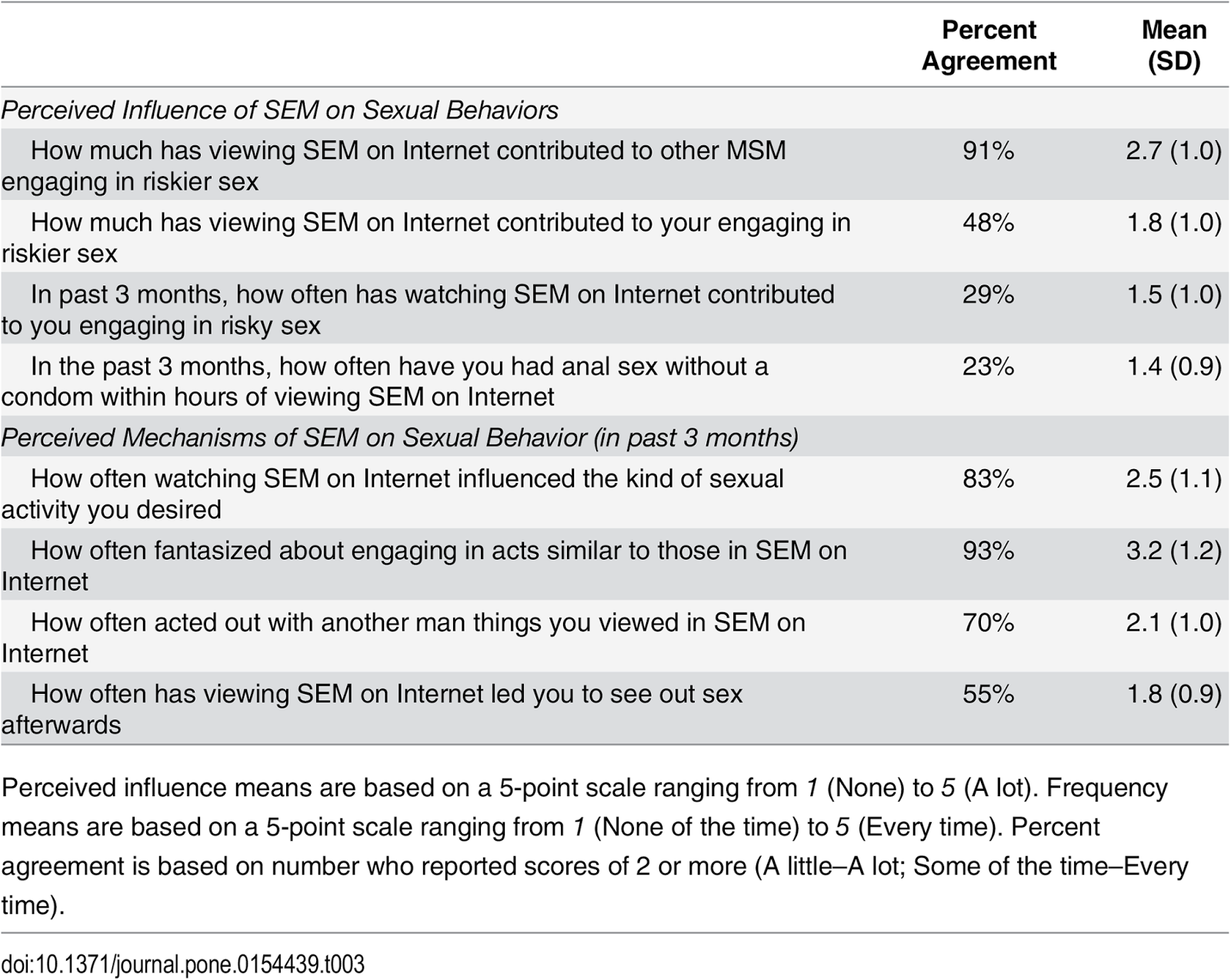
Nearly all men reported viewing SEM featuring anal sex with (91%) or without (92%) condoms in the past 3 months. Neither viewing more hours of SEM per week or compulsively viewing SEM were associated with more condomless anal sex encounters. Rather, viewing a greater proportion of SEM containing condomless anal sex was associated with engaging in more condomless anal encounters (IRR = 1.25), while viewing a greater proportion of SEM containing anal sex where condoms were used was associated with fewer condomless anal sex encounters (IRR = 0.62). MSM reported that viewing SEM caused changes in their sexual fantasies, desires, and behaviors. 

These findings provide important insights for health policy and the design of interventions addressing SEM and condomless sex among MSM. The findings suggest that condom use by SEM performers may benefit not only actor health, but also have health implications for SEM viewers.

Below:  Perceptions of the Influence of SEM (N = 265)


Full article at:   http://goo.gl/MNLVSE

By:
Eric W. Schrimshaw, Nadav Antebi-Gruszka
Department of Sociomedical Sciences, Mailman School of Public Health, Columbia University, New York, New York, United States of America

Martin J. Downing Jr.
Research and Evaluation, Public Health Solutions, Inc., New York, New York, United States of America


Sunday, March 20, 2016

Social Movements Against Racist Police Brutality and Department of Justice Intervention in Prince George's County, Maryland

Racist police brutality has been systemic in Prince George's County, Maryland. The victims include African Americans, the mentally challenged, and immigrant populations, creating a complex and uneven public health impact. Three threads characterize the social movements and intervention since 1970. 

First, a significant demographic shift occurred as African Americans became the majority population in the late 1980s when the first Black county executive was elected in 1994. Despite the change in political leadership, police brutality remained rampant. Lower-income households located close to the District of Columbia and "inside the beltway" experienced the most police brutality. 

In 2001, The Washington Post revealed that between 1990 and 2000, Prince George's police shot and killed more citizens per officer than any of the 50 largest city and county law enforcement agencies in the country, 84 % of whom were black. Of the 147 persons shot during the 1990s, 12 were mentally and/or emotionally disturbed; 6 of these shootings were fatal. 

Second, resistance to police brutality emerged in a variety of political formations throughout the period, especially in the late 1990s. Sustained community pressure prompted the Department of Justice (DOJ) to open a civil rights investigation of the police department in November 2000. To avoid a potential federal lawsuit, the county leadership negotiated a memorandum of agreement (MOA) with the DOJ to enact policy reforms, part of which called for supplementing the departmental mobile crisis team, comprised of mental health care professionals, to respond to all cases involving mentally challenged citizens. 

Third, the incomplete process of change subsequent to the ending of DOJ oversight suggests a continued challenge to social movements opposing police brutality. This study focuses on the effectiveness of the MOA along with the activism of the People's Coalition for Police Accountability (PCPA) in reforming a culture of police brutality. The intensive oversight by the DOJ, combined with engaged resident activism, reduced the incidences of police brutality during the period 2004-2013. 

Since the termination of DOJ oversight, disturbing developments suggest the need for continued and sustained activism. Since 2010, county police officers have fatally shot 21 people, several in questionable circumstances. 

At the same time, the Prince George's Police Department has received more tactical military weaponry than any other jurisdiction in the state of Maryland under the 1033 program of the National Defense Authorization Act.

Purchase full article at:   http://goo.gl/8xSskR

By:    Hutto JW Sr1, Green RD2.
  • 1Howard University, Washington, DC, USA.
  • 2Howard University, Washington, DC, USA. rgreen@howard.edu. 
  •  2016 Feb 16.


Thursday, January 28, 2016

Assessing Syringe Exchange Program Access among Persons Who Inject Drugs (PWID) in the District of Columbia

Prior research has explored spatial access to syringe exchange programs (SEPs) among persons who inject drugs (PWID), but these studies have been based on limited data from short periods of time. No research has explored changes in spatial access to SEPs among PWID longitudinally. 

The purpose of this research is to examine spatial access to SEPs among PWID who accessed services at a SEP in Washington, District of Columbia (DC), from 1996 to 2010. The geometric point distance estimation technique was used to calculate the mean walking distance PWID traveled from the centroid point of their zip code of home residence to the mobile exchange site where they accessed SEP services. Analysis of variance (ANOVA) was used to examine differences in walking distance measures by year. 

The results of this research suggest that the distance DC PWID traveled to access SEP services remained relatively constant (approximately 2.75 mi) from 2003 to 2008, but increased to just over 4 mi in 2010. 

This research provides support for expanding SEP operations such that PWID have increased access to their services. Increasing SEP accessibility may help resolve unmet needs among injectors.

Purchase full article at:   http://goo.gl/abqaOJ

By:  Allen ST1,2, Ruiz MS3, Jones J4.
  • 1Department of Prevention & Community Health, Milken Institute School of Public Health at The George Washington University, 950 New Hampshire Ave Suite 300, Washington, DC, 20052, USA. sallen63@jhu.edu.
  • 2Johns Hopkins University, 615 N. Wolfe St., Room E6534, Baltimore, MD, 21205, USA. sallen63@jhu.edu.
  • 3Department of Prevention & Community Health, Milken Institute School of Public Health at The George Washington University, 950 New Hampshire Ave Suite 300, Washington, DC, 20052, USA. msruiz@gwu.edu.
  • 4Department of Health Policy & Management, Jiann-Ping Hsu College of Public Health at Georgia Southern University, PO Box 8015, Statesboro, GA, 30460, USA. jajones@georgiasouthern.edu. 
  •  2016 Jan 19.


Thursday, December 31, 2015

An Evaluation of Hepatitis C Knowledge & Correlations with Health Belief Model Constructs among African American “Baby Boomers”

Background
Baby boomers (people born between 1945 and 1965) are responsible for three-quarters of Hepatitis C (HCV) infections in the US; however, HCV testing is distinctly underused by them.

Aim
To assess the status, predictors, and correlates of HCV knowledge among African-American baby boomers (AABBs) in Washington, DC.

Methods
A cross-sectional survey among persons aged 46–69 was conducted using audio computer-assisted self-interviewing (ACASI). Data on HCV knowledge, socio-demographics, prior history of HCV testing, health-related characteristics, HCV vulnerability and HCV treatment perceptions were collected. Descriptive statistics was used to describe the study population. Pearson correlations were used to examine linear associations between HCV knowledge and Health Belief Model constructs related to HCV. Linear regression analysis was conducted to assess the predictors of knowledge.

Results
Out of the 137 participants, about sixty percent (60.6%) were females, mean age 59 ± 6.40; 44.8% had at least a college education. The average knowledge score was low (48.7%). HCV knowledge was significantly correlated with constructs of perceived severity and perceived benefits. Age (β = −0.10; p = 0.003), and level of education (β = 0.93, p = 0.027) were significant predictors.

Conclusions
Overall, respondents have a low level of knowledge. The lower level of education and older age were significant predictors of inadequate HCV knowledge. Thus, HCV education among these people may be a vital component in reducing the gaps in HCV knowledge.

Purchase full article at:   http://goo.gl/DwHGux

College of Pharmacy, Howard University, 2300 4th St., NW Washington, DC 20059, USA


Patterns of Abstinence or Continued Drug Use among Methadone Maintenance Patients & Their Relation to Treatment Retention

The efficacy and effectiveness of methadone maintenance treatment (MMT) in the medical management of opioid addiction has been well-established, but treatment outcomes are compromised by the continued use of licit and illicit drugs during MMT. 

The present study examined the relationship between in-treatment illicit drug use and retention and dropout of 604 MMT patients in Washington, D.C. Sixty-eight percent of patients did not test positive for an unprescribed drug during the study period. 

Of patients who tested positive for an illicit drug during the baseline period, 55% tested positive for cocaine, 44% for opiates, 23% for THC, 20% for benzodiazepines, 7% for PCP, and 4% for amphetamines. Those testing positive were three times more likely to leave treatment than those who did not test positive. Testing positive for one drug doubled the rate of attrition; testing positive for multiple drugs quadrupled the risk of attrition. Non-prescribed opioid or benzodiazepine use was a predictor of MMT dropout, but prescribed opioid or benzodiazepine use was not. 

Continued illicit drug use poses significant risk for subsequent premature termination of MMT. Assertive clinical management of continued illicit drug use could provide mechanisms to enhance MMT retention and long-term recovery outcomes.

Purchase full article at:   http://goo.gl/xG1nEe

  • 1a Emeritus Senior Research Consultant, Chestnut Health Systems , Punta Gorda , FL. 


Tuesday, December 22, 2015

Prescription Drug Diversion: Predictors of Illicit Acquisition and Redistribution in Three U.S. Metropolitan Areas

Objective
Prescription drug diversion, the transfer of prescription drugs from lawful to unlawful channels for distribution or use, is a problem in the United States. Despite the pervasiveness of diversion, there are gaps in the literature regarding characteristics of individuals who participate in the illicit trade of prescription drugs. This study examines a range of predictors (e.g., demographics, prescription insurance coverage, perceived risk associated with prescription drug diversion) of membership in three distinct diverter groups: individuals who illicitly acquire prescription drugs, those who redistribute them, and those who engage in both behaviors.

Methods
Data were drawn from a cross-sectional Internet study (N = 846) of prescription drug use and diversion patterns in New York City, South Florida, and Washington, D.C.. Participants were classified into diversion categories based on their self-reported involvement in the trade of prescription drugs. Group differences in background characteristics of diverter groups were assessed by Chi-Square tests and followed up with multivariate logistic regressions.

Results
While individuals in all diversion groups were more likely to be younger and have a licit prescription for any of the assessed drugs in the past year than those who did not divert, individuals who both acquire and redistribute are more likely to live in New York City, not have prescription insurance coverage, and perceive fewer legal risks of prescription drug diversion.

Conclusion
Findings suggest that predictive characteristics vary according to diverter group.

...3.2. Illicit Acquirer
Table 2 shows results from three separate regression analyses (one for each diversion classification group). For the acquirer group, age was negatively associated with illicit acquisition (β = −0.02, OR = 0.98, p < 0.05). Also, having a history of having a licit prescription for any class of drug assessed in this study was positively associated with illicit acquisition (β = 1.14, OR = 3.24, p < 0.001). Area of residence, race, gender, education, being a student, income, prescription insurance coverage, perceived legal risk of prescription diversion, and perceptions of legal risk of illicit drug diversion were not associated with membership in the illicit acquirer group.

3.3. Illicit Redistributor
For the redistributor group, regression analyses demonstrated that age was negatively associated with illicit redistribution (β = −0.04, OR = 0.97, p < 0.01). As with illicit acquisition, a history of having a licit prescription for any class of drug assessed in this study was positively associated with illicit redistribution (β= 0.89, OR = 2.44, p < 0.05). Additionally, perceived legal risks of prescription diversion was negatively associated with redistribution (β = −0.87, OR = 0.42, p < 0.01). Area of residence, race, gender, education, being a student, income, insurance coverage, and perceptions of legal risk of illicit drug diversion were not associated with membership in the illicit redistributor group.

3.4. Illicit Acquirer/Redistributor
Regression analyses demonstrated several main effects for individuals involved in both illicit acquisition and redistribution. As with the illicit acquisition and redistribution groups, age was negatively associated with both illicit behaviors (i.e., acquisition and redistribution) (β = − 0.05, OR = 0 .95, p < 0.001) and a history of having a licit prescription for any class of drug assessed in this study was positively associated with both illicit behaviors (β = 1.86, OR = 6.44, p < 0.001). However, there were some differences with the combined group. First, compared to participants in New York City (referent), participants in South Florida were less likely to participate in both illicit acquisition and redistribution of prescription drugs (β = − 0.91, OR = 0.40,p < 0.05). Second, perceived legal risks of prescription drug diversion was negatively associated with being in the combined illicit acquisition and redistribution group (β = − 0.71, OR = 0.49, p < 0.05). In fact, those who engaged in both illicit acquisition and redistribution had the lowest perception of legal risk associated with prescription and illegal drug diversion of all the groups assessed (see Table 1). Finally, participants who had insurance with prescription drug coverage were less likely to engage in both acquisition and redistribution than those without such coverage (β = − 0.97, OR = 0.38, p < 0.05). Race, gender, education, being a student, income, and perceptions of legal risk of illicit drug diversion were not associated with membership in the illicit acquirer/redistributor group...
  
Full article at:   http://goo.gl/95fBBe

1Department of Anthropology, University of Central Florida, 4000 Central Florida Boulevard, Howard Phillips Hall 309, Orlando, FL 32816-1361, USA
2Psychology Department, Queens College, City University of New York, 6530 Kissena Boulevard, SB A344, Queens, NY 11367-1597, USA
3Social Science Department, LaGuardia Community College, City University of New York, 31-10 Thomson Avenue, Long Island City, NY 11101, USA
4School of Social Work, Rutgers University, 536 George Street, New Brunswick, NJ 08901, USA
5National Development and Research Institutes, 71 West 23rd Street, 4th Floor, New York, NY 10010, USA
6Department of Social Work, Binghamton University, P.O. Box 6000, Binghamton, NY 13902-6000
7Science Department, Berkeley College, 3 East 43 Street New York, NY 10017, USA
8Graduate School of Education, University of Pennsylvania, 3700 Walnut Street Philadelphia, PA 19104, USA
9Sociology and Criminology Department, Cabrini College, 610 King of Prussia Road, Radnor, PA 19087-3698, USA
10Department of Pediatrics, Harlem Hospital Center, 506 Malcolm X Boulevard, New York, NY 10037, USA
11Public Health Solutions, 40 Worth Street, 5th Floor, New York, NY 10013, USA
*Correspondence: Email: ude.fcu@sirrah.anahs; Tel: 407-823-2227


Tuesday, October 13, 2015

Assessing Seasonality of Travel Distance to Harm Reduction Service Providers among Persons Who Inject Drugs

Prior research has examined access to syringe exchange program (SEP) services among persons who inject drugs (PWID), but no research has been conducted to evaluate variations in SEP access based on season. This is an important gap in the literature given that seasonal weather patterns and inclement weather may affect SEP service utilization. The purpose of this research is to examine differences in access to SEPs by season among PWID in the District of Columbia (DC).

A geometric point distance estimation technique was applied to records from a DC SEP that operated from 1996 to 2011. We calculated the walking distance (via sidewalks) from the centroid point of zip code of home residence to the exchange site where PWID presented for services. Analysis of variance (ANOVA) was used to examine differences in walking distance measures by season. Differences in mean walking distance measures were statistically significant between winter and spring with PWID traveling approximately 2.88 and 2.77 miles, respectively, to access the SEP during these seasons.

The results of this study suggest that seasonal differences in SEP accessibility may exist between winter and spring. PWID may benefit from harm reduction providers adapting their SEP operations to provide a greater diversity of exchange locations during seasons in which inclement weather may negatively influence engagement with SEPs. Increasing the number of exchange locations based on season may help resolve unmet needs among injectors.

Table 3

Mean walking distance by season
SeasonExchanges used in distance calculationsMean walking distance (miles)Standard deviationRange
Spring8,4782.882.0711.4
Summer8,6942.851.9911.4
Fall9,2732.831.9411.4
Winter7,5142.771.9811.9
Allen et al.
Allen et al. Harm Reduction Journal 2015 12:45   doi:10.1186/s12954-015-0081-y

Full article at: http://goo.gl/slBTyG

By: Sean T. Allen1*, Monica S. Ruiz1, Amira Roess1 and Jeff Jones2
1Department of Prevention and Community Health, Milken Institute School of Public Health at The George Washington University, 950 New Hampshire Ave, Suite 300, Washington 20052, DC, USA
2Department of Health Policy and Management, Jiann-Ping Hsu College of Public Health at Georgia Southern University, Statesboro 30460, GA, USA
